Key takeaways
- Under-desk clearance: With the seat at its lowest (~17 in), armrest tops sit around 24–29 in from the floor. That slides under most standard 28–30 in desks, but may catch on desks with low drawer aprons — measure the underside first.
- Kneehole width: The 26-in base plus your legs needs roughly a 28-in-wide kneehole to swivel freely.
- Recline footprint: Fully reclined, allow about 40 in of depth behind your seated position. In a 10×12 ft office, keep at least 36 in between desk edge and the wall behind you.
- Doorways: The ~45 lb box (roughly 30 × 26 × 24 in) fits through any standard 30-in doorway; a second person helps carry it upstairs.
What's inside
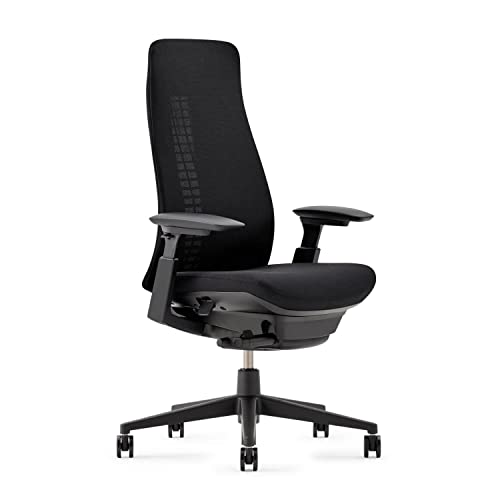
The Union & Scale FlexFit Hyken mesh task chair is one of the strongest budget ergonomic buys for anyone sitting 6+ hours a day — provided you stand roughly 5’4″ to 6’1″, weigh under 275 lbs, and prefer firm, breathable support over a plush cushion. Its all-mesh build, adjustable lumbar, and headrest deliver features rarely bundled below $150–$260, but the headrest’s fit window and the taut mesh seat have real limits worth understanding first.
Key Measurements and Limits
Figures below are approximate across recent production runs; always confirm against the current spec sheet.

Staples Hyken Ergonomic Mesh Task Chair, Lumbar Support, Swivel, Black
Included for 'FlexFit Hyken Mesh Task Chair Review: Ergonomics and Everyday Comfort' because the listing specifies Lumbar Support and Swivel, details this guide uses to compare options.
View on Amazon
Staples Ergonomic Mesh Task Chair with Lumbar Support, Swivel, Gray
Included for 'FlexFit Hyken Mesh Task Chair Review: Ergonomics and Everyday Comfort' because the listing specifies Swivel and Gray, details this guide uses to compare options.
View on Amazon
Staples Hyken Ergonomic Mesh Office Chair, Lumbar Support, Swivel, Black
Included for 'FlexFit Hyken Mesh Task Chair Review: Ergonomics and Everyday Comfort' because the listing specifies Lumbar Support and Swivel, details this guide uses to compare options.
View on Amazon| Measurement | Approximate Figure |
|---|---|
| Seat height (floor to top of seat) | ~17–21 in |
| Seat width × depth | ~19.5 × 19 in |
| Armrest travel (height above seat) | ~7–11 in |
| Overall height (headrest fully raised) | ~46–50 in |
| Caster base diameter | ~26 in |
| Recline range | ~30° recline, locks upright |
| Rated weight capacity | 275 lbs |
| Chair weight / boxed weight | ~36 lbs / ~45 lbs |
Mesh Breathability: The Main Reason to Buy It
Most chairs under $300 pair a mesh back with a foam-padded seat. The Hyken uses technical mesh across both, which is what makes it unusual at this price. Air moves freely around your back and underneath your thighs, so in a warm home office — especially one without dedicated AC — it stays noticeably cooler than any cushioned alternative.
The trade-off is feel. The seat mesh is stretched taut over the pan, so it reads as firm rather than soft, and lighter users (under ~140 lbs) may feel pressure at the sit bones during hour three or four. There is no foam to compress, which also means no foam to degrade — but the mesh itself is the wear item (more on that below). If you want a yielding seat surface, a mesh-back/foam-seat design like the IKEA Järvfjället will suit you better.
Recline Tension and Working Posture
The Hyken uses a conventional center-tilt mechanism with an under-seat tension knob and an upright lock — not a multi-position lock. Practically, that means two modes: locked upright for typing, or unlocked recline up to roughly 135° with resistance you set yourself.
To dial it in, sit normally and unlock the tilt. If you tip backward with no resistance, tighten the knob a quarter-turn at a time until reclining takes deliberate effort but doesn’t hold you rigid. Users under ~120 lbs typically run the knob near minimum; over ~200 lbs, expect to be near maximum. The lack of intermediate lock positions matters if you like to sit reclined for long stretches — this chair supports recline breaks, not a reclined working posture. Chairs with synchro-tilt and multi-position locks, such as the Steelcase Series 1 (usually $500–$650), do that better but cost substantially more.
Headrest and Lumbar: Fit Depends on Your Height
The headrest adjusts in height and angle, but its effective range has a ceiling — literally. Based on the chair’s backrest geometry, here’s the honest fit map:
| Your Height | Where the Headrest Lands | Verdict |
|---|---|---|
| Under ~5’4″ | Bottoms out above the base of the skull; pushes the crown forward | Leave it unbolted — the chair works fine without |
| ~5’4″–5’9″ | Cradles the skull base in recline | Best fit |
| ~5’9″–6’1″ | Contacts mid-head upright; comfortable reclined | Good |
| Over ~6’1″ | Maxes out behind the neck/upper back | Poor — look at taller-back chairs like the IKEA Markus |
The lumbar support is a height-adjustable mesh band rather than a depth-adjustable pad. Sliding it to sit in the small of your back (roughly belt-line height) gives genuine support, but if your lumbar curve needs aggressive depth, a chair with a dial-adjustable or add-on lumbar cushion will serve better.
Desk and Room Fit: Clearance Numbers
- Under-desk clearance: With the seat at its lowest (~17 in), armrest tops sit around 24–29 in from the floor. That slides under most standard 28–30 in desks, but may catch on desks with low drawer aprons — measure the underside first.
- Kneehole width: The 26-in base plus your legs needs roughly a 28-in-wide kneehole to swivel freely.
- Recline footprint: Fully reclined, allow about 40 in of depth behind your seated position. In a 10×12 ft office, keep at least 36 in between desk edge and the wall behind you.
- Doorways: The ~45 lb box (roughly 30 × 26 × 24 in) fits through any standard 30-in doorway; a second person helps carry it upstairs.
Assembly and What Wears First
Assembly is genuinely easy — about 20–30 minutes with the included Allen key. Two tips from the design: attach the arms to the seat before joining seat to back, and leave every bolt finger-loose until all parts are aligned, then torque down. The casters and base simply press together. Total hardware count is low, which also means fewer loosen points over time.
For durability during daily 6+ hour use, expect this wear order:
- Seat mesh tension — the front edge gradually relaxes over years, especially near the 275-lb limit.
- Armrest pad surfaces — the vinyl skin creases and eventually cracks where forearms rest.
- Gas lift — slow height sink is the classic failure of any budget cylinder; usually appears well past year two.
- Casters — stock wheels wear quickly on hard floors; rollerblade-style replacements ($20–$40) are a worthwhile swap.
The frame and mechanism themselves rarely fail first, which is why this chair has remained a default budget recommendation for years. Note the seat mesh is not realistically user-replaceable, so cover sagging under the manufacturer’s limited warranty while it’s active.
Decision Matrix: Does It Fit Your Situation?
| Your Situation | Hyken Verdict | Reason / Alternative |
|---|---|---|
| Warm room, runs hot while working | Buy | All-mesh seat + back out-breathes every foam-seat rival |
| Prefers soft, cushioned seating | Skip | Mesh seat stays firm; choose a mesh-back/foam-seat design |
| Taller than ~6’1″ or shorter than ~5’3″ | Caution | Headrest and lumbar won’t land correctly |
| Over ~250 lbs | Skip | 275-lb cap leaves no headroom; look at big-and-tall chairs rated 300–400 lbs |
| Budget under $300, wants headrest + lumbar | Buy | That feature pairing is rare at this price |
| Shared household desk | Buy with caveat | Seat/arms adjust quickly; headrest range only fits mid-range heights |
| Serious lower-back pain | Caution | Fixed-depth lumbar may be too mild; consider a chair with adjustable lumbar depth |
Frequently Asked Questions
Can the headrest be removed?
Yes — it bolts on, so you can leave it off during assembly or remove it later. For users under ~5’4″, the chair is often more comfortable without it.
Does it roll well on carpet?
The stock casters manage low-pile carpet adequately. On thick carpet or hard floors, budget $20–$40 for aftermarket soft-wheel casters — it’s the single best upgrade for this chair.
Will it fit under a 28-inch desk?
Almost always. At a mid-range seat height, armrest tops sit around 26–27 in — below most 28-in undersides. If your desk has a keyboard tray or drawer unit, measure that instead.
Bottom line: For a mid-height adult who wants breathable, adjustable support for long daily sessions without spending Steelcase money, the FlexFit Hyken remains the value benchmark — just confirm your height falls in its headrest window before checkout.