Our Top Picks
The best graphics cards GPUs to pair with 7800X3D are the GeForce RTX 5070 or Radeon RX 9070 for 1440p value, the RTX 5070 Ti or RX 9070 XT for high-refresh 1440p and entry-level 4K, and the RTX 5080, RTX 4090, RTX 5090, or Radeon RX 7900 XTX when 4K performance matters more than cost, heat, and power draw.
Quick picks by gaming situation
| Gaming goal | Recommended GPU | Typical resolution and refresh rate | Suggested PSU | Main reason to choose it |
|---|---|---|---|---|
| Best balanced upgrade | GeForce RTX 5070 | 1440p, 100–180Hz | 750W | Strong efficiency, DLSS support, and manageable case requirements |
| High-refresh 1440p | GeForce RTX 5070 Ti or Radeon RX 9070 XT | 1440p, 165–240Hz | 750–850W | More headroom for demanding games and high settings |
| Value-oriented 4K | Radeon RX 7900 XTX or RX 9070 XT | 4K, 60–144Hz | 850W | Large raster-performance gains without the highest flagship prices |
| 4K ray tracing | GeForce RTX 5080 | 4K, 100–165Hz | 850–1000W | Excellent ray tracing, frame generation, and upscaling support |
| Maximum performance | GeForce RTX 5090 | 4K, high refresh; some 8K workloads | 1000–1200W | The greatest performance ceiling, but also the most demanding build |
Why the 7800X3D can support a powerful GPU
AMD’s Ryzen 7 7800X3D remains a particularly capable gaming processor because its 3D V-Cache reduces the need to retrieve game data from slower system memory. Its eight cores and 16 threads are sufficient for modern games, and its relatively low gaming power draw makes it easier to cool than many high-end CPUs.

KOTIN Prebuilt Gaming PC Ryzen 7 7800X3D 16GB DDR5 RTX 5060 Ti 8GB 1TB SSD
Picked as a relevant option in this category.
View on Amazon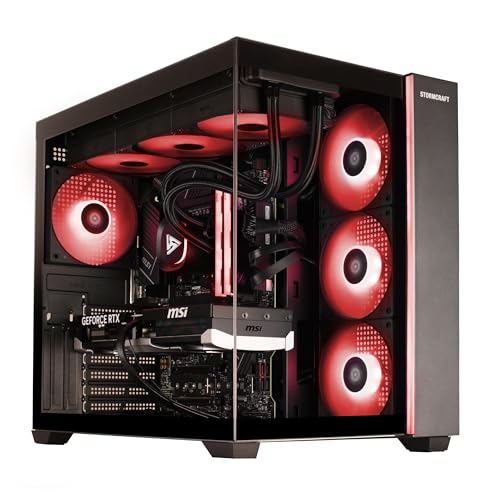
STORMCRAFT Falcon Prebuilt RTX 5070 Gaming PC,R7 7800X3D,32GB DDR5,1TB SSD
Chosen because it specifies R7 7800X3D and 32GB DDR5.
View on Amazon
STORMCRAFT Valkyrie Gaming PC,R7 7800X3D,RX 9070XT 16GB,2TB SSD,32GB DDR5
Chosen because it specifies R7 7800X3D and RX 9070XT 16GB.
View on Amazon
Micro Center AMD 7800X3D Processor with ASUS TUF Gaming B850-E Motherboard
Picked as a relevant option in this category.
View on AmazonAt 4K, the graphics card usually determines frame rate, so a 7800X3D can pair successfully with very fast GPUs. At 1080p, especially in esports games running above 240Hz, the processor becomes more likely to limit performance. That is not a permanent problem: a GPU bottleneck is usually preferable because it means the graphics card is being used fully.
Best pairings by resolution and refresh rate
1080p and competitive gaming
For a 1080p monitor at 144Hz or 165Hz, a GeForce RTX 4060, RTX 4060 Ti, Radeon RX 7600 XT, or similar midrange card is enough for many games. Pairing a 7800X3D with one of these GPUs makes sense if you play competitive titles, want low noise, or plan to upgrade to a higher-resolution monitor later.
For 240Hz or 360Hz esports gaming, the 7800X3D is a strong CPU choice, but the result depends heavily on the game and settings. An RTX 4070 Super, RTX 5070, or RX 9070 provides more useful headroom for high frame rates while also making the system suitable for 1440p later. A flagship GPU is usually poor value for 1080p unless you need unusually high frame rates in demanding games.
1440p at 144Hz to 240Hz
This is the 7800X3D’s most balanced pairing range. The RTX 4070 Super and RTX 5070 are sensible choices for high-quality 1440p gaming. The RTX 5070 Ti, RX 9070, and RX 9070 XT are better suited to 165Hz monitors, demanding ray-traced games, or owners who prefer maximum settings.
The RTX 5070 Ti is particularly attractive when ray tracing, DLSS, and frame generation matter. The RX 9070 XT can be compelling for traditional rasterized gaming and often offers substantial memory capacity for large textures. Compare the games you actually play rather than choosing by brand alone.
4K at 60Hz to 144Hz
For 4K at 60Hz, an RX 9070 XT, RTX 5070 Ti, RTX 5080, or RX 7900 XTX can work well depending on the game and desired settings. Upscaling is often useful at this resolution, especially with ray tracing enabled.
The RTX 5080 is the stronger all-round choice for 4K ray tracing and image-quality features. The RX 7900 XTX remains an attractive option for raster performance and its 24GB of video memory, although its ray-tracing performance and feature ecosystem are not as strong as Nvidia’s current high-end alternatives.
The RTX 5090 is appropriate for a 4K high-refresh display when you want the fewest compromises. It is also the pairing most likely to expose limits elsewhere, including game-engine frame caps, memory latency, cooling, and monitor capability.
Ray tracing, upscaling, and video memory
- Choose Nvidia if ray tracing, DLSS, frame generation, CUDA applications, or video encoding are major priorities.
- Choose AMD if rasterized performance, generous video memory, and value at 1440p or 4K matter more than maximum ray-tracing performance.
- Consider memory carefully: 12GB can be adequate for 1440p, while 16GB or more offers more comfort for 4K texture packs and future releases.
- Do not treat generated frames as a replacement for base performance: a card should first deliver a reasonably strong native or upscaled frame rate before frame generation is enabled.
Power supply and case-clearance realities
| GPU class | Approximate board power | Practical PSU target | Case clearance to plan for | Build concern |
|---|---|---|---|---|
| RTX 4070 Super / RTX 5070 | 220–250W | 650–750W | 280–330mm length; 2–3 slots | Usually easy to cool and install |
| RTX 5070 Ti / RX 9070 XT | 300–320W | 750–850W | 300–350mm length; commonly 3 slots | Check front radiator and drive-cage interference |
| RX 7900 XTX / RTX 5080 | 320–355W | 850–1000W | 320–360mm length; often 3 slots | Needs strong case airflow and unobstructed intake |
| RTX 4090 | 450W | 1000W is a sensible target | 330–360mm length; 3–4 slots | Large cooler and careful power-cable routing |
| RTX 5090 | About 575W | 1000–1200W, depending on the model | 330–380mm length; up to 4 slots | Heat, weight, connector clearance, and case support are critical |
Check the exact graphics card specification rather than relying only on the GPU name. Partner models can differ by several centimeters. Leave at least 30mm of open space in front of the card where possible, and avoid bending a high-power connector immediately against the side panel. A 340mm graphics card may not fit once a front-mounted radiator, fan, or drive cage occupies the same area.
For heavy cards, use the supplied support bracket or a properly positioned support post. Do not let the card’s full weight hang from the motherboard slot. If your case is narrow, also check GPU thickness: a three-and-a-half-slot card can block adjacent expansion slots and restrict airflow to the lower intake fans.
How much bottleneck should you expect?
With a 7800X3D, bottleneck risk is determined more by resolution, game, and frame-rate target than by a simple GPU ranking.
- RTX 4070 Super through RTX 5070 at 1440p: generally well balanced, with the GPU limiting performance in most visually demanding games.
- RTX 5070 Ti, RX 9070 XT, and RTX 5080: excellent matches for 1440p high refresh and 4K gaming.
- RTX 4090 or RTX 5090 at 1080p: likely to encounter CPU or game-engine limits, particularly above 200 frames per second.
- Any GPU in simulation, strategy, or massively populated games: the CPU may limit minimum frame rates even at 4K, because those workloads depend heavily on simulation and game logic.
If your GPU utilization stays near 95–99% during gameplay, the pairing is working as intended. If utilization remains low while one or more CPU threads are saturated, lowering graphics settings will not substantially improve frame rate; a higher-resolution monitor, higher visual settings, or a less expensive GPU may be a better use of the system.
Best choice for most 7800X3D builds
For a new 1440p gaming PC, choose the RTX 5070 when you want efficient, broadly capable performance, or the RX 9070 XT and RTX 5070 Ti when you have a 165Hz-or-faster monitor and want more headroom. For 4K, the RTX 5080 is the most versatile premium match, while the RX 7900 XTX remains worth considering for high raster performance and 24GB of memory.
Choose the RTX 5090 only if your monitor and budget justify it and your case, power supply, cooling, and cable routing are designed around a very large, high-power graphics card. The 7800X3D will not prevent it from performing well, but the rest of the computer must be built to accommodate the GPU.
FAQ
Is the 7800X3D too weak for an RTX 5090?
No. At 4K, the RTX 5090 will usually be the primary performance limit. At 1080p and very high refresh rates, some games may become CPU-limited, but that does not make the combination unsuitable for 4K gaming.
Should I upgrade the CPU before buying a faster GPU?
Usually not if you already own a 7800X3D. For a 1440p or 4K upgrade, spending the budget on a faster graphics card normally produces a larger gaming improvement than replacing this processor.
Is a 750W power supply enough?
It is generally suitable for cards around the RTX 5070 class, provided the unit is high quality and the rest of the system is conventional. Higher-power cards such as the RTX 5080, RTX 4090, RX 7900 XTX, and RTX 5090 call for stronger supplies and careful attention to the manufacturer’s recommendation.