Our Top Picks
Pros & cons
- Four memory presets simplify switching between heights
- Aerospace-grade lifting columns aim for long-term stability
- Low-VOC materials support a healthier indoor workspace
- 48 x 24 inch top limits room for larger multi-monitor setups
- At nearly 44 pounds, assembly needs some help


Buying a height adjustable desk online means you can’t test the wobble, hear the motor, or check how it feels at your actual sitting height before you commit. That’s not a reason to avoid buying one online — almost everyone does — but it does mean you need to know what the spec sheet isn’t telling you.
Electric vs manual vs pneumatic
There are three ways a desk changes height, and the difference matters more than most listings let on.
Electric desks use a motor and a button or keypad. You get one-touch height changes, often with programmable presets, and lift capacities that range from 150 lbs on budget single-motor frames to 300+ lbs on dual-motor ones. The trade-off is noise (most sit around 40-50 dB, which is noticeable in a quiet room) and a dependency on being near an outlet.
Manual crank desks use a hand crank. They’re slower — going from sitting to standing height takes 20-30 cranks depending on the gear ratio — but they’re mechanically simple, which means fewer things to fail. If a motor controller dies five years in, you’re stuck; a crank almost never breaks in a way you can’t fix or just live with.
Pneumatic/spring-assisted desks use gas struts, like an office chair. You pull a lever and the desk floats to where you push it. They’re fast and quiet but imprecise — you can’t set an exact height and expect it to return there consistently, and the struts weaken over a few years of daily use, so the desk starts sagging under load.
For most home office setups, electric dual-motor is worth the extra $100-150 over single-motor if you’re over 220 lbs combined desk+monitor+gear weight, or if you want a desk wide enough (60″+) that a single motor would cause one side to lift slower than the other, racking the frame.
What the listing photos don’t show you
Three things cause most of the buyer’s remorse with online desk purchases:
Height range. Many budget frames bottom out around 28″ and top out at 47-48″. If you’re under 5’4″ or over 6’2″, check the actual range in inches, not just “sit-stand capable.” A desk that only goes to 47″ is unusable standing for anyone over 6’1″ without hunching.
Tabletop not included, or included and bad. A lot of “desk” listings are frame-only. Read the title and bullet points twice. If a tabletop is included, it’s often 3/4″ particleboard with laminate that chips at the edges within a year. That’s fine for light use, but if you’re mounting a monitor arm or heavy shelf, you want at least 1″ thick material or a frame rated for the clamp load you’re adding.
Crossbar or no crossbar. Cheaper electric frames skip the stabilizing crossbar between the legs to save cost, and the desk wobbles noticeably at full height, especially if you type with any force. If the listing photos don’t show a crossbar, assume there isn’t one and expect more wobble at 45″+ heights.
| Frame type | Typical cost | Height change speed | Weight capacity | Main failure point |
|---|---|---|---|---|
| Manual crank | $120-200 | Slow (20-30 cranks) | 150-220 lbs | Stiff crank over time, rarely total failure |
| Single-motor electric | $200-350 | Fast (~15-20 sec) | 150-220 lbs | Motor controller, uneven lift on wide desks |
| Dual-motor electric | $300-600 | Fast (~15-20 sec) | 220-350 lbs | More expensive to replace if motor fails |
| Pneumatic/spring | $250-450 | Very fast (~5 sec) | 120-180 lbs | Struts weaken, height drifts down over years |
Buying online without regret
Check the return policy before anything else — these ship in heavy boxes (50-90 lbs), and return shipping on a desk frame can run $40-80 if the seller doesn’t cover it. Look for “free returns” explicitly, not just a generic 30-day window.
Read the 1-star and 2-star reviews specifically for mentions of “wobble,” “crooked,” or “stopped working after.” A desk with 4.5 stars overall can still have a cluster of motor failures around the 18-month mark, which is past most 1-year warranties but exactly when you’ll notice it.
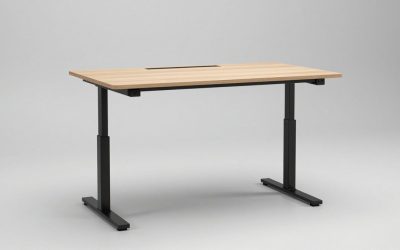
If you’re starting from scratch rather than replacing a single piece, it’s usually cheaper and less risky to buy a complete sit-stand height adjustable desk than to buy a frame and top separately — matched components, one return process, one warranty to deal with. But if you already have a tabletop you like, or want a nonstandard size, a standalone adjustable desk frame lets you keep it and just swap the base.
What to budget for after the desk arrives
The desk price is rarely the whole cost. Plan for a few extras:
An anti-collision sensor is standard on most mid-range electric desks now, but if yours doesn’t have one, be deliberate about keypad presets so you’re not slamming the desk into a shelf above it. If you’re mounting monitors, a monitor arm frees up desk space and moves with the desk height more predictably than a monitor sitting directly on the surface — just confirm the clamp fits your tabletop thickness.
Cable management gets harder with a moving desk, not easier. Cables that run from a wall outlet to the desk need slack for the full range of motion, or they’ll pull taut and strain the plug at full standing height. A desk-mounted cable tray that moves with the frame, plus a flexible sleeve for the floor-to-desk run, solves this better than zip-tying everything to one fixed point, which just rips loose the first time you raise the desk fully.
Budget roughly 10-15% of the desk’s price for these extras if you don’t already own them. Skipping them doesn’t break anything, but it’s the difference between a desk that looks like an afterthought and a setup that actually works at every height you use.