Our Top Picks
 VIVO STAND-V002F Dual LED LCD Monitor Free-Standing Desk13" - 27" screens17.5 x 11.4 x 3.8 inches4.48 PoundsCheck on Amazon

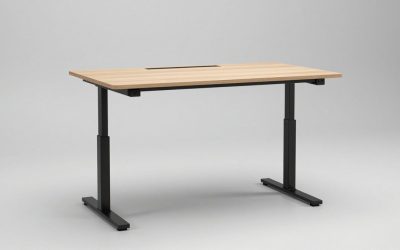
“Affordable” and “standing desk” don’t usually belong in the same sentence without a catch. Either the frame wobbles at full height, the motor strains on anything over 150 lbs, or the laminate top starts peeling after a year of coffee rings. But the budget end of this market has gotten genuinely decent over the past few years, mostly because the core components (motors, controllers, steel tubing) are now commoditized. You’re not paying for innovation anymore, you’re paying for assembly quality and whoever’s doing quality control on the welds.
Here’s what actually matters when you’re trying to spend less than $350 and not regret it.
What the cheap desks get right
Most sub-$300 electric standing desks now use the same dual-motor lifting mechanism as desks costing twice as much. That’s not marketing spin, it’s just how the supply chain works, a handful of Chinese manufacturers make most of the motor and controller units sold under dozens of different brand names. So the lifting itself, the part people worry about most, is rarely the weak point.
What you’re actually trading off at the low end is: desktop material (thinner MDF instead of real bamboo or solid-core laminate), cable management (none, or a flimsy plastic tray), weight capacity (100-150 lbs instead of 225+), and crossbar stability (some budget frames skip the stabilizing crossbar entirely, which is why they wobble at height).
Single motor vs. dual motor
Single-motor frames drive both legs through a shared rod. They’re cheaper and fine for anyone under about 220 lbs of combined desk and equipment weight. Dual-motor frames give each leg its own motor, which means faster transitions (usually 1.5 inches per second vs. 1 inch per second) and better stability under heavier loads, since the legs aren’t relying on a mechanical link that can develop play over time.
If you’re running two monitors on arms, a laptop dock, and maybe a small CPU shelf, go dual motor. If it’s one monitor and a laptop, single motor saves you $50-80 and won’t be a bottleneck.
How the budget tiers actually compare
| Price range | Motor setup | Typical weight capacity | Where it fails |
|---|---|---|---|
| $150-200 | Single motor | 110-150 lbs | Wobble at max height, no memory presets, thin desktop warps under heat/moisture |
| $200-300 | Dual motor | 150-200 lbs | Cable management is an afterthought, controller sometimes lacks collision detection |
| $300-400 | Dual motor, reinforced frame | 200-275 lbs | Rarely fails outright; main gap is finish quality vs. premium brands |
The jump from $150 to $250 buys you real stability. The jump from $250 to $400 buys you cosmetics and a slightly higher weight ceiling. For most home office setups, that second jump isn’t worth it unless you’re mounting a lot of hardware.
Buy a frame, or buy the whole desk?
This is the actual budget decision most people skip. A bare frame plus your own tabletop (even a $40 piece of birch plywood from a hardware store) is often $80-100 cheaper than a bundled desk, and you control the surface quality. If you already have a solid door or table slab lying around, this is the move. If you want something that shows up and works without a trip to a lumber yard, a complete electric standing desk under $300 is the simpler path and the quality gap has narrowed enough that it’s a reasonable default.
If budget is tighter than $150, skip electric entirely and look at a manual crank standing desk. You lose the one-touch height change, and cranking up a 32-inch desktop takes maybe 20-30 seconds, but you also lose every motor failure mode entirely. For a desk that gets adjusted twice a day (sit in the morning, stand after lunch) rather than every 20 minutes, manual is not a real sacrifice.
What actually breaks
Having set up and used several of these, the complaints cluster around three things. First, controllers losing their height memory after a power outage or unplug, which is annoying but not a functional failure, you just reset the presets. Second, the desktop surface delaminating at the edges where water or condensation sits, usually from a mug placed too close to the border, a $15 silicone coaster mat fixes this preventatively. Third, and the real one to watch for, is frame racking, where one side rises slightly faster than the other over months of use, causing visible tilt. This shows up more on single-motor desks and on any frame with plastic (rather than metal) leg-to-crossbar brackets. If you notice even 1/8 inch of tilt at full height in the first month, that’s a return, not a wait-and-see.
The one thing not to cut corners on
Regardless of price tier, don’t buy a standing desk without checking the actual stated weight capacity against what you’re putting on it, including the desktop’s own weight if you’re adding a different top. A monitor arm with two 27-inch displays, a laptop, and a dock easily hits 40-50 lbs before you’ve put anything else down. Budget desks rated at 110 lbs have less margin than that number suggests, because the rating usually assumes even distribution, not two monitor arms clamped at the back edge. If your setup is monitor-arm heavy, size up a tier even if it costs more, this is where the “fine for most people” caveat stops applying.
A good standing desk monitor arm setup actually reduces strain on cheap frames too, since it gets weight off the desktop’s leading edge and onto the clamp point near the back legs, where the frame is strongest.