Key takeaways
- Hip angle opens to 120–135°. Your thighs drop downward instead of running parallel to the floor, which takes tension off the hip flexors shortened by conventional sitting.
- Lumbar lordosis is maintained automatically. The forward pelvic tilt lets your lower spine hold its natural curve without a lumbar cushion doing the work—that’s the core ergonomic argument for the design.
- Weight redistributes. Instead of ~90% of your weight on your sit bones and thighs, roughly 20–30% shifts to your feet pressing flat on the floor. That’s why seat height matters so much—too low and the benefit disappears, too high and your feet dangle.
What's inside
An ergonomic saddle chair with backrest is the right buy if you want the open-hip posture of saddle sitting—roughly a 120–135° hip angle instead of the 90° bend of a conventional office chair—while keeping a lumbar contact point for long, static stretches like calls, reading, and detailed screen work. The key thing to understand before spending $300–$1,200: the backrest is a safety net, not the support system. On a saddle seat, your posture comes from the seat angle and your legs doing part of the work, not from leaning back.
How Saddle Seating Changes Your Posture
A saddle seat tilts your pelvis forward about 30°, which does three measurable things:

Antlu Saddle Stool Chair with Back Support, Ergonomic Esthetician Stool Chair for Salon Tattoo Spa Medical Dentist Clinic (with Backrest, Black)
Included for 'Ergonomic Saddle Chair With Backrest: Benefits and Who It's For' because the listing specifies Black), details this guide uses to compare options.
View on Amazon
VEVOR Saddle Stool with Back Support and Wheels, 450 LBS Weight Capacity Ergonomic Rolling Stool, Height Adjustable Thickened PU Leather Swivel Saddle Chair for Salon, Spa, Massage, Tattoo, Black
Included for 'Ergonomic Saddle Chair With Backrest: Benefits and Who It's For' because the listing specifies 450 LBS Weight Capacity Ergonomic Rolling Stool and Spa, details this guide uses to compare options.
View on Amazon
SONGMICS Saddle Stool with Back Support and Wheels, Ergonomic Saddle Chair
Included for 'Ergonomic Saddle Chair With Backrest: Benefits and Who It's For' because the listing specifies Ergonomic Saddle Chair, details this guide uses to compare options.
View on Amazon
Rolling Saddle Chair with Back Support, Ergonomic Swivel Stool
Included for 'Ergonomic Saddle Chair With Backrest: Benefits and Who It's For' because the listing specifies Ergonomic Swivel Stool, details this guide uses to compare options.
View on Amazon- Hip angle opens to 120–135°. Your thighs drop downward instead of running parallel to the floor, which takes tension off the hip flexors shortened by conventional sitting.
- Lumbar lordosis is maintained automatically. The forward pelvic tilt lets your lower spine hold its natural curve without a lumbar cushion doing the work—that’s the core ergonomic argument for the design.
- Weight redistributes. Instead of ~90% of your weight on your sit bones and thighs, roughly 20–30% shifts to your feet pressing flat on the floor. That’s why seat height matters so much—too low and the benefit disappears, too high and your feet dangle.
This is “active sitting” in a literal sense: your legs and core stay lightly engaged, and most users naturally shift position more often than they do in a task chair.
The Measurements That Decide Whether It Fits
Seat Height: Size by Inseam, Not Height
The reliable method: measure your inseam in bare feet (floor to crotch) and set the compressed seat height within 1–2 inches of that number. Most adults land between 22 and 28 inches. Check the gas lift range before buying—standard lifts cover roughly 21–27 inches, while extended or “drafting” lifts reach 26–33 inches. If you’re under 5’3″ or over 6’2″, the lift range is the single most important spec on the page.
Desk Height: The Part Most Buyers Miss
Because you perch higher on a saddle, your desk surface needs to sit about 9–12 inches above the compressed seat. A fixed 29-inch desk—the standard in North America—is often too low for a proper saddle posture. Under-desk clearance also matters less than you’d think: since your knees drop rather than project forward, you need roughly 24–26 inches of clearance under the surface, not the 27+ a task chair demands.
| Inseam (approx. height) | Suggested seat height | Desk surface needed | Works at a fixed 29–30″ desk? |
|---|---|---|---|
| 28 in (~5’2″) | 21–23 in | 30–33 in | Borderline—sit at the low end |
| 30 in (~5’6″) | 23–25 in | 32–35 in | No—add risers or a keyboard tray |
| 32 in (~5’10”) | 25–28 in | 34–37 in | No—height-adjustable desk recommended |
| 34 in (~6’2″) | 27–30 in | 36–39 in | No—extended lift + tall desk |
The workaround if you can’t change your desk: run the seat 2–3 inches lower than your inseam suggests. Your hip angle closes toward 100–110°, which loses some of the benefit but still beats a 90° posture.
The Backrest Trade-Off: Long Hours vs. Active Sitting
Saddle-chair backrests aren’t scaled-down task chair backs. Most are compact lumbar pads 6–9 inches tall, positioned to meet your lower back only when you lean into them. HÅG’s Capisco 8106 is the well-known exception—a full backrest on a saddle-style seat that even lets you sit facing backward and rest your chest against it.
The trade-off is real: every minute you spend fully leaned back, your hip angle closes and you lose the active-sitting benefit you paid for. A backrest also adds $100–$300 to the price and 4–7 lbs to the chair. So the honest decision rule is:
- Get the backrest if you sit in static positions more than 4–5 hours a day, take frequent calls, or are transitioning from a conventional chair and need a recovery position while your body adapts.
- Skip it if you alternate sitting and standing every 30–60 minutes, or do forward-leaning task work (dental and clinical work, sewing, crafting, playing instruments) where a backrest is just unused hardware behind you.
One detail worth checking: on split-seat designs with a swing mechanism, a poorly placed backrest post can restrict the tilt. Look for models where the backrest adjusts in height and depth.
Construction and Materials: What Actually Wears
| Component | Budget spec (~$150–$350) | Premium spec (~$500–$1,300) | What fails first |
|---|---|---|---|
| Seat | One-piece molded foam, ~40 kg/m³ | Split seat or thicker molded foam, 55–70 kg/m³ | Foam compression at the front edge, year 3–5 |
| Upholstery | PU leather / basic vinyl | Wool-blend fabric, genuine leather, medical-grade vinyl | PU cracks at seams within 2–4 years |
| Gas lift | Unbranded, class 3 | Branded class 4 cylinder | Height drift after 3–5 years |
| Base & casters | Nylon 5-star, ~24 in diameter | Polished aluminum, 26–28 in, floor-matched casters | Caster bearings on hard floors |
| Backrest | Fixed-position pad | Height- and depth-adjustable lumbar | Lock/tilt mechanism under daily use |
Upholstery choice is situational, not just price-tiered: vinyl wins anywhere spills or disinfection matter (clinics, kitchens, salons); fabric breathes better for 8-hour days; leather is durable but slippery on a steep seat tilt. Weight capacity on most quality models is 250–300 lbs; split-seat designs from brands like Salli and Kanewell also reduce perineal pressure, which matters for tailbone sensitivity and prostate concerns.
Match the Chair to Your Situation
| Your situation | Best configuration | Why |
|---|---|---|
| Fixed 29″ desk you can’t modify | Saddle stool without backrest, standard lift | You’ll sit lower anyway; don’t pay for a backrest you won’t reach |
| Height-adjustable standing desk | Split-seat saddle with adjustable backrest | Full posture range plus sit/stand alternation |
| Lower-back pain, first saddle chair | Height/depth-adjustable backrest model | Recovery position during the 1–3 week adaptation |
| 8+ hour static days (calls, editing, CAD) | Full-back design (Capisco-style) | Backwards-sitting option gives real position variety |
| Dental, clinical, salon work | Vinyl seat, foot-operated height ring, compact base | Hands-free adjustment and wipe-down upholstery |
| Small apartment / shared space | Stool version, ~24″ base diameter | Tucks under a desk; base still spans a 2 ft circle |
Who should skip the category entirely: anyone who relies on armrests for mouse work (most saddle chairs have none), people who like to recline and lounge, and—worth an honest flag—some users with hip impingement find the wide leg-abduction posture uncomfortable. If that’s you, a kneeling chair or conventional ergonomic chair is the better spend.
Ownership Realities: Delivery, Assembly, Adaptation
- Box weight and fit: One box, typically 30–50 lbs and around 30×26×18 inches—fits through any standard 32-inch doorway and up apartment stairs without drama.
- Assembly: 10–20 minutes. Base, gas lift, seat, backrest post. No tools beyond an included hex key on most models from Salli, Score, Bambach, or Kanewell.
- Adaptation period: Expect sit-bone soreness for the first 1–3 weeks. Start with 30–45 minute sessions and build up; this is the most common reason people return a perfectly good chair too early.
- Casters: Hard-floor casters (soft polyurethane) versus carpet casters matter more here than on task chairs—saddle chairs roll easily because your feet are already on the floor.
- Longevity: Frames and bases commonly carry 5–10 year warranties on premium models. Budget for the seat upholstery and gas cylinder as the wear items.
FAQ
Can I use a saddle chair at a normal-height desk?
Yes, but imperfectly. Lower the seat so your elbows meet the desk, accepting a smaller hip angle (~100–110°). A height-adjustable desk or desk risers unlock the full benefit.
Is a saddle chair with backrest good for lower-back pain?
The forward pelvic tilt restores lumbar lordosis, which is why many back-pain users report relief—but it’s a posture tool, not a medical fix, and the adaptation weeks can initially feel worse before better. The backrest version is the safer entry point.
Split seat or one-piece seat?
Split seats (two pads with a gap) relieve perineal pressure and run cooler; one-piece seats feel more familiar and suit narrower hips. Anyone with tailbone or prostate sensitivity should strongly favor the split design.
How does it compare to a kneeling chair?
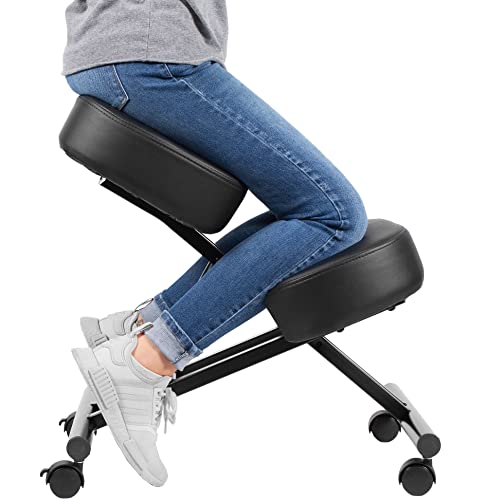
Kneeling chairs load your shins and restrict leg movement; saddle chairs load your feet and let you roll and swivel freely. For all-day desk work, saddle seating is the more sustainable posture of the two.