Key takeaways
- Seat depth adjustment range: As you shift posture through the day, a fixed-depth seat either digs into the back of your knees or leaves your lower back unsupported. Look for at least 2-3 inches of sliding seat pan travel (a total usable range of 16-20 inches depth) so you can adjust as fatigue changes your posture.
- Foam density vs. mesh suspension: Foam seats compress and trap heat over hours of sitting; mesh seats stay cooler but can feel like a hammock without a supportive frame underneath. Neither is universally “better,” but the wrong one for your body type gets uncomfortable fast (more below).
- Recline lock durability: A tilt-lock mechanism that holds firmly out of the box can start slipping after 3-6 months of daily 8-10 hour use. This is the single most common failure point in chairs used for full-time work, and it’s almost never mentioned in product listings.
- Lumbar support adjustability: Height and depth-adjustable lumbar (not just a fixed bump) matters more the longer you sit, since your spine’s natural curve shifts as core muscles tire late in the day.
What's inside
The best chair for long hours at the computer is one that still fits your body correctly at hour eight, not just hour one: that means at least 4-5 inches of seat depth adjustment, a seat foam density of 2.5-3.0 lb/ft³ or a taut mesh with real lumbar support, and a recline lock that doesn’t creep after months of daily use. Most of what separates a genuinely all-day chair from a “looks ergonomic” chair only shows up after the fourth hour, which is exactly where most buying guides stop paying attention.
This comparison ranks chairs by the three things that actually break down over a full workday: fit adjustability, material behavior under sustained pressure and heat, and mechanical durability of the recline and tilt lock. If you’re shopping for a comfortable computer chair for long hours rather than an occasional-use desk chair, these are the specs to weigh before price or looks.

Herman Miller Classic Aeron Chair - Size B, Posture Fit
Included for 'Best Chair for Long Hours at the Computer: Compared Picks for All-Day Sitting' because the listing specifies Size B and Posture Fit, details this guide uses to compare options.
View on Amazon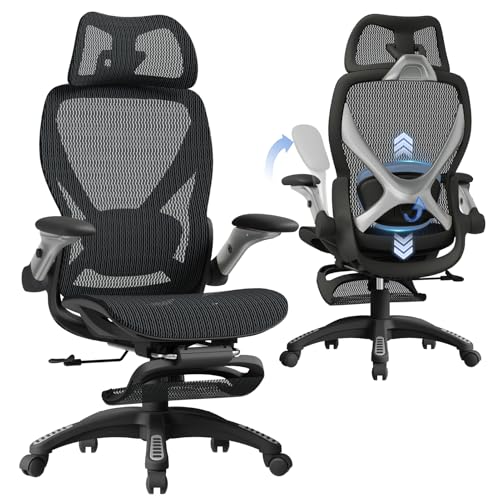
ELABEST X100 Ergonomic Mesh Office Chair with Footrest, Big and Tall Hone Desk Chair with 5D Flip-Up Arms, Adjustable 3D Lumbar Support,Gaming & Executive Computer Chairs
Included for 'Best Chair for Long Hours at the Computer: Compared Picks for All-Day Sitting' because the listing specifies Big and Tall Hone Desk Chair with 5D Flip-Up Arms and Adjustable 3D Lumbar Support, details this guide uses to compare options.
View on Amazon
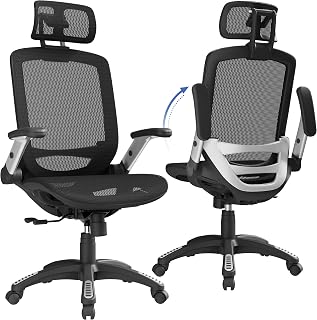
GABRYLLY Ergonomic Office Chair, High Back Home Desk Chair with Headrest, Flip-Up Arms, 90-120° Tilt Lock and Wide Cushion, Big and Tall Mesh Chairs for Man Woman, Black Task Chair
Included for 'Best Chair for Long Hours at the Computer: Compared Picks for All-Day Sitting' because the listing specifies High Back Home Desk Chair with Headrest and Flip-Up Arms, details this guide uses to compare options.
View on AmazonWhat Actually Matters Past Hour Four
In the first hour, almost any chair with a cushion feels fine. Problems show up later, and they show up in predictable places:
- Seat depth adjustment range: As you shift posture through the day, a fixed-depth seat either digs into the back of your knees or leaves your lower back unsupported. Look for at least 2-3 inches of sliding seat pan travel (a total usable range of 16-20 inches depth) so you can adjust as fatigue changes your posture.
- Foam density vs. mesh suspension: Foam seats compress and trap heat over hours of sitting; mesh seats stay cooler but can feel like a hammock without a supportive frame underneath. Neither is universally “better,” but the wrong one for your body type gets uncomfortable fast (more below).
- Recline lock durability: A tilt-lock mechanism that holds firmly out of the box can start slipping after 3-6 months of daily 8-10 hour use. This is the single most common failure point in chairs used for full-time work, and it’s almost never mentioned in product listings.
- Lumbar support adjustability: Height and depth-adjustable lumbar (not just a fixed bump) matters more the longer you sit, since your spine’s natural curve shifts as core muscles tire late in the day.
Foam vs. Mesh: The Trade-Off That Decides Comfort After Hour 4
This is the split that determines which “most comfortable computer chair for long hours” is actually right for you, and it depends more on your body and climate than on price.
| Factor | High-density foam seat (2.5-3.0 lb/ft³) | Mesh seat/back over a frame |
|---|---|---|
| Pressure distribution over 8+ hrs | Very good if density holds; low-density foam (under 1.8 lb/ft³) flattens within a year | Good, but depends heavily on frame tension; cheap mesh sags and creates pressure points |
| Heat buildup | Noticeably warmer, especially in rooms without AC | Stays cooler, better for hot climates or poorly ventilated offices |
| Best for body type | Better cushioning for lighter frames and bony-hip sitters | Better for larger frames since mesh flexes to distribute weight, foam alone can bottom out |
| Durability | 3-5 years before noticeable compression at typical daily use | 5-8 years for the mesh itself; frame tensioners can loosen sooner |
| Typical price range | $150-$500 (foam-only chairs skew cheaper) | $300-$900+ (quality mesh frames cost more to engineer) |
If you run warm, sit in a room without strong climate control, or weigh more than about 200 lbs, mesh usually wins on comfort retention. If you’re lighter, sit in a cooler space, or want a plush feel from day one, dense foam usually wins.
Recline Lock: The Feature Nobody Tests Before Buying
A synchro-tilt or multi-position recline lock is rated for a certain number of cycles, but that spec rarely appears on a product page. In practice, three tiers show up in the market:
- Basic tilt-lock (budget chairs, usually under $200): Often holds for the first few months, then starts to lean forward or backward under body weight as the tension spring or ratchet wears. Not built for 8-10 hour daily cycles.
- Multi-position synchro-tilt (mid-range, roughly $300-$600): Locks at several recline angles independently of backrest tension. This is the tier where most genuinely durable all-day chairs live, and where the lock reliably holds for years of full-time use.
- Weight-activated or infinite-lock recline (premium, $600-$1,500+): Locks at any angle and distributes load through a heavier-gauge mechanism rated for continuous commercial use. Best durability, but often more recline range than a desk worker actually needs.
If you sit 8-10 hours a day, five days a week, the mid-range multi-position lock is usually the sweet spot: it’s rated for the cycle count that basic tilt-locks aren’t, without paying for commercial-grade hardware most home offices don’t need.
Decision Matrix: Match the Chair to Your Situation
| Your situation | What to prioritize | What to skip |
|---|---|---|
| Back pain or a herniated disc history | Adjustable lumbar (height + depth), 4D armrests, seat tilt lock independent of backrest recline | Ultra-soft foam that lacks underlying support structure |
| Small home office / apartment | A chair with a smaller footprint when upright (check base diameter, usually 26-27 inches) and a back that doesn’t require a headrest to feel supportive | Executive-style chairs with high fixed headrests that dominate a small room visually |
| Hot climate or no AC | Full mesh back and seat, breathable fabric if not mesh | Bonded leather or PU leather seats, which trap heat and get sticky |
| Larger body frame (over 250 lbs) | Chairs rated to 300-400+ lb weight capacity with reinforced steel frames and wider seat pans (20+ inches) | Chairs where the weight rating is close to your actual weight; look for real margin |
| Shared desk / multiple users | Wide seat depth adjustment range and easily reachable pneumatic height lever | Chairs with lumbar adjustment that requires tools to reset |
| Tight budget but full-time use | Mid-range mesh chair with a synchro-tilt lock; spend on the mechanism over upholstery | Gaming-style chairs with thick foam bolsters that look supportive but flatten fast |
Seat Height, Depth and Desk Fit: The Numbers That Matter
A chair rated for “all-day comfort” still fails if it doesn’t fit your desk. Use these ranges as a baseline:
- Seat height range: Most ergonomic office chairs adjust between 17 and 21 inches from the floor. If you’re under 5’4″ or over 6’2″, check the exact range since the standard 17-21 inch spread can leave shorter or taller users without proper knee angle.
- Desk clearance: Standard desks sit 28-30 inches high. With a seat height of 18-20 inches and the recommended 10-12 inches of thigh clearance under the desktop, most chairs fit standard desks fine; issues usually show up with desks under 28 inches or thick desktop aprons.
- Seat depth: For proper support, there should be a 2-4 inch gap between the front edge of the seat and the back of your knees when seated fully back. This is only achievable with adjustable-depth seat pans if your torso length falls outside the average range.
- Armrest height: Should let your elbows rest at roughly a 90-100 degree angle with shoulders relaxed; look for at least 4 inches of height adjustment plus width and pivot adjustment (4D) if you type for long stretches.
What Wears Out First
Across full-time use, the failure order tends to be consistent: gas lift cylinders (height sinks slowly, usually within 2-4 years), then recline lock tension, then armrest pads (foam-covered pads crack before hard plastic ones), then casters on hard flooring (upgrading to hard-floor-rated casters extends this significantly). Seat foam or mesh is usually the last thing to fail on a well-built mid-range or premium chair, which is why spending on the mechanical parts (base, gas cylinder, tilt lock) pays off more than spending on upholstery alone.
Bottom Line by Priority
For most people looking for good computer chairs for long hours, a mid-range mesh-back chair with a multi-position synchro-tilt lock and at least 3 inches of seat depth adjustment covers the largest number of use cases well. Reserve foam-seat picks for cooler rooms or lighter frames, and reserve premium weight-activated recline chairs for people who genuinely shift recline angle throughout the day rather than sitting upright by default. The chair that wins after hour four is rarely the one that impresses in the first five minutes in a showroom or a photo.