Our Top Picks
 HON 4 Drawer Lateral File Cabinet with Lock4 Drawers21.31 x 214 x 56.06 inches5.9 poundsCheck on Amazon
For busy workspaces, filing cabinets for office use come down to three decisions: choose a 4-drawer vertical if you need maximum filing per square foot, a 2-drawer lateral or mobile pedestal if you need access under or beside a desk, and a fire-resistant steel model only if you must protect paper originals from fire for at least 1 hour.
2-Drawer vs 3-Drawer vs 4-Drawer: Which Size Actually Fits Your Workload?
The drawer count determines capacity, floor footprint, and how comfortably you can work around the cabinet in a real office.

HON Brigade File Cabinet, 4 Drawer Filing Cabinet, Desk Storage, Black
Chosen because it specifies 4 Drawer Filing Cabinet and Desk Storage.
View on Amazon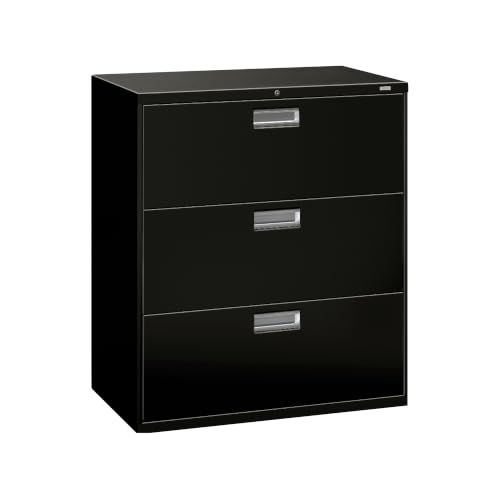
HON Brigade File Cabinet, 3 Drawer Filing Cabinet, Desk Storage, Black
Chosen because it specifies 3 Drawer Filing Cabinet and Desk Storage.
View on AmazonHON 4 Drawer Lateral File Cabinet with Lock, Metal Filing Cabinets for Offices, Adjustable Hangrails for A4, Legal, Letter Files, 18" Deep, Light Gray
Chosen because it specifies Metal Filing Cabinets for Offices and Adjustable Hangrails for A4.
View on Amazon
HON 4 Drawer Vertical File Cabinet with Lock, Metal Filing Cabinets with 4 Drawers for Hanging Files and Letter Files, 26.5" Deep, Putty
Chosen because it specifies 26.5" Deep and Putty.
View on Amazon| Configuration | Typical Overall Dimensions (W x D x H) | File Capacity (Letter Size) | Footprint | Best For |
|---|---|---|---|---|
| 2-Drawer Vertical | 15″ W x 25″ D x 29″ H | ~2,400 sheets per drawer, ~4,800 total | 2.6 sq ft | Under-window storage, personal office with 1-2 users |
| 3-Drawer Vertical | 15″ W x 25″ D x 40″ H | ~7,200 sheets total | 2.6 sq ft | Standing-height access without a 52″ tall tower |
| 4-Drawer Vertical | 15″ W x 25″ D x 52″ H | ~9,600 sheets total | 2.6 sq ft | High-volume departments, accounting, HR, legal |
| 2-Drawer Lateral (30″ wide) | 30″ W x 18″ D x 28″ H | ~4,800 sheets side-by-side per drawer, ~9,600 total | 3.75 sq ft | Shared files where two people need to browse at once |
| 2-Drawer Lateral (36″ wide) | 36″ W x 18″ D x 28″ H | ~5,800 sheets per drawer, ~11,600 total | 4.5 sq ft | Sits flush under 30″ H counter height for extra worksurface |
Legal-size files need an additional 2″ to 3″ of drawer depth. A standard 25″ deep vertical cabinet accepts both letter and legal with front-to-back hanging rails, but compact 18″ deep verticals sold for home offices often only hold letter size unless noted as letter/legal. Always check interior drawer depth, not exterior depth.
Clearance and Room Fit You Can Measure Before You Buy
Busy offices fail on clearance, not capacity. Use these real measurements:
- Drawer extension: A vertical file needs 25″ depth + 15″ to 18″ for a fully extended drawer, plus 24″ for you to stand and flip files. Plan on 48″ to 52″ of clear depth in front of the cabinet.
- Lateral files need more front space: A 36″ wide lateral with receding drawers needs 36″ W + 4″ side clearance for the lock bar and 42″ to 48″ of open floor in front to pull a drawer and step aside for traffic.
- Side-by-side fit in a 10×12 ft office: You can fit two 15″ wide vertical cabinets (30″ total width) plus a 60″ desk on the 10 ft wall with 36″ of walkway remaining, which meets fire code for egress. Three verticals (45″ wide) leaves only 21″ of walkway and will block chair movement.
- Doorway and elevator: A boxed 4-drawer vertical ships at 60″ x 20″ x 30″ and weighs 90 to 130 lbs. It will not fit through a 28″ residential doorway upright. Plan to unbox in the hallway and slide it in. Fire-resistant 4-drawer models weigh 300 to 550 lbs empty and require a freight elevator and 32″ minimum doorway.
- Floor loading: A loaded 4-drawer steel vertical holds 600 to 800 lbs of paper. That is 230 to 310 lbs per square foot over its 2.6 sq ft footprint, fine for concrete slab but worth checking on raised floors or older wood-framed second stories.
Steel Office-Grade vs Fire-Resistant: Construction Trade-Offs
Both are steel, but they are built for different kinds of durability.
| Feature | Standard Office-Grade Steel | Fire-Resistant Insulated Steel |
|---|---|---|
| Body Construction | 18-22 gauge welded steel, powder coat, ball-bearing telescoping slides | Double-wall steel with gypsum or ceramic insulation between walls |
| Fire Rating | None – steel warps at ~800°F, paper chars at 400°F | UL 72 Class 350: interior stays below 350°F for 1 or 2 hours at 1700°F exterior |
| Drawer Weight Capacity | 50-75 lbs per drawer on full-extension slides | 75-100 lbs per drawer, but slides are stiffer due to weight and seals |
| Locking | Central cam lock, gang locks all drawers; optional core-removable for rekeying | High-security UL-listed lock, often with separate plunger key per drawer |
| Anti-Tip System | Mechanical interlock allows one drawer open at a time | Interlock plus counterweight; still requires wall anchor if not fully loaded |
| Empty Weight (4-Drawer Vertical) | 95-135 lbs | 350-550 lbs |
| Typical Market Range | Usually $250-$550 for 2-drawer, $400-$750 for 4-drawer | Usually $1,200-$2,500 for 2-drawer, $2,000-$4,500 for 4-drawer |
| What Wears First | Paint at drawer handles, follower block springs, plastic label holders | Intumescent seals around drawers, insulation cracking if dropped |
For day-to-day durability in a busy workspace, office-grade steel wins on smooth glide, lighter weight, and easier leveling. The steel gauge matters less than the slide quality: look for full-extension, ball-bearing slides with a lifetime warranty and a follower block that keeps hanging folders upright when the drawer is half full. Thinner 22-gauge bodies dent easier on delivery but perform identically once placed if the suspension is sound.
Fire-resistant models are not more secure against theft unless they specify a burglary or tool-resistance rating. Their value is retention of paper after a fire. If your retention policy is digital-first and you can scan and back up, a standard steel cabinet plus a small UL-rated fire safe for vital originals is lighter, cheaper, and easier to move.
Decision Matrix: Pick by Your Situation
| Your Situation | Recommended Pick | Why |
|---|---|---|
| Small team, 1-2 people, limited floor space | 2-drawer vertical or 2-drawer mobile pedestal (15″ W x 23″ D x 27″ H) that fits under a 29″-30″ H desk | Keeps active files within arm’s reach without blocking walkways; mobile pedestal rolls for cleaning |
| High-volume filing, 5+ years retention | 4-drawer vertical, letter/legal, 25″ deep | Most sheets per square foot; vertical drawers are faster to file front-to-back than lateral side-to-side |
| Shared department, multiple people file at once | 30″ or 36″ wide 2-drawer lateral | Wide drawers let two users browse without queuing; top at 28″ H doubles as print station landing |
| Need fire protection for original contracts, medical records | 2-drawer fire-resistant vertical with 1-hour UL 72 Class 350 rating | Protects the few files you cannot recreate; avoid paying to fire-protect everything |
| Renters or frequent moves | Standard 2 or 3-drawer steel, knock-down or welded with removable drawers | 90-110 lbs per cabinet vs 400+ lbs for fire files; drawers lift out to cut carry weight by 60% |
| Back pain or daily heavy use | 3-drawer vertical (40″ H) or lateral at 28″ H | Top drawer at 36″-40″ H avoids bending to floor level like a 2-drawer; lateral drawers at waist height reduce reaching |
Durability Features That Matter in Busy Workspaces
Anti-Tip and Stability
All vertical files holding letter/legal files should have a factory interlock that prevents more than one drawer from opening at once. Without it, a single open drawer loaded with 50 lbs of paper creates a tip-over moment that can pull a 100-lb cabinet forward. For safety, anchor 3 and 4-drawer verticals to the wall with an L-bracket if the bottom drawer will ever be empty while upper drawers are open. Lateral files are inherently more stable due to their wide stance but still need leveling glides on uneven floors to prevent racking.
Slides, Suspension, and File Hardware
Demand full-extension slides rated to at least 50 lbs per drawer, double-extension for lateral files. Three-member telescoping slides with steel ball bearings last longer than two-member friction slides and prevent the drawer from sagging when loaded with legal files. Check that hanging rails are included and adjustable for letter and legal, and that the follower block has a spring lock rather than a friction wedge, which slips when drawers are less than half full.
Assembly, Moving, and What Wears First
Most office-grade vertical cabinets ship fully welded and assembled except for handles and leveling feet. Laterals often ship with some assembly: attaching the top, installing drawer pulls, and inserting hanging bars, typically 20 to 40 minutes with two people. Box weight is a better predictor of effort than drawer count: a 2-drawer lateral ships at 85 to 120 lbs in one carton, a 4-drawer vertical at 95 to 135 lbs. Fire-resistant cabinets ship on a pallet and require a two-wheel dolly or stair climber.
What actually wears first after 3 to 5 years of daily use is not the steel shell but the consumables: powder coat chips at the leading edge of drawers, nylon label holders crack, and follower springs lose tension. Choose a model with replaceable label holders and available slide kits, and add adhesive bumpers inside drawer fronts to reduce metal-on-metal noise in open offices.
How to Choose Letter vs Legal Capacity Without Overbuying
If your files are 95% letter, buy a letter/legal convertible cabinet and set rails to letter. You save 2″ of depth per drawer and gain smoother sliding because folders do not shift side-to-side. If you hold even 10% legal, commit to 25″ to 28″ deep verticals or 18″ to 20″ deep laterals rated for legal. Shallow 15″ deep mobile pedestals will force legal sheets to curl and jam the follower.
A practical starting point for 2026 offices: allow one linear filing inch per 100 sheets of 20 lb paper. A 25″ deep drawer holds about 24″ of files, or roughly 2,400 sheets, which equals one standard bankers box. Count your bankers boxes to estimate drawers needed, then add 25% growth space so followers can compress properly.
Placement Tips for Busy Workspaces
Place vertical cabinets perpendicular to walls rather than flat against them if multiple people retrieve files daily; this creates an aisle where one person can file while another passes behind with 36″ clearance. Keep fire-resistant cabinets away from exterior doors where temperature swings degrade seals, and leave 2″ of rear ventilation gap. If you use sit-stand desks, avoid placing a 52″ tall 4-drawer cabinet directly behind the desk where it blocks sightlines; a 28″ H lateral under a window maintains light and visual openness.