Our Top Picks
 HON Brigade 800 Series Lateral File with 44-Drawer21.31 x 44.13 x 57.32 Inches206 poundsCheck on Amazon
 HON 10563NN 10500 Series Two-Drawer Lateral File 36w2 Drawer38.13 x 22.13 x 32.25 inches0.06 PoundsCheck on Amazon
A lateral filing cabinet is the best choice when you need to store letter and legal files side-by-side in wide, shallow drawers that open fully for easy access without pulling a deep drawer into the middle of the room.
Lateral vs. Vertical: How Dimensions Change Storage and Floor Space
The core difference is orientation. A vertical filing cabinet stores files front-to-back in narrow, deep drawers, while a lateral cabinet stores them side-by-side across the width of the drawer. That changes both capacity and how the cabinet fits in a room.
HON Brigade 800 Series Lateral File with 4 Drawers and Radius Pull, 42", Black
Chosen because it specifies 42" and Black.
View on Amazon
HON, H682LP, 600 Series Two-Drawer Lateral File, 36w x 18d x 28h, Black
Chosen because it specifies H682LP and 600 Series Two-Drawer Lateral File.
View on AmazonHON 10563NN 10500 Series Two-Drawer Lateral File 36w x 20d x 29-1/2h Mahogany
Picked as a relevant option in this category.
View on Amazon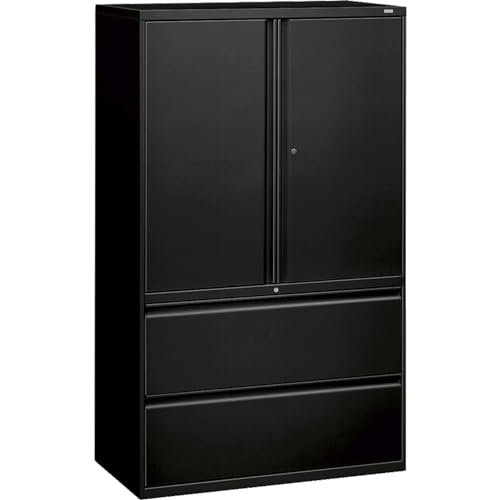
HON Brigade 800 Series Lateral File Cabinet with Storage, Letter/Legal, 2-Drawer, Black, 19 1/4" D
Chosen because it specifies Letter/Legal and 2-Drawer.
View on Amazon| Feature | Vertical Filing Cabinet (2- to 4-Drawer) | Lateral Filing Cabinet (2-Drawer) |
|---|---|---|
| Typical Footprint (W x D) | 15″ W x 25″ to 29″ D | 30″ to 42″ W x 18″ to 20″ D |
| Typical Height (2-Drawer) | 27″ to 29″ H | 27″ to 29″ H |
| Typical Height (4-Drawer Vertical vs. 2-Drawer Lateral) | 52″ to 56″ H | 27″ to 29″ H (same storage as 4-drawer vertical) |
| File Orientation | Letter files front-to-back, legal files require deeper 29″ depth | Letter and legal side-by-side in same drawer with adjustable hanging rails |
| Drawer Extension Needed | 25″ to 29″ plus your body clearance | 18″ to 20″ plus your body clearance |
| Files Per Drawer | One row, approx. 25-27 linear inches | Two rows or one wide row, approx. 30-36 linear inches |
Because lateral drawers are wider but shallower, they require less aisle space to open. For a standard office chair with a 24-inch depth, you need at least 45 to 48 inches from the wall behind your chair to the front of the cabinet to open a vertical drawer, stand, and file comfortably. A lateral cabinet reduces that to 38 to 42 inches, which is why it works better along the back wall of a shared office or under a window.
Letter vs. Legal: What Fits Side-by-Side
Almost every lateral cabinet 30 inches wide or wider includes two adjustable hanging bars per drawer. In the default position, the bars are set for letter size (11.75 inches wide per folder). Slide the bars outward and the same drawer holds legal size (14.75 inches wide) without changing cabinets.
- 30″ wide lateral: Holds 30-32 letter folders or 24-26 legal folders per drawer in a single side-by-side row.
- 36″ wide lateral: The most common shared-office size. Holds 36-40 letter folders per drawer, or 28-32 legal folders. Most models allow you to place two letter rows front-to-back if you use the included divider bars, effectively doubling capacity for letter files.
- 42″ wide lateral: Holds 42-48 letter folders per drawer. Best for departments that mix file sizes. Check drawer weight limits before loading to this density.
If you only file letter size, a 30-inch model saves 6 inches of wall space. If you file any legal contracts, real estate documents, or medical forms, choose 36 inches wide to avoid overcrowding.
Why Wide Drawers Work Better for Shared Offices
In a shared office, two people often need access to the same drawer bank at different times. A vertical cabinet creates a bottleneck: one deep drawer open blocks the aisle for everyone. A lateral cabinet’s wide, shallow drawer opens outward only 18 to 20 inches and presents all files at once, so you can scan, grab, and close without stepping into the walkway.
Wide drawers also operate at a more ergonomic height. A 2-drawer lateral at 28 to 29 inches high matches standard desk height (29 to 30 inches), so it can double as a printer stand or an extension to a desk return. You can retrieve files without bending to the floor-level drawer of a 4-drawer vertical, which reduces strain when filing multiple times per day.
Room Layout and Clearance: Will a Lateral Fit?
Lateral cabinets need wall length more than floor depth, so measure both before you buy.
- The one-drawer rule: Most lateral cabinets have an interlock that allows only one drawer open at a time for anti-tip safety. Plan for the width of one open drawer plus 24 inches of standing space in front of it.
- Doorway and hallway clearance: A 36-inch wide cabinet will not fit through a 29-inch interior doorway if shipped assembled. Flat-pack models ship in a 38″ x 22″ x 10″ box and assemble inside the room. Assembled steel models need a 32-inch doorway minimum.
- Wall space: Leave 2 inches on each side for ventilation and to avoid scraping baseboards, and 1 inch behind for the hanging bar clearance. Do not place a lateral directly against a door swing.
| Room Size | Best Lateral Size | Layout Guidance |
|---|---|---|
| 10 x 12 ft small office (2 desks) | 30″ W 2-drawer | Place on the 10-ft wall opposite the desks. Maintains a 42″ aisle for two chairs to roll back simultaneously. Leaves room for a 48″ bookcase. |
| 12 x 14 ft shared office (2-3 people) | 36″ W 2-drawer | Place on the long wall under a window. At 52″ to 54″ with two chairs pulled out, you still have a 36″ walkway to the door, meeting office code. |
| 14 x 16 ft open work area | 36″ or 42″ W 2-drawer, or two 30″ stacked side-by-side | Use as a room divider perpendicular to the wall behind desks. Anchor to wall if used as divider to prevent tip. Top can serve as a 60″ collaboration surface at standing height if you add a topper. |
What to Look for Before You Buy: Decision Criteria
1. Construction and Material
The material determines weight, noise, durability, and whether the top can be used as a work surface.
| Material | Typical Weight (36″ 2-Drawer) | Weight Limit Per Drawer | Pros | Cons |
|---|---|---|---|---|
| Steel (18-22 gauge) | 95 to 130 lbs assembled | 60 to 80 lbs | Highest durability, fire-resistant options available, smooth ball-bearing slides, best for daily high-use | Can dent, louder to close, heavier to move upstairs |
| Engineered Wood (MDF / particleboard with laminate) | 65 to 90 lbs assembled | 30 to 45 lbs | Matches home office furniture, warm look, lighter price (usually $180–$400), usable as credenza | Swells with moisture, sags if overloaded, cam-lock hardware wears faster |
| Solid Wood / Wood Veneer on Plywood | 85 to 110 lbs | 40 to 55 lbs | Most stable wood option, refinishable, holds screws better than MDF | Higher price (usually $400–$800+), can warp in unconditioned garages |
For paper storage, steel remains the most reliable. A single letter-size hanging file packed full weighs about 1.8 to 2.2 lbs. A full 36-inch drawer with 35 folders can weigh 65 to 75 lbs, which exceeds the rating of many engineered-wood drawers. If you plan to fill drawers completely, choose steel with 75-lb rated full-extension ball-bearing slides.
2. Drawer Slides and Locking
Look for full-extension slides rated for the weight above. Three-quarter extension leaves the back 6 inches of files hard to reach. A core-removable lock lets you rekey multiple cabinets alike, which matters in shared offices. Lateral cabinets should also have a built-in interlock bar that prevents a second drawer from opening to stop tip-over.
3. Levelers and Floor Protection
At 100+ lbs empty and 200+ lbs loaded, a lateral cabinet will dent vinyl plank and scratch hardwood. Choose a model with adjustable levelers rather than just plastic glides if your floor is uneven. Add a 36″ x 20″ low-pile mat underneath to spread the load.
Decision Matrix: Which Lateral Cabinet Fits Your Situation
| Your Situation | Recommended Choice | Why |
|---|---|---|
| Small apartment / home office in a bedroom corner | 30″ W, 2-drawer engineered wood lateral | Shortest wall footprint, doubles as a nightstand-height side table at 28″ H, lighter to carry up stairs in a flat-pack box (usually 55–70 lbs boxed) |
| Shared office for 2 people with mixed letter and legal | 36″ W, 2-drawer steel lateral with adjustable bars | Stores both sizes side-by-side, handles full daily use, shallow depth keeps the aisle open for two rolling chairs |
| Renter who may move in 12-24 months | 36″ W, 2-drawer steel flat-pack or light engineered wood | Flat-pack disassembles to fit in a moving van doorway; welded steel is durable but requires professional movers due to 120-lb assembled weight |
| Back pain or frequent filing | 2-drawer lateral at 28-29″ H, not a 4-drawer vertical | Eliminates bending to a 6-inch-high bottom drawer; all files are at waist-to-chest height when standing |
| Need extra work surface, kids and pets at home | 36″ W engineered wood or wood veneer with soft-close slides and lock | Flat top at desk height creates a stable surface; soft-close prevents slammed fingers; lock keeps files away from children |
Assembly, Moving and Long-Term Durability
Expect real-world logistics to influence satisfaction more than finish color.
- Box weight and assembly time: Steel flat-pack lateral cabinets usually ship in one box at 75 to 105 lbs. Engineered wood ships at 60 to 85 lbs in two boxes. Plan for 45 to 90 minutes with two people, a Phillips driver, and a 4mm Allen key. The hanging rails are the last step and are easy to install backward, so check the notch orientation before tightening.
- Moving it loaded: Never move any filing cabinet with files inside. Drawers can extend during a turn and tip the unit. Unload, lock drawers with the included transit clips, and use a furniture dolly. Steel cabinets with welded frames should be moved upright, never on their side, to keep the frame square.
- What wears first: On steel, the nylon rollers on low-cost slides flatten first, causing drawers to stick. On engineered wood, the cam-lock inserts loosen if overloaded, causing side panels to wobble. Tighten all hardware after the first 30 days as the material settles.
- Weight limits matter: If a drawer is rated 40 lbs, that is about 18 to 20 full hanging folders, not 35. Overloading bends the slide and prevents the interlock from engaging, which creates a tip hazard when another drawer is opened.
A practical test before loading: pull the empty drawer fully out and gently press down on the front edge. A rigid steel drawer with ball-bearing slides will deflect less than 1/8 inch. If it drops more than 1/4 inch, reduce the intended load.
Placement Tips for Easy Access
Set the cabinet so the most-used drawer is between 24 and 42 inches from the floor, which is comfortable reach for most seated and standing users. If you use the cabinet top for a printer, leave at least 14 inches of clearance above the printer for paper loading and keep the printer weight under the top’s rated load, often 50 to 80 lbs for wood tops. In a shared setup, position the cabinet perpendicular to natural light so glare does not hide folder labels, and leave a permanent 36-inch clear path to the exit that no open drawer can block.
Frequently Asked Questions
Can a lateral filing cabinet hold both letter and legal files at the same time?
Yes, but only in separate rows. You cannot mix sizes in the same hanging row because the rails are set to one width. In a 36-inch drawer, you can run one section with letter rails and leave the other section empty or use file dividers to create two zones if the manufacturer includes a center divider.
Is a 2-drawer lateral tall enough to use as a desk?
It is desk-height at 28 to 29 inches, but 18 to 20 inches deep is too shallow for a primary desk. It works well as a return or side extension to a 48- or 60-inch desk. Add a 20″ x 36″ topper to create a seamless L-shape.
Do I need to anchor a lateral filing cabinet to the wall?
Any 2-drawer lateral under 30 inches high is relatively stable when the interlock works, but anchoring is still recommended on carpet, uneven floors, or in homes with small children. Use the included wall anchor strap at the back top rail into a stud. It does not affect drawer function.