Our Top Picks


A gaming PC desk setup lives or dies on three things: whether the desk can physically hold your gear without flexing, whether you can reach everything without stretching, and whether the cable situation behind it makes you want to cry. Everything else — RGB, aesthetics, cup holders — is decoration on top of that foundation.
Desk size and depth
Most gaming desks sold as “gaming desks” are 55-63 inches wide and 24-29 inches deep. Depth matters more than people think. A 24-inch deep desk is fine for a single 27-inch monitor sitting on an arm, but it gets cramped fast if you’ve got a monitor stand (which eats 8-10 inches of depth on its own), a keyboard, and a mouse mat in front of it. If you’re running dual monitors or anything curved and 32+ inches, go for 30 inches of depth minimum. You lose nothing by having extra depth except floor space, whereas not having enough means your face ends up 18 inches from the screen.
Width is simpler math: measure your monitor(s) side by side, add 6 inches on each side for speakers, a mic arm, or just elbow room, and that’s your minimum width. A single ultrawide needs about 48 inches of clearance; dual 27-inch monitors need closer to 55-60.
Fixed height vs standing desk
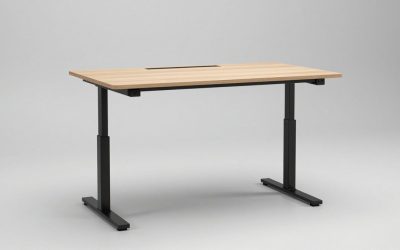
Standing desks for gaming are mostly unnecessary unless you already stand at your desk for work and game in the same spot. The electric motor adds $150-300 to the price and most people set it once and never move it again. Where a standing desk actually earns its cost is if you’re over 6’2″ or under 5’4″ — fixed-height desks are built around a 29-30 inch standard that doesn’t fit everyone, and a sit-stand desk lets you dial in the exact height instead of compensating with your chair.
If you do go electric, check the weight rating. Cheap sit-stand frames are rated for 150-200 lbs, which sounds like plenty until you add a 40 lb monitor arm setup, a PC case, and a desktop full of peripherals. Look for frames rated 220 lbs or higher if you’re running dual monitors on arms plus a tower.
Desktop material: the part people skip
This is where cheap desks fail first. Particleboard desktops under 0.75 inches thick will visibly sag in the middle within a year if you’ve got monitor arms clamped to them, because the clamp concentrates weight on a single point rather than distributing it like direct placement does. MDF with a laminate finish holds up better and is what most $150-250 desks actually use despite being marketed as “solid wood.” Actual solid wood or bamboo tops cost more but resist the sag problem entirely and feel noticeably more rigid when you lean on them while reaching for something.
If you’re using a monitor arm or want to add one later, check the desk’s clamp-mount thickness tolerance (usually 0.8-3.2 inches) before buying either piece separately.
Three price tiers compared
| Tier | Price range | What you get | Where it fails |
|---|---|---|---|
| Budget | $80-150 | Particleboard top, steel frame, basic cable tray | Sags under monitor arms, wobbles if you lean on it |
| Mid-range | $200-400 | Thicker MDF/laminate top, grommet holes, sometimes a cable management basket | Still not solid wood; motorized versions here often have weaker motors |
| Premium | $450+ | Solid wood or bamboo top, stronger motor (if standing), integrated cable channels | Diminishing returns past this unless you need extreme width/depth |
For most single-PC setups without monitor arms, the budget tier is genuinely fine. The failure mode (sagging) only shows up under concentrated load, so if everything sits flat on the desktop you’re unlikely to notice a difference versus a $400 desk.
Layout: where things actually go
Tower placement is the most common mistake. Putting the PC case under the desk directly at knee height blocks airflow and means you’re kicking it constantly. Side-mounted cases (on a shelf bracket off the desk leg) or placing the tower on the floor to the side, not underneath, both solve this. If your desk has a built-in PC shelf, check the clearance — a lot of them are sized for mid-tower cases and won’t fit anything with a front-mounted radiator.
Monitor height should put the top third of the screen at eye level, which for most people means the monitor arm or stand needs 4-6 inches of adjustment range above where it ships. This is the main reason to use a monitor arm instead of the stock stand — stock stands are rarely tall enough and eat desk depth with their base.
Cable management that actually works
Grommet holes and a basic under-desk tray handle 80% of the problem. The other 20% is power — a gaming setup easily has 6-10 things that need mains power (PC, 1-2 monitors, speakers, mic interface, charger, desk motor), and running them all to a single far-away outlet is where cable chaos actually starts. Mount a power strip to the underside of the desk itself with its own cable clip or Velcro strap, so the strip travels with the desk and you’re not routing ten cables to a strip sitting on the floor. A cable management tray mounted just behind the grommet holes keeps the power strip and the bulk of the slack contained in one place instead of spread across the floor.
For the PC itself, sleeved cable extensions are cosmetic and do nothing for cable management behind the desk — skip them unless you have a side-panel window you actually look at. A cable sleeve bundling the monitor, PC, and peripheral cables into one or two runs makes a bigger visible difference than anything branded “gaming.”
What to actually spend money on
If you’re budget constrained, put the money into desktop rigidity and depth before you put it into a motor or RGB trim. A $150 fixed-height desk with a thick top and the right depth for your monitor setup will outperform a $300 standing desk with a sagging particleboard top. Spend on the motor only if you have a real reason to change height during the day, not because it looks more premium in photos.