Our Top Picks
Pros & cons
- Four memory presets simplify switching between heights
- Aerospace-grade lifting columns aim for long-term stability
- Low-VOC materials support a healthier indoor workspace
- 48 x 24 inch top limits room for larger multi-monitor setups
- At nearly 44 pounds, assembly needs some help


Desk height matters more than most people think when they’re setting up a workspace. Get it wrong and you’ll feel it in your wrists, shoulders, and lower back within a few weeks. Get it right and you stop thinking about your desk at all, which is really the goal.
The standard number, and why it’s wrong for most people
The old-school office desk height is 29 or 30 inches. That number comes from decades-old furniture standards built around an “average” adult, which in practice meant an average adult male of average height from the mid-20th century. If you’re between 5’8″ and 6’0″, a 29-30 inch desk might work fine for typing. If you’re shorter or taller, it’s a problem waiting to happen.
The real target isn’t a fixed number, it’s elbow height when you’re seated with your shoulders relaxed and upper arms hanging straight down. Your forearms should be roughly parallel to the floor when your hands are on the keyboard. For most people that lands somewhere between 22 and 30 inches, depending on your height and your chair.
Finding your number
Sit in your actual chair with your feet flat on the floor (or on a footrest if your feet don’t reach). Let your arms hang naturally, then bend your elbows to 90 degrees. Measure the distance from the floor to the bottom of your elbow. That’s your target desk height, give or take half an inch for keyboard thickness.
A few reference points to sanity-check against:
| Height | Typical elbow height (seated) | Desk height to target |
|---|---|---|
| 5’0″ | 21-23 in | 22-24 in |
| 5’5″ | 23-25 in | 24-26 in |
| 5’10” | 25-27 in | 26-28 in |
| 6’2″ | 27-29 in | 28-30 in |
| 6’6″ | 29-31 in | 30-32 in |
These are rough bands, not gospel. Torso length, chair seat thickness, and how you like to sit all shift the number. The point of the table is to show you that a 6’2″ person and a 5’0″ person should not be using the same fixed-height desk, yet millions of them are.
Fixed height desks vs. sit-stand desks
If you’re buying new and your height is close to average (5’6″ to 5’10”), a fixed-height desk at 28-29 inches is genuinely fine. You don’t need to spend extra on adjustability just because it exists. Where fixed desks fail is households where multiple people share a desk, or anyone noticeably outside that height range who ends up compensating with a too-high or too-low chair, which then throws off their keyboard angle and shoulder position.
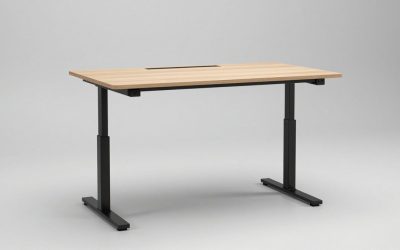
A sit-stand desk solves the height problem permanently because you dial in your own number instead of hoping the manufacturer guessed right. It also solves the second problem, which is that sitting at the “correct” height for eight hours straight still isn’t great for you. Being able to drop the desk slightly when you switch to standing (your ideal standing elbow height is a bit higher than seated, usually by 6-10 inches) matters more than people expect. If you’re shopping, electric standing desks with memory-height presets are worth the premium over hand-crank models, since you’ll actually use presets daily rather than crank a handle fifty times.
When you can’t change the desk
Renting, using a desk you already own, or stuck with a built-in counter that’s the wrong height? You have two cheaper fixes before buying a new desk.
If the desk is too low, you can’t easily raise it without risking stability, so the fix is usually chair height plus a footrest to keep your feet supported once the chair goes up. If the desk is too high, which is the more common complaint, an adjustable keyboard tray mounted under the desk lets you drop your typing surface by 2-4 inches without touching the desk itself. A keyboard tray is a $30-50 fix for a problem that would otherwise mean replacing an entire desk.
Monitor height is a separate issue people conflate with desk height. Even at the right desk height, if your monitor sits on the desk surface itself you’ll be looking down at it, which strains your neck over time. Top of the screen should be at or just below eye level. A stack of books works. A monitor stand or arm works better and frees up desk space underneath for cable management or storage.
Signs your current height is wrong
You don’t need a physical therapist to diagnose this. Watch for these over a normal work week:
- Shoulders creeping up toward your ears while typing (desk too high)
- Wrists bent upward at the keyboard rather than flat or slightly downward (desk too high)
- Leaning forward or slouching to reach the keyboard (desk too low, or chair too high relative to it)
- Numbness or tingling in your hands after long sessions (often desk height combined with poor wrist position)
- Lower back fatigue that improves when you stand up and stretch (sometimes a desk/chair mismatch rather than desk height alone)
Any one of these after a single day isn’t diagnostic. If they’re showing up most days for a couple of weeks, it’s worth the 15 minutes to re-measure your elbow height and compare it to what you’re actually working at.
Bottom line
Don’t shop by a single “correct” desk height, because there isn’t one. Measure your own elbow height, buy or adjust to that number, and treat the 28-29 inch standard as a decent default only if you’re already close to average height. The $30 keyboard tray and the $400 electric standing desk are solving the same underlying problem at very different budgets, and either one beats working for years at a height that was never built for your body.