Our Top Picks


Why an L-desk actually makes sense for gaming
An L-shaped desk isn’t just a bigger rectangle. The corner gives you a dedicated zone — usually for a secondary monitor, a laptop, or just elbow room — without pushing your main setup off center. If you’re running dual or triple monitors, streaming with a capture card and audio mixer, or just hate having your desk double as a dining table, the extra depth in the corner solves real problems. The trade-off is space: a true L-desk needs 60 inches on one leg and 48+ on the other to not feel cramped. If your room is under 10×10 feet, measure twice before you buy, because returning a 150-pound desk is its own ordeal.
Sizing: corner vs. bowed vs. reverse L
There are three real shapes sold as “L-desks.” A true 90-degree corner desk maximizes corner storage but wastes some reach — you can’t comfortably use the far corner for anything except a printer or speakers. A bowed/curved L (sometimes marketed as a “racing” or “bomber” shape) rounds that corner so your chair can swing through it, which matters if you actually use the whole desk rather than just the main monitor zone. A reverse L just mirrors the shape for left-handed setups or room layouts where the door is on the wrong side. For gaming specifically, the bowed corner is worth the extra $50-100 over a square corner because you’ll actually sit in that curve instead of avoiding it.
Materials: what holds up and what doesn’t
Most L-desks under $200 use particleboard with a laminate wrap. That’s fine for monitors and a keyboard, but it sags over 36+ inches of unsupported span if you load it with a 50-pound dual-monitor arm clamp or a heavy PC case on the desktop itself. Look for a desktop at least 1 inch thick, or add a center leg/cross brace if the kit doesn’t include one. MDF with a particleboard core is more common at the $150-300 range and resists warping better in humid rooms. Solid wood or bamboo tops show up above $300 and are genuinely sturdier, but you’re paying for the material more than any gaming-specific feature.
Fixed height vs. electric standing
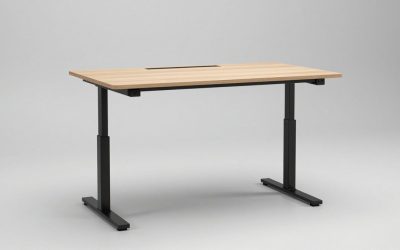
Electric sit-stand L-desks exist, but they’re expensive to do right — a dual-motor frame rated for 300+ lbs at full L-desk width runs $500-900. Cheaper single-motor units flex and wobble at full extension, especially under a 40-inch monitor’s weight plus a PC. If budget-constrained, a fixed-height desk at the correct seated height (28-30 inches, adjusted by your chair) is a better use of money than a wobbly electric one. Save the standing-desk budget for later if gaming is the primary use case — you’re sitting for most sessions anyway.
Cable management on an L-desk is harder than on a rectangle
This is the part most buying guides skip. An L-desk has a corner where cables from two directions converge — monitor cables from the back wall, PC cables from under the desk, peripheral cables crossing the surface. Without a plan, that corner turns into a knot within a week. A few things that actually work: route power separately from signal cables along each leg before they meet at the corner, use a desktop grommet at the back of the corner section specifically (not just at the edges), and mount a basic cable tray or raceway under the desk along both legs rather than one. If your desk doesn’t ship with grommets, a cable management tray that clips to the underside solves most of it for under $20.
Monitor arms change your cable routing
If you’re running a monitor arm instead of the stock stand, decide that before you buy the desk, not after. Clamp-style arms need at least 2 inches of exposed desk edge to grip, which some L-desks with wraparound edge trim don’t have. A dual monitor arm mount frees up the corner for a mic arm or a second small display, and it also means your monitor cables run up a pole instead of across the desktop, which is one less thing to manage in that busy corner zone.
Three realistic setups by budget
| Budget | Desk type | Approx. price | Best for |
|---|---|---|---|
| Under $150 | Particleboard L, fixed height | $100-150 | Single or dual monitor, light peripherals, first setup |
| $150-350 | MDF/bowed corner, reinforced legs | $180-320 | Dual/triple monitor, streaming gear, long-term use |
| $400+ | Electric dual-motor L, solid top | $500-900 | Daily long sessions, sit-stand preference, heavier gear |
The middle tier is where most people should land. The jump from particleboard to reinforced MDF matters more for long-term stability than the jump from MDF to premium hardwood. Electric adjustability is a comfort upgrade, not a performance one — don’t buy it expecting better frame rates or less eye strain, buy it because sitting all day genuinely bothers your back.
Where the PC actually goes
On an L-desk, the natural spot for a tower is under the corner or at the end of the short leg, not centered under the main monitor zone, because that’s where your feet live. Check clearance before buying: most L-desks have 24-26 inches of vertical clearance under the main leg, which fits most mid-tower cases but not full towers with extra radiator space. If you’re running a full tower with a 360mm or 420mm radiator, measure the case height first — some only clear 27+ inches, and you don’t want to find that out after assembly.