
Key takeaways
- Warranty Description: 2 Year Manufacturer
- Tension Supported: 1000 pounds
- Handle Type: Fixed Handle
A power cage lives or dies on two numbers: the wall thickness of its uprights and the square footage it steals from your floor. Everything else — the finish, the branded J-cups, the laser-cut logos — is secondary to whether the frame stops flexing when you dump 405 pounds into the safety bars and whether you can still open the garage door afterward. Eleven-gauge steel measures roughly 0.120 inches thick; fourteen-gauge is about 0.075. That difference sounds trivial on paper and feels enormous when a failed rep lands hard on the spotters.
The cages below were sorted by that pair of constraints. I looked at upright profile (2×2, 2×3, or 3×3 inches), hardware diameter, hole spacing through the bench and rack zones, and the actual outside dimensions you need to chalk on your floor before ordering. A few are built for a nine-foot basement ceiling; one folds against the wall to reclaim a parking space. Prices shift constantly, so treat the ranking as a durability-and-fit guide rather than a value snapshot.
Our top picks
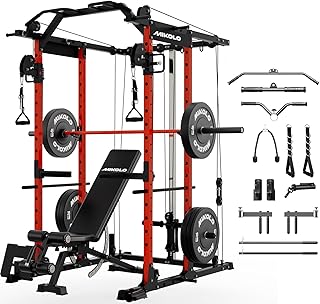
 ULTRA FUEGO Power Cage
- Warranty Description: 2 Year Manufacturer
- Tension Supported: 1000 pounds
- Handle Type: Fixed Handle

 DP01 Power Cage
- Warranty Description: 2 year
- Tension Supported: 2000 pounds
- Grip Size: Standard


As an Amazon Associate we earn from qualifying purchases at no extra cost to you.
As an Amazon Associate we earn from qualifying purchases.

Quick Comparison
| Cage | Upright / Gauge | Hardware | Approx. Footprint | Best Suited To |
|---|---|---|---|---|
| Rogue R-3 Power Rack | 2×3 in., 11-gauge | 5/8 in. | ~48 x 53 in. | Low ceilings, serious loading |
| REP Fitness PR-4000 | 3×3 in., 11-gauge | 1 in. | ~49 x 50 in. (depth configurable) | Attachment ecosystems |
| Titan T-3 Series | 2×3 in., 11-gauge | 5/8 in. | ~48 x 48 in. | Budget builds with real steel |
| PRx Profile Rack | 3×3 in., 11-gauge | 1 in. | Folds to ~6 in. deep | Shared garages |
| Force USA MyRack Modular | 2.4×2.4 in., 12-gauge | 5/8 in. | ~57 x 51 in. | All-in-one training stations |
| Titan T-2 Short | 2×2 in., 12-gauge | 5/8 in. | ~46 x 47 in. | Tight spaces, moderate loads |
How to Choose
- Match gauge to your working weight. If your heaviest squat sits under 300 pounds, 12-gauge 2×2 tubing is genuinely sufficient. Past that, or if you plan to bail bars into safeties regularly, step up to 11-gauge with 2×3 or 3×3 uprights. Thicker walls also mean less ring and vibration, which matters more than you’d expect in a finished basement.
- Measure ceiling height before anything else. Most full cages run 90 to 93 inches tall, and you need clearance to press overhead inside the frame. Short versions typically land near 72 inches, which suits an 80-inch basement but forces you to pull up outside the cage or skip the bar entirely.
- Check hole spacing in the bench range. One-inch or two-inch spacing across the lower uprights lets you dial in safety bars just above chest level. Three-inch spacing throughout is a real limitation for benching, since the difference between “catches the bar” and “pins you” can be an inch.
- Confirm hardware diameter and attachment compatibility. One-inch holes on 3×3 tubing open the door to the widest range of third-party arms, dip bars, and landmines. Five-eighths-inch systems are lighter and cheaper but lock you closer to a single manufacturer’s catalog.
- Plan the walk-around space, not just the base. Add 24 inches behind the cage for pull-through attachments and at least 36 inches in front for loading plates. A 48-inch-wide rack realistically consumes an 8-by-8-foot zone once you account for a bench, plate tree, and room to step back with a loaded bar.
Top Picks Reviewed
Rogue R-3 Power Rack — Best Overall for Low Ceilings
The R-3 has been the default answer for basement lifters for a long time, and the reason is geometry: a 30-inch depth and multiple height options, including a version that clears a 90-inch ceiling with room to spare. The 2×3 eleven-gauge uprights use 5/8-inch hardware and one-inch spacing through the bench zone, so safety bar placement is precise where it counts. Assembly is straightforward, the powder coat holds up to chalk and sweat, and the accessory list is deep enough that the cage grows with you rather than boxing you in.
REP Fitness PR-4000 — Best for Expandability
If you want one frame to eventually carry a lat pulldown, a set of jammer arms, and a weight storage system, the PR-4000’s 3×3 eleven-gauge uprights with one-inch holes are the right foundation. You can specify depth and height at order time, which lets you fit a 41-inch shallow build into a spare bedroom or run a 53-inch cage with a rear plate rail in a garage. The bolt-together build is rigid once torqued, and the included J-cups are UHMW-lined so your bar knurling survives.
Titan T-3 Series — Best Steel per Dollar
The T-3 borrows the 2×3, eleven-gauge, 5/8-inch-hardware formula and sells it for noticeably less. The tradeoffs are cosmetic and logistical: powder coat that chips more easily, hole tolerances that occasionally require persuasion during assembly, and support that runs slower. None of that affects load capacity. For a lifter who wants heavy-gauge steel and doesn’t mind a screwdriver-and-patience afternoon, it’s the strongest argument in the category.
PRx Profile Rack — Best Space Saver
This one solves a different problem entirely. Bolted into wall studs, the Profile folds to roughly six inches of depth, turning a squat station back into usable floor in about fifteen seconds. It uses 3×3 eleven-gauge uprights, so strength isn’t the compromise — mounting is. You need solid framing, a willingness to drill, and acceptance that you’re anchoring to the building. For a shared garage where a car parks nightly, nothing else comes close.
Force USA MyRack Modular — Best All-in-One
Slightly lighter tubing at 12-gauge, but the MyRack is designed as a training hub rather than a bare cage. Add-ons bolt into the frame to create a functional trainer, lat tower, dip station, and landmine, which suits someone replacing an entire gym membership in a single corner. Expect a larger footprint and a longer build day. If you’re only going to squat, bench, and press, you’re paying for capability you won’t use.
Titan T-2 Short — Best for Very Tight Rooms
At roughly 71 inches tall with 2×2 12-gauge uprights, the T-2 Short slips under ductwork and low basement joists that eliminate every full-height option. Capacity is lower and the frame moves a bit under aggressive re-racking, so bolt it down or load the base with plates. Within its limits — moderate weights, limited headroom, minimal budget — it does the job honestly.
Frequently Asked Questions
Do I need to bolt a power cage to the floor?
Not usually, if the cage is heavy-gauge and reasonably wide. Most 11-gauge cages weigh enough to stay planted. Lighter 2×2 racks and any cage used with band-resisted pulls or heavy pull-through attachments benefit from anchoring, or from loading the base rails with plates as a non-permanent alternative.
Is 3×3 tubing meaningfully better than 2×3?
For strength at home-gym loads, rarely. The real advantage is the one-inch hardware and hole pattern, which unlocks a much larger accessory market and sturdier attachment mounting. If you never plan to add arms or a pulley system, 2×3 eleven-gauge is plenty of rack.
How much room do I actually need?
Budget an 8-by-8-foot area minimum for a standard cage plus bench and loading space, with at least 90 inches of ceiling for overhead pressing inside the frame. A 7-foot barbell needs about 90 inches of lateral clearance, so check your wall-to-wall width, not just the rack width.
Can a cage replace a squat stand entirely?
Yes, and it adds a safety margin a stand can’t match. Adjustable safety bars let you train close to failure alone. The cost is footprint and setup time — stands are lighter and more portable, cages are safer and more capable.
Final Thoughts
Buy for the two constraints you can’t change: the ceiling above you and the honest weight on your bar. Low basement, heavy squats, no plans for attachments? The Rogue R-3. Building toward a complete gym with pulleys and arms? The PR-4000’s 3×3 frame and one-inch hardware. Sharing the space with a vehicle? The PRx Profile pays back its mounting hassle every single day. Tight budget but unwilling to compromise on steel? The T-3. Measure the room twice, pick the gauge that matches your ceiling for progress, and skip the features that only look good in photos.
8 Best Gym Mats for Home: Rubber vs Foam Picks for Any Floor
Best gym mat for home choices come down to material density and...
8 Best Rowers for Home Gym: Air, Magnetic and Water Compared
Best rowers for home gym shortlists usually collapse once someone measures the...
8 Best Weight Home Gyms: 6 All-in-One Machines for Small Rooms
Best weight home gym decisions come down to two numbers before brand...
8 Best Home Gym Equipment for Beginners: The Starter Setup
Best home gym equipment for beginners is not a machine – it...

Best Treadmills for Home Gym: 5 Picks by Deck and Motor
Best treadmills for home gym decisions come down to two specifications and...
8 Best Home Gym Compact Setups: 6 Space-Saving Picks Ranked
Best home gym compact claims usually quote a stored footprint and stay...

Best Adjustable Bench for Home Gym: 5 Picks Ranked by Use
Best adjustable bench for home gym decisions turn on three numbers most...
Best Cable Machine for Home Gym: 5 Picks and Pulley Ratios
Best cable machine for home gym shortlists collapse quickly once you convert...
8 Best Cable Machines for Home Gym: 5 Types and Their Limits
Best cable machines for home gym use are not one product category...
8 Best Home Gym Setups: Floors, Ceilings, Noise and Layout
Best home gym setup guides talk about equipment and skip the room,...
Write Your Review
No reviews yet. Be the first to share your experience!