
Key takeaways
- Warranty Description: 2 Year Manufacturer
- Tension Supported: 1000 pounds
- Handle Type: Fixed Handle
A power cage is one of the few pieces of home equipment that will outlive the room you put it in. That changes how you should shop. The question is not “what can I afford right now” so much as “which frame will still make sense after I add plates, a bench, and eventually a cable attachment I have not budgeted for yet.” Racks with proprietary attachment mounts and unusual hole spacing look like a bargain on day one and become a dead end in year three, when the accessory you want only exists for a different brand’s post size.
The other thing worth deciding early is what happens under the rack. Concrete garage slabs chip when a loaded bar comes off the safeties, and second-floor rooms transmit every plate clank straight into the ceiling below. Three-quarter inch rubber mats add roughly $150 to the project and change the noise profile completely. Factor that in, because a cage that leaves no money for flooring tends to get used half as often as one that does. The six racks below span that budget spectrum, from a compact frame to a full Smith-and-crossover station.
Our top picks

 ULTRA FUEGO Power Cage
- Warranty Description: 2 Year Manufacturer
- Tension Supported: 1000 pounds
- Handle Type: Fixed Handle
 DP01 Power Cage
- Warranty Description: 2 year
- Tension Supported: 2000 pounds
- Grip Size: Standard


As an Amazon Associate we earn from qualifying purchases at no extra cost to you.
Quick Comparison
| Product | Best For | Standout Feature | Watch Out For |
|---|---|---|---|
| SPORTSROYALS Power Rack | All-round home setups | Lat pulldown and low row included | Pulley ratio is not one-to-one |
| ULTRA FUEGO Power Cage | Squat and press focus | Landmine sleeve plus dip handles | Cables cost extra later |
| DP01 Power Cage | Long-term upgrade path | Two independent weight carriages | Needs a wide, deep room |
| Mikolo Power Cage | Modest budgets | Crossover in a compact frame | 1500 lb rating limits abuse |
| pooboo Power Cage Smith | Doing everything in one station | Guided Smith bar built in | Very long assembly time |
| JEEKEE Power Rack | Lowest cost per feature | 2000 lb frame at a low price | Fastener quality varies |
How to Choose
- Post dimensions: 2-by-2 inch and 2-by-3 inch uprights dominate the home market, and attachments are rarely cross-compatible. Pick the size that has the accessory ecosystem you want, because you are effectively choosing a platform, not just a rack.
- Total cost of ownership: Add flooring, a bench, and 300 lb of plates to your rack budget before you decide. A cheaper cage that leaves room for rubber mats usually produces a better gym than a premium frame on bare concrete.
- Safety system type: Pin-and-pipe safeties are cheap and loud; strap safeties are quieter and gentler on bar knurling; flip-down arms are fastest to adjust. Match the type to how often you actually train to failure.
- Assembly reality: These arrive in three to six boxes weighing 60 to 100 lb each. Confirm the delivery reaches the room, not just the driveway, and plan for two people on the overhead members regardless of what the listing claims.
- Noise and neighbours: If the rack sits above a living space, prioritise strap safeties, a Smith option, and heavy mats. Steel-on-steel pin contact is the single loudest event in a home gym.
Top Picks Reviewed
Best Overall Value: SPORTSROYALS Power Rack
This rack sits at the point where the feature list stops feeling like marketing. Cage, pull-up bar, lat pulldown and low pulley cover the majority of a well-rounded programme, and the frame is stable enough that you stop thinking about it after a week. For a first serious rack it removes most of the reasons you would need to upgrade.
Its honest weakness is the cable ratio. Because the pulley setup multiplies travel rather than load, the plate weight on the carriage does not translate one-to-one to what you feel. Plan on loading more than you expect and stop comparing numbers to a commercial machine.
Best for Free Weights: ULTRA FUEGO Power Cage
Strip a home gym back to what actually drives progress and it is barbell work. This cage is built around that: dependable J-hooks, dip handles rated for real bodyweight loading, and a landmine attachment that adds a whole category of pressing and rotational movements for very little space.
Its limitation is that the pulley system is sold separately. If you know you want cables, pricing them in now avoids the common outcome of paying more for the retrofit than the bundle would have cost.
Best Cable Setup: DP01 Power Cage
Dual independent pulleys are what separate a rack you will keep from one you will resell. Independent carriages let you run unilateral work, set asymmetric heights, and do proper crossovers, and the 2000 lb frame rating reflects genuinely heavy uprights rather than optimistic paperwork.
The catch is space. This is the deepest option here and it needs lateral clearance for the crossover arms. In a garage with a car still in it, this rack rarely works.
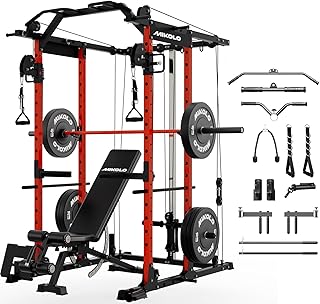
Best Compact Option: Mikolo Power Cage
For anyone converting a spare bedroom rather than a garage, Mikolo’s smaller footprint is the deciding factor. It still includes a crossover system and a lat pulldown, and the documentation is genuinely better than the category average, which matters at hour three of assembly.
The 1500 lb rating is the lowest in this group. For ninety-five percent of home lifters that is irrelevant, but it does mean lighter tubing, and it is not the rack to buy if you routinely bail heavy squats onto the safeties.
Best All-in-One: pooboo Power Cage Smith Machine
Combining a Smith carriage, a cage and a dual pulley crossover into one unit is the most floor-space-efficient way to get every training modality into a single corner. It also makes heavy pressing viable without a training partner.
Assembly is the real cost. The Smith rails must be aligned within a very small tolerance or the carriage sticks, and the total build regularly runs past five hours. Do not schedule it for the same day the boxes arrive.
Best Budget Frame: JEEKEE Power Rack
A 2000 lb cage with a working lat pulldown at the low end of the price band is a legitimate offer, and the primary steel is better than the price suggests. If the alternative is no rack at all, this is a sensible compromise.
Where the cost comes out is in the small parts — bolts, bushings and pulley hardware are inconsistent between production runs. Expect to check every fastener after the first month and be prepared to replace one or two.
Frequently Asked Questions
How much does a full home power cage setup cost?
The rack is roughly half the project. Add a bench, 300 lb of plates, a barbell and rubber flooring and the realistic total lands well above the rack price alone. Building the list before you buy prevents the common trap of an excellent cage with nothing to load it.
Is a Smith machine worth having if I also have a cage?
It is if you train alone. A Smith carriage lets you push a set to genuine failure with a simple wrist rotation as the bailout, which is difficult to replicate safely with free weights and no spotter.
Can I put a power cage on a second floor?
Structurally, usually yes — the distributed load is comparable to a bookcase and a person. Acoustically it is a different question. Rubber mats and strap safeties are essential, and dropping plates should be off the table entirely.
What size plates fit these racks?
All of these use standard two-inch Olympic sleeves for both the barbell and the storage horns. If you own one-inch standard plates, they will not fit without adapters, and adapters on a loaded rack are not a good idea.
Final Thoughts
The SPORTSROYALS Power Rack remains the most sensible default for a first full-size cage, covering barbell and cable work without demanding a garage-sized room. If you want a rack you will never outgrow and you have the floor space, the DP01 Power Cage with its dual independent pulleys is the better long-term platform. Working with a tighter budget or a smaller room, the Mikolo Power Cage delivers most of the same capability at a size and price that actually fits a spare bedroom.
Write Your Review
No reviews yet. Be the first to share your experience!