
Key takeaways
- Warranty Description: 2 Year
- Tension Supported: 264 lb
- Strap Type: Cable/Pulley straps
The single biggest reason a Smith machine ends up as a coat rack is that somebody bought it before measuring the ceiling. These are tall pieces of equipment, and the vertical clearance they demand is not the number printed on the box — it’s that number plus the height of the bar at full lockout plus your own arm extension if you press standing. A basement with joists at 7 feet and a duct running through the middle of the room is a different purchase than a two-car garage with 9-foot walls. Room size dictates the machine, not the reverse.
What follows is organized by footprint rather than by price, because that’s the constraint most people actually run into. I’ve grouped options into three buckets: attachments that bolt onto a rack you already own, standalone frames that fit in a spare bedroom or a single garage bay, and full cage-style stations that want a dedicated wall. Each entry notes what the machine gives up to fit its space, since every compact design trades away something — usually plate storage, cable stations, or the ability to bench and squat without reconfiguring.
Our top picks

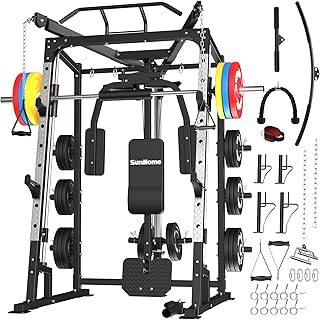
 Mikolo Smith Machine with Weight Stack
- Warranty Description: 2 Year
- Tension Supported: 264 lb
- Strap Type: Cable/Pulley straps
Dual weight stacks let two users train independently
Consolidates ten stations into one power rack footprint
2200-pound frame capacity supports heavy long-term use
128-pound stack per side caps very heavy lifters
Ten-station setup needs a dedicated home gym room
 MAJOR FITNESS Drone2 Advanced Training Smith Machines–
- All-in-One Home Gym System - The Drone2 Premium…
- Built to Last with Lifetime After-Sales Support -…
- Premium Cable System - This cable machine home…


As an Amazon Associate we earn from qualifying purchases at no extra cost to you.
Quick Comparison
| Machine | Best Room Size | Type | Notable Tradeoff |
|---|---|---|---|
| Force USA MyRack Smith Machine Attachment | Any room that already fits a rack | Bolt-on module | Requires a compatible MyRack |
| Body-Solid Powerline PSM144X | Spare bedroom, ~8 ft ceilings | Standalone vertical | No cable stack, minimal storage |
| Valor Fitness BE-11 | Narrow basement corner | Angled Smith | Fixed bar path takes adjustment |
| Marcy MD-9010G Smith Cage | Single garage bay | Cage with bench | Bench occupies the cage footprint |
| Body-Solid Series 7 GS348QP | Dedicated gym wall, 9 ft+ ceilings | Full station | Tallest and heaviest of the group |
How to Choose
- Measure vertical clearance twice. Note the lowest obstruction in the machine’s footprint — a light fixture, a garage door track, a soffit. Then add 8 to 12 inches above the machine’s listed height for overhead pressing room if you plan to press standing.
- Decide whether the bar path should be vertical or angled. Angled Smith machines feel closer to a free-weight bench press and are usually shallower front-to-back. Purely vertical machines are easier to load and to spot yourself on, and they tend to be narrower.
- Count your walk-around space. You need roughly 24 to 30 inches on at least one side to load plates and to slide a bench in and out. A machine that technically fits against the wall is useless if you can’t get to the sleeves.
- Check whether the bench is included and where it lives. Cage-style units often ship with a bench that only stows inside the frame. In a shared space, look for a bench you can wheel out or stand upright.
- Match plate storage to your plate collection. Six or eight weight horns keep the floor clear, which matters far more in a 10 by 10 room than in a garage. Storage pegs also add a few inches to the machine’s real-world width.
Top Picks Reviewed
Force USA MyRack Smith Machine Attachment
If you already own a MyRack, this is the space-efficient answer: the carriage mounts to the uprights you’re standing in front of, so your footprint grows by a few inches rather than by a whole machine. It’s the right call for anyone whose room has exactly one viable equipment wall. The obvious catch is compatibility — this only works within the Force USA modular system, and adding it means committing to that ecosystem. The bar path is vertical and the travel is smooth once the guide rods are wiped down and lightly lubricated, which the manual asks for more often than most owners actually do it.
Body-Solid Powerline PSM144X
The Powerline is the machine I’d point someone toward for a spare bedroom or a low basement. It’s a straightforward vertical Smith press with a slim frame and a modest overall height, which is precisely what you want under 8-foot joists. There’s no cable stack and no lat tower, so it presses and it squats and that’s the extent of it. In exchange you get a piece of equipment that doesn’t dominate the room and that a single person can assemble in an afternoon. Pair it with a decent adjustable bench and you have a legitimate upper-body setup.
Valor Fitness BE-11
Valor’s angled Smith machine is the pick for a long, narrow space — a basement corner or the strip along a garage side wall. The 7-degree bar path mimics a natural pressing arc, which most people find more comfortable than a strictly vertical track. Expect an adjustment period if you’re coming from a barbell; the fixed path will feel unfamiliar for a few sessions. Build quality is solid for the price, though the safety catch spacing is coarse enough that you’ll want to test your stopping points before loading heavy.
Marcy MD-9010G Smith Cage
This one earns its place in a single garage bay. You get a cage-style frame, a Smith carriage, and an included bench with a leg developer, which covers squats, presses, and accessory work without buying separate pieces. The compromise is that the bench lives inside the cage, so reconfiguring between exercises takes more shuffling than a modular setup would. Assembly is long — plan on several hours and a second set of hands for the top crossmembers.
Body-Solid Series 7 GS348QP
The Series 7 is the buy-once option, and it wants a real room. It’s the tallest and heaviest machine here, with commercial-grade uprights, generous plate storage, and a bar carriage that feels noticeably more refined under load than the budget units. In a garage with 9-foot walls or a finished basement built for the purpose, it’s the machine you stop upgrading from. In a bedroom with 7-and-a-half-foot ceilings, it simply will not go in.
Frequently Asked Questions
What ceiling height do I actually need?
Most standalone Smith machines stand between 7 and 8 feet tall. For seated and lying work, clearing the frame itself is enough. If you want to press or squat with the bar overhead, budget at least 8 feet of clearance, and closer to 9 if you’re over 6 feet tall.
Can a Smith machine replace a squat rack?
Partially. The guided bar path is excellent for controlled pressing and for training close to failure without a spotter, but it removes the stabilization demand that makes free-weight squats valuable. Cage-style units with J-hooks let you do both, which is why they’re worth the extra footprint if you have it.
Do these machines accept standard Olympic plates?
The models above use 2-inch sleeves and accept standard Olympic plates. Some budget machines use 1-inch sleeves, so verify the sleeve diameter against the plates you already own before ordering.
How much does the bar itself weigh?
Smith machine carriages vary widely — anywhere from around 15 pounds on lightweight counterbalanced units to 40 pounds or more on heavy commercial frames. Manufacturers don’t always publish this figure. Weigh the empty carriage with a luggage scale if you’re tracking loads precisely.
Final Thoughts
Start with a tape measure and a pencil, not a shopping cart. Write down your ceiling height, the width of your usable wall, and how much floor you can give up permanently, then eliminate everything that doesn’t fit. A modest vertical Smith machine that lives comfortably in your space will get used several times a week; an impressive full station wedged in at an angle with no room to load plates will get used twice. Fit first, features second.
Write Your Review
No reviews yet. Be the first to share your experience!