Our Top Picks
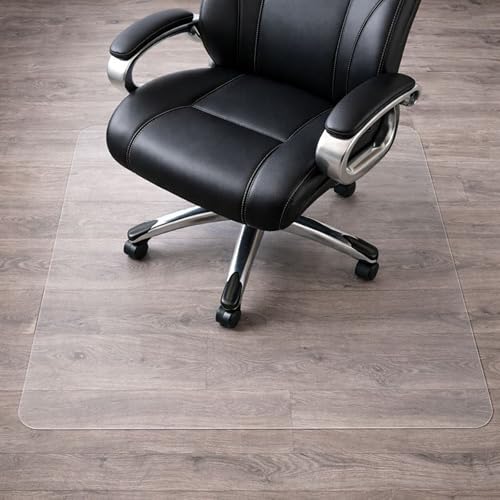 Marvelux Durable Polycarbonate Office Chair Mat for Hard36" x 48" Rolled48 x 36 x 0.08 inches4.4 poundsCheck on Amazon

If you’ve got a hardwood or tile floor and a chair with casters, you already know the problem: the chair slides when you push off it, the casters grind grit into the finish, and after a year you’ve got a scuffed track worn into the floor exactly where you roll back and forth. On carpet, it’s different but just as annoying: hard casters sink in, rolling takes effort, and the carpet fibers mat down permanently under the chair legs. A floor mat fixes both problems, but the right mat depends entirely on what’s under it, not on how nice the mat looks.
Hard floor mats vs carpet mats are not interchangeable
This is the first thing people get wrong. A mat designed for carpet has a spiked or gripped underside meant to anchor into fibers, and it’s often thinner since it doesn’t need to resist denting. A hard floor mat is thicker, smooth-backed or lightly textured, and designed to resist scratching from caster wheels while staying flat without curling at the edges. Put a carpet mat on a hard floor and it’ll slide around the room with you still sitting in the chair. Put a hard floor mat on carpet and it’ll bunch up or shift because it has nothing to grip into.
If you’re not sure which you have, go by the surface, not the chair. Laminate, engineered wood, tile, and vinyl plank all count as hard floor. Low-pile and high-pile carpet both need the carpet-specific style, though high-pile needs a thicker mat with longer grip spikes or it’ll still shift.
PVC, polycarbonate, glass, and bamboo
Most mats fall into one of four materials, and the differences actually matter for how long they last under daily rolling.
| Material | Best for | Typical lifespan | Watch out for |
|---|---|---|---|
| PVC | Budget setups, renters | 1-3 years | Off-gassing smell at first, can yellow and crack in cold rooms |
| Polycarbonate | Daily heavy use, home offices | 5-10 years | Costs 2-3x PVC, but doesn’t crack or dent |
| Tempered glass | Hard floors only, aesthetics | 10+ years | Heavy, can chip at edges if dropped, not for carpet |
| Bamboo/wood composite | Hard floors, visual warmth | 3-5 years | Casters leave visible wear marks over time, needs flat subfloor |
For most people setting up a basic computer desk, a PVC chair mat is genuinely fine. It’s cheap, replaceable, and does the job for a year or two before it curls at the corners or clouds in the middle from wheel traffic. If you’re at a desk 8+ hours a day, five days a week, the cheap PVC mats start showing wear within 6-8 months, usually as a worn patch directly under where you roll back from the desk. That’s when it’s worth stepping up to a polycarbonate chair mat, which costs more upfront but doesn’t develop that worn, cloudy patch because the material doesn’t compress the same way.
Glass mats look good and never wear out, but they’re heavy, cold underfoot, and transmit more noise when you roll the chair since there’s no give at all. I wouldn’t recommend them unless you specifically want the look and you’re on a hard floor with a flat subfloor underneath.
Size and shape matter more than material
Standard mats run around 36 x 48 inches, which is enough for most single desks, but if you have a corner desk setup or an L-shaped desk where you roll between two work surfaces, that’s too small. You’ll end up rolling off the edge constantly, which defeats the purpose and also means the mat itself shifts every day. For L-shaped or corner desks, look for the larger L-shaped mats or oversized rectangular mats in the 48 x 60 inch range or bigger. Measure your actual rolling range, not just the desk width, standing at your chair and rolling back as far as you normally would.
Thickness matters too. Hard floor mats are usually around 2mm thick. Carpet mats need to be thicker, often 3-4mm with longer grip spikes, especially for carpet pile over half an inch. If you buy a carpet mat that’s too thin for your pile height, it won’t lie flat and will curl at the edges within weeks.
When you can skip the mat entirely
If your chair has soft rubber casters instead of hard plastic ones, and you’re on a hard floor, you may not need a mat at all for floor protection, though you’ll still slide around on smooth surfaces like tile or polished wood. Soft casters are a cheap fix on their own, usually sold as replacement sets that swap onto standard chair bases. If your main complaint is sliding rather than floor damage, swapping to soft rubber casters solves it for less than a mat costs, and it’s a five-minute swap on most office chairs.
On carpet, if you’re not rolling much and your main issue is the chair legs denting the pile, a cheap PVC carpet mat or even furniture coasters under stationary legs will do more than you’d expect, no need to go premium.
A few things that actually affect how well it works
Chair mats need to sit on a clean, debris-free surface or they’ll trap grit against the floor and scratch it anyway, which defeats the purpose on hardwood. Vacuum or sweep before laying it down, and do it again every few weeks if you’re on carpet, since dust and crumbs work their way under the mat edges. On hard floors, avoid mats with a felt or fabric backing meant for carpet grip, since that backing holds moisture and can leave a faint ring on wood finishes over time if the room gets humid.