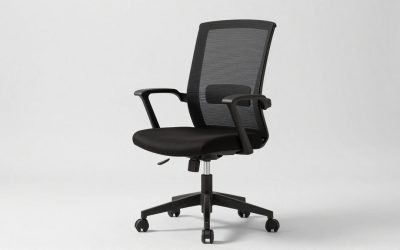
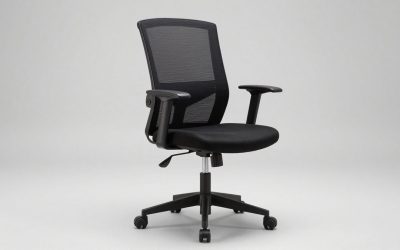
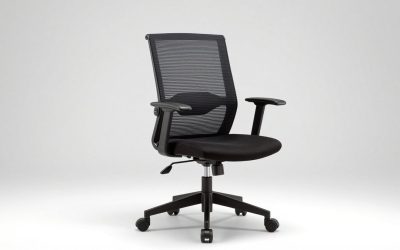
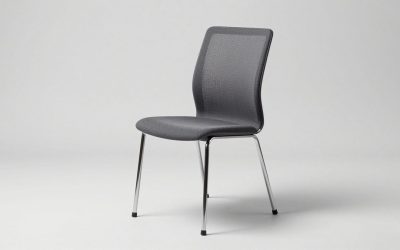
The Eurotech Vera mesh back ergonomic chair is a strong fit for daily office use if you weigh under 250 lbs, need breathable back support, and want seat-depth and arm-height adjustability in a compact, professional frame without paying for a premium-tier task chair.
Who Should Choose the Vera (and Who Should Skip It)
Based on its design and stated specifications, the Vera is built for 6-8+ hours of desk work in a home office or small business office where airflow, posture support, and a smaller footprint matter more than heavy cushioning or high weight capacity.
- Choose it if you: Run warm and want full mesh ventilation, need to fine-tune seat depth for shorter or average leg length, want height-adjustable arms to match a 29-30 inch standard desk, and prefer a mid-back profile that fits under most desks.
- Consider another option if you: Need a 300+ lb weight capacity, want 4D arms or an adjustable lumbar depth, are over 6’2″ and need a deeper seat pan, or prefer thick foam padding over a suspended mesh seat.
Mesh Tension and Back Support: How It Actually Feels
The Vera uses a tensioned elastomeric mesh back over a flexible frame, rather than a padded upholstered back. This construction does two things product listings rarely explain well: it distributes pressure more evenly across the shoulders and mid-back, and it allows passive flex when you lean or recline.
The mesh on the Vera is moderately taut, not trampoline-tight and not hammock-soft. That middle tension is intentional. Too firm and the mesh creates pressure points along the frame edges; too soft and you sag and lose lumbar contact. In this chair, the mesh provides consistent contact through the thoracic region while the built-in lumbar curve adds forward support at the lower back. The lumbar itself is fixed in height and depth, meaning the mesh tension and frame flex are doing most of the support work, not a pump or dial.
For daily office use, that means less heat buildup than foam and better breathability in summer or in rooms without strong AC. The trade-off is less plushness. If you like to sink into a cushioned backrest, mesh will feel firmer and more upright at first. If you sit with your back fully against the chair, the Vera maintains posture well; if you frequently perch forward to type, you will get less benefit from the mesh contour.
Recline and Tilt Function
The Vera uses a synchro-tilt mechanism where the back reclines at a faster rate than the seat. It includes tilt tension adjustment and a tilt lock that secures the chair in an upright position. It does not offer a multi-position back lock for reclined angles. For most desk work, you will keep it locked upright or floating with light tension so you can micro-recline during calls or reading. It is not a deep lounge recline.
Armrest and Seat Adjustments That Affect Fit
Adjustability is where the Vera justifies its place above basic mesh task chairs. Product pages list the features, but not how much range they actually give you.
- Seat height: Pneumatic lift with a range that typically accommodates a standard 29 to 30 inch desk. Average seat height range is approximately 17.5 to 21.5 inches from floor to seat pan, suitable for users from about 5’2″ to 6’0″.
- Seat depth (seat slider): About 1.5 to 2 inches of forward/backward travel. This lets you set 2-3 fingers of clearance between the front edge of the seat and the back of your knees, which is critical for circulation if you are shorter. At full extension it suits longer thighs better than most fixed-depth chairs in this price class.
- Arm height: Height-adjustable T-arms with a range of roughly 3 inches. They move up and down but do not pivot, slide forward/back, or adjust in width. You can align arm height to keep elbows at 90-100 degrees without shrugging shoulders, but you cannot narrow them for a small frame or flare them for a broad torso.
- Waterfall seat edge: The front edge curves downward to reduce pressure behind the knees, which helps during long sessions even though the seat itself is mesh over foam, not thick memory foam.
What is missing for ergonomic purists is adjustable lumbar and 4D arms. If you have diagnosed lumbar issues and need precise depth control, a chair with an adjustable lumbar system will be more adaptable.
Real Measurements: Will It Fit Your Space and Body?
The Vera is a compact mid-back chair, which matters more than it seems in a home office. Unlike large executive chairs that are 28-30 inches wide and dominate a 10×12 ft room, the Vera leaves clearance for a desk, lateral file, and walking path.
| Specification | Eurotech Vera (Approx.) | Why It Matters |
|---|---|---|
| Overall Width | 25.5 – 26 inches | Fits through standard 29-30 inch doorways without removing arms |
| Overall Depth | 25 – 26 inches | Leaves 36+ inches of walkway in a 10×12 ft room with a 60 inch desk |
| Overall Height | 37.5 – 41.5 inches | Mid-back height slides under low hutches more easily than high-backs |
| Seat Width | 20 – 20.5 inches | Adequate for most users up to ~250 lbs, narrow for broader builds |
| Seat Depth (with slider) | 18 – 19.75 inches | Adjustment range is the key fit factor for 5’2″ to 6’0″ users |
| Seat Height Range | 17.5 – 21.5 inches | Matches standard desk height with feet flat; may be low for very tall users |
| Weight Capacity | 250 lbs | Standard for light/medium-duty daily use, not heavy-duty rated |
| Base Diameter | 25 inches | Stable stance but compact enough for apartment offices and small rugs |
For desk clearance, measure from the floor to the underside of your desk. The Vera’s arms at their lowest setting are about 26 inches from the floor, so they will slide under most 29 inch desks if you need to tuck the chair fully. If your desk has a keyboard tray or apron at 26.5 inches, you will need to lower arms or remove the tuck-under expectation.
Weight Limits and Long-Term Durability for Daily Use
The Vera is rated for 250 lbs under normal 8-hour daily use. That rating applies to the gas cylinder, base, and mesh suspension together. Exceeding it does not mean immediate failure, but it accelerates wear on the cylinder and causes the seat mesh to stretch faster, leading to a hammock effect over time.
For construction context, this table explains the trade-offs you are buying into with a mesh chair at this level:
| Component | Eurotech Vera Approach | Trade-Off vs Alternatives | What Wears First |
|---|---|---|---|
| Back Material | Elastomeric mesh on flexible frame | Vs upholstered foam: cooler, more durable against compression, but less plush and lumbar is not independently adjustable | Mesh can loosen after 3-5 years of heavy daily use; frame flex may develop creak |
| Seat Material | Mesh over molded foam with waterfall edge | Vs all-mesh seat: more cushioned initially; vs thick foam: firmer and less heat retention | Front foam edge compresses, mesh can sag at sit bones |
| Base/Frame | Nylon base, plastic/composite back frame | Vs aluminum base: lighter and lower cost, but less rigid under high loads | Casters and gas cylinder show wear before frame |
| Arms | Height-only adjustable T-arms | Vs 4D arms: simpler, fewer failure points, but less custom positioning | Arm pads can peel or compress with elbow pressure |
In a home office where the same person uses the chair 40+ hours per week, expect the first signs of wear around years 2-4 to be arm pad softening and slight seat mesh stretch, especially if you frequently shift weight to one side. The mesh back itself tends to outlast a foam back because it does not permanently compress, but it can collect dust and needs occasional vacuuming to maintain tension and appearance.
Assembly, Moving and Everyday Practicality
Box weight is typically 40-45 lbs, so most people can manage it solo but a second person helps on stairs. The box dimensions usually require a 30 inch doorway to carry flat; unpacked components fit easily through any interior door. Assembly is straightforward, usually 15-25 minutes with included tools: attach casters to the base, insert the cylinder, mount the seat mechanism, and bolt the back to the seat.
No special tools are needed beyond the included Allen key, but tightening the back bolts fully is important to prevent wobble later. Once assembled, the chair weighs about 35-38 lbs, making it easy to move between rooms compared to 50+ lb executive models. The nylon casters work well on hardwood and low-pile carpet; on thick high-pile carpet or chair mats, rolling resistance increases and the relatively light weight can make the chair feel less planted when you lean.
Decision Matrix: Pick by Your Situation
Use this to match the Vera to your actual use case, rather than just feature lists:
| Your Situation | Is the Vera a Good Choice? | Consider Instead |
|---|---|---|
| Small apartment or 10×10 ft bedroom office, need to tuck chair under desk | Yes – compact footprint and mid-back height are ideal | A folding or armless task chair only if space is extremely tight |
| You run warm or office lacks AC | Yes – full mesh back is significantly cooler than bonded leather or thick fabric | An all-mesh chair if you also want a mesh seat for maximum airflow |
| 5’2″ to 5’7″ with shorter legs, need knee clearance | Yes – seat slider lets you reduce depth to avoid pressure behind knees | A petite-specific chair if slider range is still too deep |
| 6’1″ and above or over 250 lbs | No – capacity and depth/height range will feel limited | A large-and-tall rated chair with 300-350 lb capacity and deeper seat |
| Back pain requiring precise lumbar tuning | Maybe – fixed lumbar works for general support but not targeted relief | A chair with height and depth adjustable lumbar or a Steelcase Leap type design |
| Renter who moves often, needs light, easy-to-assemble chair | Yes – light weight, simple assembly, nylon base resists floor scuffs | Only avoid if you need heavy-duty durability for 10+ year static placement |
How the Vera Compares to Common Alternatives
In the general market range of usually $300 to $550, the Vera sits between basic $200-$300 mesh task chairs and premium $800+ ergonomic models. Compared to a basic task chair, you gain the seat slider and synchro-tilt, which are meaningful for fit. Compared to chairs like the HON Nucleus or higher-end Eurotech models, you lose adjustable lumbar depth and advanced arm articulation.
If your priority is breathability and a tailored seat depth in a small space, the Vera is more refined than entry mesh chairs. If your priority is full ergonomic tuning for chronic pain or shared use by multiple body types in the same household, a chair with 4D arms and an independent lumbar adjustment will adapt better between users.
Bottom Line for Daily Office Use
The Eurotech Vera mesh back ergonomic chair delivers what most daily home-office users actually need: a breathable, posture-supportive back that does not trap heat, a seat that can be shortened for proper leg clearance, and arms that adjust enough to keep wrists and shoulders neutral at a standard desk. Its limits are clear and honest: 250 lb capacity, fixed lumbar, and height-only arms. Within those limits, it is durable, space-efficient, and comfortable for long, regular workdays. Outside those limits, especially for larger users or those needing highly specific lumbar control, look to a large-and-tall or fully adjustable ergonomic category instead.