Our Top Picks
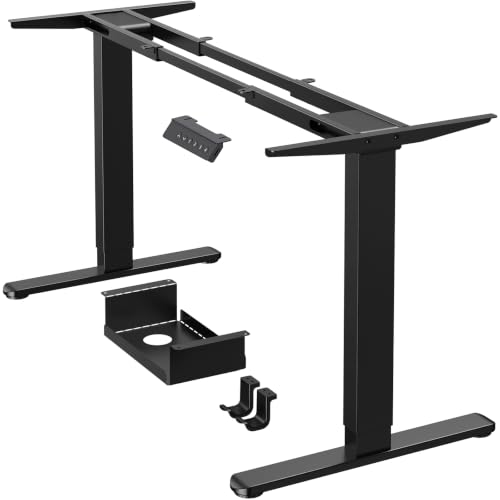


Programmers sit still longer than almost anyone else at a desk job, which sounds backwards for an article about standing desks, but it’s exactly why the desk matters more here than in most office setups. You’re not standing up to answer phones or shuffle papers. You’re standing up to stare at the same 20 lines of code for an hour, which means the desk has to be rock steady, dead silent, and set at the right height, or you’ll just sit back down and never adjust it again.
I’ve used a few different sit-stand desks over the years of doing this job, and the pattern is consistent: the desks that fail aren’t the cheap ones, they’re the ones with underpowered motors or wobbly frames at full height. A programmer’s desk setup usually carries two monitors, a mechanical keyboard, maybe a laptop dock, and a mug that’s been reheated four times. That’s 25-40 lbs of static load plus the stress of raising and lowering it daily. Cheap frames can technically hold the weight sitting still, but they shake under that load when extended to standing height, and shaking monitors while you’re trying to read a stack trace is miserable.
What actually matters for a dev setup
Three things determine whether a standing desk works for programming specifically, more than for general office use:
Height range. Most desks list a range like 28″ to 48″. If you’re over 6’2″, check the max height carefully, some budget frames top out at 45″ which isn’t enough for standing typing at a neutral wrist angle. If you’re under 5’4″, check the minimum, 28″ is still too tall for a lot of shorter users sitting with a standard chair.
Stability at full extension. This is the single biggest differentiator between a $250 desk and a $600 desk. Dual-motor frames with a crossbar or thicker steel legs resist the side-to-side wobble that single-motor or C-leg designs get at 45″+. If you type hard (a lot of programmers do, mechanical keyboards especially), wobble shows up as a slight jitter in your monitor every time you hit a key.
Weight capacity with margin. Don’t buy a desk rated for exactly what you’re carrying. A 150 lb capacity desk carrying 100 lbs of gear will feel noticeably more solid than a 175 lb capacity desk carrying the same load, because capacity ratings are measured at full height, and the margin matters more than the number people assume.
Frame types, briefly
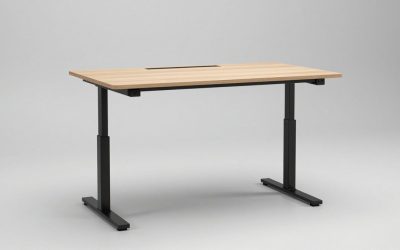
Single-motor desks adjust one leg at a time via a connecting rod, and they’re fine for lighter loads under 100 lbs, but they tend to tilt slightly during movement and are slower. Dual-motor desks move both legs independently and simultaneously, which means better stability and even leveling, especially under an asymmetric load like a monitor arm mounted off-center. If you’re running two monitors on a dual arm or a single ultrawide on a heavy mount, dual-motor is worth the premium. You can browse dual-motor standing desks to see the current range, prices typically run $300-500 for a solid one.
If your setup is a single monitor and a laptop, under 60 lbs total, a single-motor desk is genuinely fine. I’m not going to tell you to spend an extra $150 for stability you won’t notice at that load.
Comparing the realistic options
| Type | Typical price | Good for | Watch out for |
|---|---|---|---|
| Fixed-height desk + monitor riser | $0-80 | Testing if standing works for you at all | No sitting option, bad for 8hr days |
| Single-motor electric | $180-320 | Single monitor, laptop setups, light loads | Slight tilt during motion, slower lift |
| Dual-motor electric | $320-550 | Dual monitors, monitor arms, heavier gear | Price jump for stability you may not need yet |
| Manual crank/pneumatic | $150-300 | Infrequent height changes, budget-conscious | Annoying to adjust multiple times a day, discourages actually standing |
The manual options are a trap for programmers specifically. The whole point of a sit-stand desk is that you change position often through the day, every 45-90 minutes ideally. If adjusting height means cranking a handle for 30 seconds, you won’t do it, and you’ve just bought an expensive fixed desk.
Desktop material and cable chaos
Laminate desktops are fine and most desks ship with them. Bamboo and solid wood tops cost more and aren’t meaningfully better for a dev setup unless you care about aesthetics. What does matter: get a desk at least 48″ wide if you’re running two monitors, 60″ if you want room for a laptop stand next to them too. Programmers accumulate cable clutter fast, docking stations, Ethernet, two monitor cables, keyboard and mouse, maybe an audio interface. A desk without a cable tray or grommet holes turns into a mess that sways every time the desk moves. If yours doesn’t have one built in, an under-desk cable management tray solves this for about $20 and keeps cables from catching on the lift mechanism, which is a real failure mode on cheaper frames where cables snag the scissor arms.
The anti-fatigue mat is not optional
If you’re going to stand for real stretches, your feet matter as much as the desk. Standing on a hard floor for 2+ hours a day will cause foot and lower back fatigue that has nothing to do with desk quality. A basic anti-fatigue standing mat costs $30-50 and makes a bigger difference to comfort than most desk upgrades past the $350 price point.
What to actually buy
If you’re running a single monitor or a laptop, a single-motor dual-motor-adjacent desk in the $200-280 range will hold up fine for years. If you’ve got two monitors on arms, or a heavier mechanical setup, spend the extra for dual-motor stability, it’s the difference between a desk that disappears into the background and one you notice every time you stand up. Skip manual cranks entirely unless you genuinely only plan to change height once a day. And budget $50-70 beyond the desk itself for a mat and cable tray, they’re cheap fixes for the two most common complaints people have after buying a standing desk.