Why an articulating tray matters more than the keyboard on it
Most keyboard tray complaints aren’t about the keyboard. They’re about geometry. A fixed tray bolted at one height and one depth works for exactly one body position, and the moment you sit back, lean in, or raise your desk, it’s wrong. An articulating tray adds a jointed arm (usually a two-piece or four-bar linkage) under the desk so the tray can tilt, slide in and out, and sometimes rotate side to side. That’s the whole value proposition: it moves with you instead of forcing you to move to it.
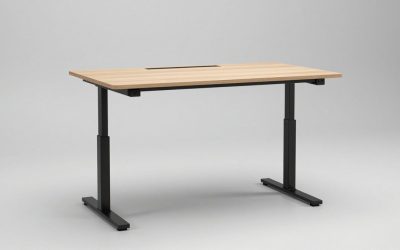
This matters more on a sit-stand desk than a fixed one. When you raise the desk to standing height, your elbow angle and wrist position change even if you don’t touch the tray. A tray that only moves up and down with the desk still leaves your wrists bent at an angle that’s fine sitting and wrong standing. The tilt and depth adjustments are what actually fix that, not the height change alone.
What to check before you buy
Three things determine whether a tray will actually work on your desk, and all three get ignored in reviews that just talk about “smooth gliding.”
Clearance underneath. Most articulating arms need 2 to 3 inches of clear space under the desktop to mount the clamp or bracket. If your desk has a center drawer, a thick apron, or a crossbar (common on cheaper electric standing desks), the arm either won’t fit or will force the tray lower than you want. Measure before ordering, not after.
Weight rating and keyboard+mouse combo. Most trays are rated 15-25 lbs, which is plenty for a keyboard and mouse, but if you’re running a mechanical keyboard with a wrist rest, a trackball, and a mousepad clamped to the same platform, check the actual rating rather than assuming “it’s a keyboard tray, of course it holds a keyboard.”
Negative tilt range. This is the number that matters most and gets buried in spec sheets. A tray that only tilts 0 to 15 degrees upward is nearly useless for wrist position — you want negative tilt, meaning the front edge drops below the back edge, so your wrists stay straight instead of cocked back. Look for at least -15 degrees of negative tilt; -20 to -25 is better if you have a history of wrist pain.
Clamp-on vs. drill-in mounting
Clamp-on trays grip the underside of the desk with a C-clamp mechanism, no screws into the desktop. Drill-in trays bolt directly to the underside, which is more rigid but permanent — not something you want on a desk you rent, resell, or share with a standing desk converter you might swap out later.
For most people on a sit-stand desk, clamp-on is the right call. It’s reversible, it works on desktops from 0.75″ to 1.5″ thick (check the clamp’s range), and it’s the style most articulating arms use anyway. The exception is if your desktop is glass, has a very thin profile, or the apron is in the way of the clamp — then you’re either drilling in or going without a tray and mounting the keyboard on the desk surface itself.
How the common tray types stack up
| Type | Articulation | Typical weight capacity | Best for | Watch out for |
|---|---|---|---|---|
| Fixed single-arm clamp tray | Height + slide only, no tilt | 15-20 lbs | Budget fix for an obviously-too-high desk | No negative tilt, wrists stay bent |
| Full articulating arm (tilt + swivel + depth) | Tilt, swivel, slide, sometimes rotate | 20-25 lbs | Anyone switching between sit and stand regularly | Needs real clearance under the desk; cheap versions sag over time |
| Platform with separate mouse tray | Varies, often tilt only | 20 lbs combined | People who want the mouse at a different angle than the keyboard | Extra joint = extra wobble if the arm is underpowered |
| Under-desk fixed shelf (no arm) | None | 10-15 lbs | Reclaiming desktop space only, not ergonomics | Don’t buy this expecting wrist relief |
The actual failure mode: sag and wobble
The complaint that shows up most in long-term reviews isn’t about missing features, it’s that the tray slowly tilts itself downward over months of use because the tension mechanism (usually a gas spring or tension knob) loosens under repeated weight. If you can retighten it yourself with a hex key, that’s a 30-second fix and not a dealbreaker. If the tension knob is sealed or hard to reach, you’re stuck re-adjusting it every few weeks or living with the drift.
Wobble is the other common issue, especially on full articulating arms with multiple joints. A little play when you type hard isn’t unusual, but if the whole tray bounces when you type, the arm is underbuilt for the weight on it or the clamp isn’t seated against something solid. Check that the clamp point is actual desk structure, not a thin edge trim or a cable management lip.
What’s actually worth buying
If you just need the keyboard lower and angled back a bit, a basic single-arm tray with negative tilt covers it, and there’s no reason to pay more. Browsing articulating keyboard trays will turn up options in the $30-60 range that handle this fine.
If you’re standing for several hours a day and have had wrist or shoulder discomfort, spend more on a tray with a real four-bar linkage arm and separate mouse platform, since independent tilt on the mouse side matters once you’re reaching across a wider range of heights. Searching keyboard trays with a mouse platform is the fastest way to compare that category directly.
And if your desk has a center drawer or thick apron blocking a standard clamp, don’t force it — look at low-profile clamp keyboard trays designed for shallower clearance before giving up on the idea entirely.
None of this requires the most expensive arm on the market. The $150 trays mostly buy you steel construction and a longer warranty, not meaningfully better ergonomics than a well-reviewed $50 one with proper negative tilt. Spend the extra money if you’re hard on hardware or plan to keep the desk for a decade; otherwise the mid-range options do the job.