Key takeaways
- Stability: two heavy pedestals act as wide feet, so double pedestal desks rarely wobble, even with tall monitor arms.
- Storage capacity: typically 4–6 drawers, including one or two letter-size file drawers.
- Separation: paperwork on one side, electronics and supplies on the other.
- Symmetry: the classic executive look works well facing into a room.
A desk with drawers on both sides, often called a double pedestal desk, needs to be at least 55 inches wide and ideally 60–72 inches to leave a comfortable knee opening of 28–30 inches between the two drawer stacks; below about 50 inches, the drawers squeeze your legs and chair arms. In return, you get balanced storage, a very stable frame and room for a file drawer on one side and supply drawers on the other.
The width math
Each drawer pedestal typically measures 14–17 inches wide. Add side panels and you can calculate the knee opening that remains:

Sauder Palladia Office Desk with Drawers, Executive Desk with File Cabinet Storage, Cable Management, Keyboard Tray, in Wind Oak Finish
Included for 'Desk With Drawers on Both Sides: Width, Legroom and Build Options' because the listing specifies Executive Desk with File Cabinet Storage and Cable Management, details this guide uses to compare options.
View on Amazon
Sauder Heritage Hill Executive Desk, Classic Cherry finish
Included for 'Desk With Drawers on Both Sides: Width, Legroom and Build Options' because the listing specifies Classic Cherry finish, details this guide uses to compare options.
View on Amazon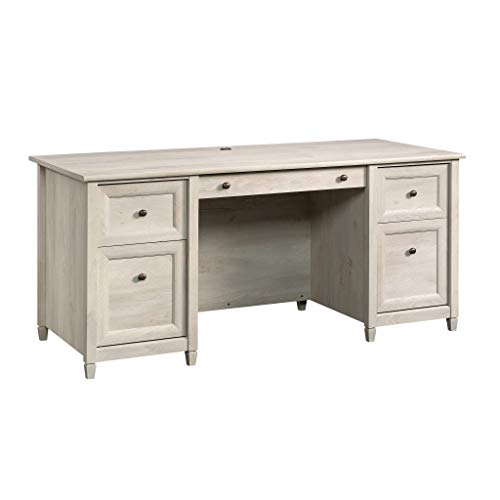
Sauder Edge Water Executive Desk, Chalked Chestnut, 65" Home Office Desk with Storage
Included for 'Desk With Drawers on Both Sides: Width, Legroom and Build Options' because the listing specifies Chalked Chestnut and 65" Home Office Desk with Storage, details this guide uses to compare options.
View on Amazon
Lorell Fortress Series Double Pedestal Desk, 60" x 30" x 29.5", Black Steel Frame with Walnut Top
Included for 'Desk With Drawers on Both Sides: Width, Legroom and Build Options' because the listing specifies 60" x 30" x 29.5" and Black Steel Frame with Walnut Top, details this guide uses to compare options.
View on Amazon| Overall desk width | Two pedestals (15 in each) | Knee opening left | Comfort verdict |
|---|---|---|---|
| 47 in | 30 in | About 15–17 in | Too narrow for most adults |
| 51 in | 30 in | About 19–21 in | Tight; armless chair needed |
| 55 in | 30 in | About 23–25 in | Minimum workable |
| 60 in | 30 in | About 28–30 in | Comfortable for most |
| 66 in | 32 in (slightly wider pedestals) | About 32 in | Roomy, fits chairs with arms |
| 72 in | 32–34 in | About 36 in | Executive size |
Many office chairs measure 25–28 inches across the armrests. If the knee opening is narrower, the chair cannot roll in fully, and you end up sitting too far from the keyboard. Measure your chair before choosing the desk.
Why choose drawers on both sides
- Stability: two heavy pedestals act as wide feet, so double pedestal desks rarely wobble, even with tall monitor arms.
- Storage capacity: typically 4–6 drawers, including one or two letter-size file drawers.
- Separation: paperwork on one side, electronics and supplies on the other.
- Symmetry: the classic executive look works well facing into a room.
The trade-offs: they are heavy, need more width and leave less room for under-desk items such as a PC tower, a footrest or a subwoofer.
Gaming and computer desks with drawers on both sides
For a computer or gaming setup, consider where the tower will go. With drawers on both sides, a PC tower (typically 8–9 inches wide and 16–19 inches tall for mid-tower cases) usually ends up in the knee opening, which takes away legroom. Better options:
- Choose a desk with an open shelf on one side in place of drawers, sized for a tower.
- Place a small-form-factor PC on the desktop.
- Mount the tower under the desk with a hanging bracket on the side nearer the pedestal, if the frame allows.
Also plan cable routing. Grommet holes near the back corners above the pedestals let cables drop straight down behind the drawers rather than across your knees.
Build options compared
| Build | Typical weight | Drawer slides | Reconfigurable? | Usual price |
|---|---|---|---|---|
| One-piece double pedestal (engineered wood) | 90–160 lb | Roller or ball-bearing | No | $250–$700 |
| Solid wood double pedestal | 150–300 lb | Wood runners or ball-bearing | No; may separate into 3 pieces | $900–$3,000+ |
| Steel office desk (all-metal) | 150–250 lb | Ball-bearing, full extension | No | $500–$1,500 |
| Tabletop + two separate drawer units (DIY) | 60–110 lb total | Varies by unit | Yes; widen or narrow anytime | $200–$500 |
The DIY approach is popular and practical: a 55–79 inch tabletop resting on two drawer units. IKEA’s ALEX drawer unit, about 14 1/8 inches wide and 27 1/2 inches tall, is a widely used base for this kind of setup. Because the tabletop is not fixed to a frame, you can move the pedestals to fit your chair, and the pieces move house separately. Make sure the drawer unit height plus tabletop thickness lands near your ideal desk height, usually 28–30 inches for adults.
White desks with drawers on both sides
White double pedestal desks keep a bulky shape from dominating a room, which matters because this style has a large visual footprint. Practical notes:
- Matte white laminate hides fingerprints better than high-gloss.
- Drawer fronts and handles collect grime first; choose recessed or metal pulls rather than white painted ones.
- Gloss white surfaces show scratches from mouse and keyboard feet; a desk pad prevents that.
- Cream or warm white pairs better with wood floors; bright white with gray or black accents.
Which configuration fits your space
| Room situation | Recommended setup |
|---|---|
| Wall of 5–6 ft in a bedroom | 55–60 in desk, slimmer 14 in pedestals |
| Dedicated home office facing a door | 60–72 in executive desk, finished back panel |
| Gaming with a full tower PC | Drawers one side, open tower bay the other |
| Renters or frequent movers | Tabletop + two separate drawer units |
| Under 55 in of wall | Single pedestal desk or rolling drawer cart |
Clearance and placement
Allow 36–42 inches behind the desk for the chair, more if it faces into the room and people walk behind. Drawers need clearance in front of them equal to their depth, usually 15–20 inches; the chair often blocks the inner drawers, so put the items you use most in the outer top drawers. A finished back panel matters if the desk faces into the room, since unfinished backs on cheaper desks are obvious from a doorway.
Assembly and moving realities
One-piece double pedestal desks in engineered wood can ship in two or three boxes totalling more than 100 pounds, with a long assembly time of two to four hours because of the many drawers. Solid wood and steel models are often delivered assembled or in three pieces (two pedestals and a top), which is the best design for doorways: a 60-inch top fits through a standard 30–32 inch doorway on its side, while a fully assembled desk may not. Empty drawers before moving, and lift by the pedestals, never by the top.