Our Top Picks
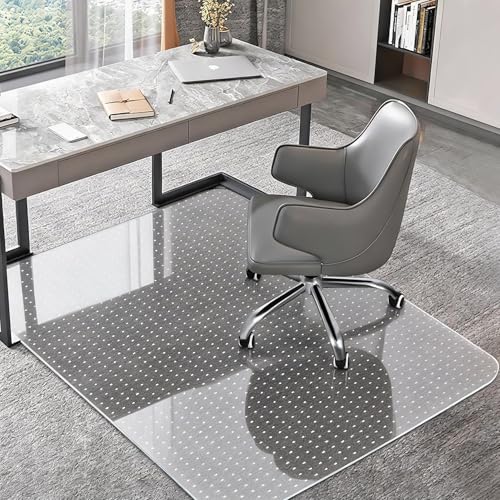 BesWin Office Chair Mat for Carpet48" X 30" Rectangle (for Carpet)48 x 30 x 0.09 inchesCheck on Amazon

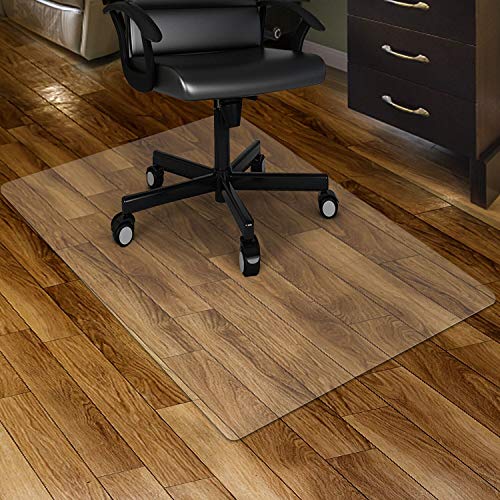
If your chair wheels are sinking into carpet, catching on fibers, or leaving a worn track across the room, a chair mat fixes it. But carpet mats are a different category from hard-floor mats, and buying the wrong one means a mat that curls up, cracks, or still lets your casters sink. Here’s what actually matters.
Why carpet mats aren’t the same as hard-floor mats
Hard-floor mats just need a smooth, grippy underside. Carpet mats need rigidity and, most importantly, cleats on the bottom. Carpet fibers are soft and compressible, so a flat-bottomed mat will slowly sink into the pile the same way your chair does without one. The cleats (small plastic spikes or nubs) grip down into the carpet backing and keep the mat from shifting or buckling.
Thickness matters too. Carpet mats are usually thicker than hard-floor mats, somewhere around 0.14 to 0.18 inches, because they need to stay rigid on top of a compressible surface. A thin mat made for hardwood will flex and crack within a few months on carpet.
Match the mat to your carpet pile height
This is the single biggest reason people end up unhappy with a chair mat. Low-pile carpet (office-grade, under about 0.25 inches) works with almost any standard carpet mat. Thick residential carpet or carpet with padding underneath needs a mat rated for medium or high pile, usually listed as suitable up to 0.75 or even 1 inch.
If you put a standard low-pile mat on thick carpet, the cleats won’t reach the backing, the mat rocks when you roll over the edges, and it wears out fast because it’s flexing instead of sitting flat. Check the pile height rating before buying, not after.
Size and shape
Measure your actual rolling area before shopping, not just the desk footprint. You want enough mat that your chair never rolls off the edge during normal use, since the carpet directly outside the mat will wear and the transition can catch casters. A reasonable rule: at least 36 inches deep from the desk edge and wide enough to cover your full side-to-side range of motion, typically 45 to 60 inches for a single desk.
Shape options:
- Rectangular – cheapest, most flexible placement, fine if your desk has an open front.
- Lipped (with a cutout) – the lip tucks under the desk so the mat doesn’t shift forward when you push back to stand up. Worth the extra cost if your desk doesn’t have a center support leg in the way.
- Oversized/rectangular for standing desks – if you have a sit-stand desk, get a mat sized for your full range so you’re not re-centering it every time you adjust height.
Material trade-offs
Three materials dominate the carpet mat market, and the differences are real, not marketing noise.
| Material | Typical cost | Pros | Cons |
|---|---|---|---|
| PVC (vinyl) | $ | Cheapest, widely available, good range of sizes | Off-gassing smell for the first week or two, can yellow over time, less durable long-term |
| Polycarbonate | $$$ | Very durable, won’t yellow, holds up under heavy daily rolling | More expensive, heavier to ship and move |
| Low-pile glass/vinyl composite | $$ | Good middle ground, decent clarity, moderate durability | Still can crack at stress points under very heavy chairs |
For a typical home office with normal use, PVC is genuinely fine. The smell fades, and most people don’t roll over the mat enough in a day for the durability gap to matter. If you’re over 250 lbs combined with chair weight, or you’re in the chair 8+ hours a day, polycarbonate earns its price by not cracking at the pivot point under your desk.
Match the mat to your caster type, not just your carpet
A mat solves half the problem if your casters are wrong for carpet in the first place. Standard hard-floor casters (hard nylon wheels) are the main reason people feel like they’re “sinking” or working hard to roll on carpet, mat or not. If you’re buying a mat anyway, it’s worth checking whether carpet-rated caster wheels would solve more of the rolling resistance than the mat alone. Soft rubber or dual-wheel carpet casters roll noticeably easier on pile carpet than the hard wheels most chairs ship with.
What to actually buy
For most home offices on standard low-to-medium pile carpet, a mid-size rectangular chair mat for carpet in the 45×53 inch range covers the job without overpaying. If your carpet has thick padding or is plush/high-pile, search specifically for a high-pile rated mat rather than assuming “chair mat” automatically covers it; many standard listings explicitly exclude thick carpet in the fine print.
If you’ve already got hardwood under part of the room and carpet under the rest (common in converted bedrooms), you want a mat rated for hard floors, not carpet, since the cleat design that grips carpet will scratch and skid on wood. In that case look for a hard floor chair mat instead and keep the carpet mat for the carpeted zone only.
Keeping it flat
New mats often arrive curled from shipping. Lay it flat, cleats down, and weight the edges with books for a day or two; most flatten out on their own without needing heat. Avoid dragging the mat when vacuuming underneath, since repeated dragging pulls cleats loose from the carpet backing faster than normal rolling wear does. If a corner starts lifting, that’s usually a sign the mat is undersized for your pile height, not a defect, worth rechecking the pile rating before buying a replacement.