Key takeaways
- Frames: powder-coated steel tubes are the backbone; they are light gauge, so stability depends on tight bolts and a level floor.
- Corner connection: the joint between main desk and return is where wobble starts. Expect some side-to-side movement when typing hard on the return of the glass versions.
- Loads: fine for a laptop, one or two monitors on their stands, speakers and a small printer. Heavy towers belong on the CPU platform or the floor, not on top.
- Keyboard slides: basic metal slides that work smoothly at first but can loosen; check their screws periodically.
Techni Mobili L-shaped desks are worth considering if you want an inexpensive corner workstation with built-in extras such as a pull-out keyboard panel, CPU platform or shelves, and you can live with a lighter-duty build; buyers who need a deep top for large monitors or a desk that survives several moves should look further up the price ladder. The brand offers its L-desks in two main styles, tempered glass on a metal frame and wood-look laminate, and picking the right one matters more than any single feature.
What Techni Mobili L-shaped desks are
Techni Mobili is a ready-to-assemble furniture brand from RTA Products, best known for budget home office desks and chairs. Its L-shaped desks cover corner computer workstations with frosted or clear tempered glass tops on steel frames, and laminate versions with storage, some paired with a hutch. Many models emphasize “workstation” features: a sliding keyboard panel, a raised monitor shelf, a lower shelf and a spot for the computer tower.
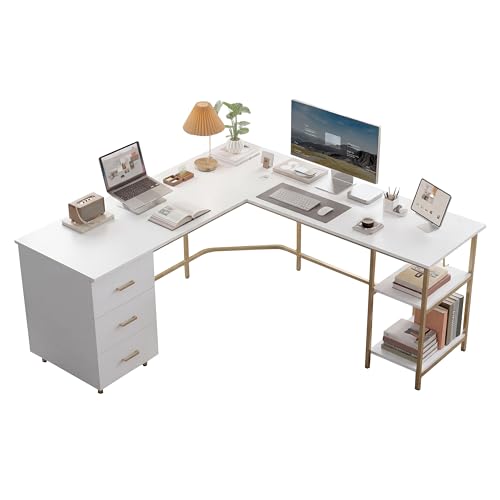
Techni Mobili 59" Two-Tone L‑Shaped Office Desk with Storage Shelves, Gold
Included for 'Techni Mobili L-Shaped Desk Review: Glass vs Laminate, Keyboard Panel Fit and Who It Suits' because the listing specifies Gold, details this guide uses to compare options.
View on Amazon
Techni Mobili L Shaped Desk with Keyboard Tray & Tempered Glass Desktop
Included for 'Techni Mobili L-Shaped Desk Review: Glass vs Laminate, Keyboard Panel Fit and Who It Suits' as a relevant option in this category; details come from the product listing.
View on Amazon
Techni Mobili L Shaped Desk - Two-Toned Computer Desks for Home Office with Storage Shelves & Cabinet - Simple Modern Furniture & Office Space Corner Table for Work & Writing - Grey & Walnut
Included for 'Techni Mobili L-Shaped Desk Review: Glass vs Laminate, Keyboard Panel Fit and Who It Suits' because the listing specifies Grey & Walnut, details this guide uses to compare options.
View on Amazon
Techni Mobili 60" L‑Shaped Office Desk with Drawers & Storage Shelves, Grey
Included for 'Techni Mobili L-Shaped Desk Review: Glass vs Laminate, Keyboard Panel Fit and Who It Suits' because the listing specifies Grey, details this guide uses to compare options.
View on AmazonThis review focuses on the L-shaped corner designs. The brand’s straight desks, such as the Classic and Contempo models, are a different category with different trade-offs.
Glass-top vs laminate: the main decision
| Factor | Tempered glass on metal frame | Laminate on particleboard/MDF |
|---|---|---|
| Typical price range | About $100–$250 | About $120–$350 (more with hutch) |
| Look | Light, airy, modern | Warmer, more furniture-like |
| Mouse use | Needs a mouse pad; some optical sensors misread glass | Works directly on the surface |
| Cleaning | Shows fingerprints and dust daily | Hides dust better, wipes clean |
| Scratch and chip risk | Edges can chip if struck; surface scratches from grit | Edge banding chips; water swelling at seams |
| Monitor arm clamp | Not recommended on glass | Possible with a reinforcement plate |
| Feel in winter | Cold on forearms | Neutral |
| Box weight (approx.) | 50–90 lb, glass packed separately | 60–120 lb |
For most people working long hours with a mouse and one or two monitors, the laminate version is the more practical buy. The glass version suits light use, small rooms where a see-through top helps the space feel bigger, and people who prefer the modern look.
Size, depth and room fit
Most Techni Mobili L-shaped desks are compact by L-desk standards, roughly 50 to 60 inches on the long side and 45 to 55 inches on the return, at the usual 29 to 30 inch height. Top depth is often around 19 to 24 inches, and the keyboard panel slides out below that.
| Room or nook | Fits a compact L-desk? | Clearance to plan |
|---|---|---|
| Bedroom corner, 9 x 10 ft | Yes | 36 in behind the chair to roll out |
| Living room corner | Yes, glass versions look lighter | 30 in walkway past the return |
| Small office, 8 x 9 ft | Yes, but tight with a door swing | Check that the door clears the return |
| Dorm or studio | Smallest models only | Measure both walls at floor and desk height |
The keyboard panel and monitor shelf: helpful or not?
A pull-out keyboard panel lowers your typing surface by roughly 2 to 3 inches, which suits many users of average height whose elbows sit below a 30 inch desktop. The catch is that it is fixed in height and tilt, and it reduces thigh clearance underneath. Measure from the floor to the underside of the panel: you need about 24 to 25 inches of clearance for most adults, more for tall users or chairs with thick cushions.
Raised monitor shelves help bring screens closer to eye level, but on shallow desks they also bring the screen closer to your face. With a 27 inch monitor, a shelf at the back of a 20 inch deep top can leave the screen less than 20 inches from your eyes, which many people find too close. Putting the main monitor in the corner, where the diagonal is deeper, usually solves that.
Build quality and load
- Frames: powder-coated steel tubes are the backbone; they are light gauge, so stability depends on tight bolts and a level floor.
- Corner connection: the joint between main desk and return is where wobble starts. Expect some side-to-side movement when typing hard on the return of the glass versions.
- Loads: fine for a laptop, one or two monitors on their stands, speakers and a small printer. Heavy towers belong on the CPU platform or the floor, not on top.
- Keyboard slides: basic metal slides that work smoothly at first but can loosen; check their screws periodically.
Assembly realities
Expect one to two and a half hours with two people, longer for laminate models with drawers or a hutch. Glass versions demand care: set glass panels on a blanket, never stand them on a corner, and tighten the glass holders evenly. For laminate models, hand-tighten screws into particleboard to avoid stripping. Assemble the desk in the room it will live in, because a fully built L-desk rarely fits through a standard door.
- Lay out all parts and hardware, matching them to the bag labels.
- Build the frame with bolts snug but not fully tight.
- Add the tops and shelves, check that everything is square, then tighten.
- Install the keyboard slides last and test that they clear your chair arms.
- Retighten all bolts after a couple of weeks of use.
Who it suits and who should skip it
| Buyer | Recommendation |
|---|---|
| Student or first home office on a tight budget | Good choice; laminate if you use a mouse a lot |
| Small apartment wanting a light look | Glass version fits visually |
| Average-height user with a fixed-height chair | Keyboard panel helps typing posture |
| Dual 27 in monitors on arms | Skip; tops are too shallow and glass can’t take clamps |
| Tall user over 6’2″ | Check knee clearance; the panel may be in the way |
| Frequent movers | Skip laminate versions that rely on cam locks |
| Homes with toddlers | Prefer laminate; glass corners and edges are a concern |
What wears first
On glass versions, the rubber pads and holders that seat the glass compress and the top starts to rattle; replacing or re-seating them fixes it. Keyboard slides loosen next. On laminate versions, the front edge banding and the area under the mouse wear first, and water spills at seams can cause permanent swelling. A desk pad and prompt cleanup go a long way.
Bottom line
A Techni Mobili L-shaped desk is a practical, low-cost way to turn a corner into a full workstation, especially the laminate models with storage. Choose glass only if appearance and a light visual footprint matter more than mouse comfort and monitor arm compatibility, and measure knee clearance under the keyboard panel before you commit.