
Key takeaways
- Allow 20 to 24 inches in front of a vertical file drawer for full extension plus your knees if you file while seated.
- Allow 36 to 42 inches in front of a lateral file drawer. Lateral drawers are wider and need more pull-out room to access files side-to-side.
- Leave 2 to 3 inches on the hinge side if the cabinet is in a closet or alcove, so the drawer frame clears baseboards and door trim.
- Keep 30 inches minimum for a primary walkway. A 15-inch wide vertical file placed along that path still leaves passage, while a 36-inch lateral file will choke it.
The best small filing cabinet for most tight rooms is a 2-drawer vertical cabinet that is 14 to 15 inches wide, 18 to 20 inches deep, and 24 to 29 inches tall, because it holds letter-size hanging files without blocking walkways while still fitting under a desk return or beside a bookcase.
If you need lateral storage or a printer stand, a 2-drawer lateral cabinet around 30 to 36 inches wide is the better compromise, but it requires more floor area and wall clearance. For home offices in 2026, rolling pedestal files and narrow vertical files save the most space without forcing you to downsize to open boxes or desktop organizers.

HON Brigade File Cabinet, 4 Drawer Filing Cabinet, Desk Storage, Black
Included for 'Best Small Filing Cabinet That Saves Space Without Losing Storage' because the listing specifies 4 Drawer Filing Cabinet and Desk Storage, details this guide uses to compare options.
View on Amazon
HON 310 Series File Cabinet, 5 Drawer Filing Cabinet, Desk Storage, Black
Included for 'Best Small Filing Cabinet That Saves Space Without Losing Storage' because the listing specifies 5 Drawer Filing Cabinet and Desk Storage, details this guide uses to compare options.
View on Amazon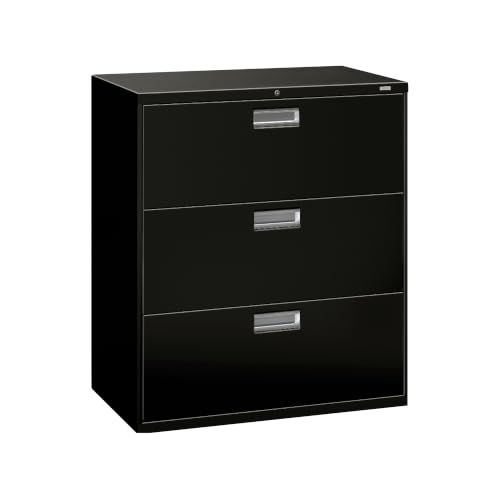
HON Brigade File Cabinet, 3 Drawer Filing Cabinet, Desk Storage, Black
Included for 'Best Small Filing Cabinet That Saves Space Without Losing Storage' because the listing specifies 3 Drawer Filing Cabinet and Desk Storage, details this guide uses to compare options.
View on Amazon
HON MOD Support Pedestal File Cabinet, 3 Storage Drawers, Mahogany
Included for 'Best Small Filing Cabinet That Saves Space Without Losing Storage' because the listing specifies 3 Storage Drawers and Mahogany, details this guide uses to compare options.
View on AmazonHow Much Space a Small Filing Cabinet Really Needs
Product specs list the cabinet footprint, but not the working clearance. You need extra space to open drawers, pull hanging files, and move a chair.
- Allow 20 to 24 inches in front of a vertical file drawer for full extension plus your knees if you file while seated.
- Allow 36 to 42 inches in front of a lateral file drawer. Lateral drawers are wider and need more pull-out room to access files side-to-side.
- Leave 2 to 3 inches on the hinge side if the cabinet is in a closet or alcove, so the drawer frame clears baseboards and door trim.
- Keep 30 inches minimum for a primary walkway. A 15-inch wide vertical file placed along that path still leaves passage, while a 36-inch lateral file will choke it.
Footprint and Storage Compared
| Type | Typical Footprint (W x D) | Height | File Capacity (Letter) | Best For |
|---|---|---|---|---|
| Rolling Pedestal File (2-drawer) | 14″ x 18″ to 15.5″ x 20″ | 26″ – 27″ | 1 hanging drawer + 1 box drawer | Under-desk use, apartments, shared desks |
| Compact Vertical File (2-drawer) | 14″ x 18″ to 15″ x 25″ | 24″ – 29″ | 2 full hanging drawers (approx. 50-60 folders per drawer) | Narrow wall, beside desk, 10×10 ft room |
| Narrow Lateral File (2-drawer) | 30″ x 18″ to 36″ x 18″ | 28″ – 52″ | 2 wide hanging drawers (approx. 80-100 folders per drawer) | Wide walls, doubles as credenza |
| Mobile Lateral Pedestal | 28″ x 18″ x 19″ | 19″ – 21″ | 1 shallow lateral drawer | Under standing desk, conference storage |
In a typical 10×12 ft home office with a 60-inch desk and a chair that needs 42 inches of push-back space, a 15×20 inch vertical file beside the desk leaves about 58 to 60 inches of open floor width on the other side. A 36-inch lateral file on the same wall leaves only 36 to 40 inches, which feels cramped once you add a trash bin or tower PC.
Rolling vs. Stationary: The Core Trade-Off for Small Spaces
Choose mobility based on whether the cabinet lives under the desk or against a wall.
Rolling Small Filing Cabinet
Rolling or mobile cabinets use four casters, two of which should lock. Overall height under 27.5 inches is critical if you want it to roll under a standard desk, which is usually 29 to 30 inches high with 25 to 26 inches of knee clearance underneath.
- Pros: Tucks away when not in use, easy to reconfigure for renters, easy to clean around, can serve as a side table or printer cart when locked.
- Cons: Limited weight capacity (usually 80 to 120 lbs total), can drift on hard floors if locks are weak, less stable for stacking items on top, may need a chair mat to roll smoothly on carpet.
- Watch for: Caster diameter. 1.5-inch casters snag on rugs; 2-inch dual-wheel casters roll better and scratch less.
Stationary Small Filing Cabinet
Stationary cabinets have levelers or fixed feet instead of casters. They are more stable and can handle heavier loads.
- Pros: Holds 150 to 250 lbs on top for a printer or scanner, no rolling when you yank a full drawer, better for vertical stacking of two units.
- Cons: You must commit to a spot, harder to move for cleaning or apartment turnover, requires precise leveling on uneven floors.
- Watch for: Anti-tip hardware. Any 2-drawer vertical file over 24 inches tall should have a wall anchor or counterweight if you have kids or will open a fully loaded drawer.
If your room is under 100 square feet or your desk moves between sitting and standing, rolling wins. If the cabinet will hold a 40-lb laser printer plus paper, choose stationary.
Drawer Glide Quality Determines Usability
Glides matter more in a small filing cabinet than in a full-size file because you access files at arm’s length and often with one hand.
- 3/4-extension ball-bearing glides: Common on budget metal and engineered wood models, usually $120–$250. Drawer opens about 75%, so folders at the back require reaching in. Supports 35 to 50 lbs per drawer.
- Full-extension ball-bearing glides: Standard on better steel files from brands like HON, Lorell, and Bush Furniture. Drawer opens 100%, so hanging bars clear the cabinet. Supports 50 to 75 lbs per drawer and feels smoother when loaded with 40+ folders.
- Full-extension with soft-close: Found on higher-end wood and metal-wood hybrids, usually $300–$600. Prevents slamming in quiet apartments and reduces wear on drawer fronts.
Test the spec, not just the feel. Look for “full extension” and “ball bearing” in the description. Friction or epoxy-coated glides wear faster and bind when a drawer holds more than 25 lbs of paper. Also check hanging rail design: integrated side rails keep letter and legal files from sagging, while add-in frames can shift and waste 1 to 2 inches of usable depth.
Weight limit tip: Paper is heavy. One fully packed letter drawer with 50 hanging folders can weigh 55 to 70 lbs. If a cabinet lists a 35-lb drawer limit, it will not handle daily office filing for long.
Material and Construction Trade-Offs
| Material | Typical Price Range | Durability | Weight and Moving | Drawbacks in Small Spaces |
|---|---|---|---|---|
| Steel (18-22 gauge) | Usually $180–$450 | Most dent-resistant, best fire resistance, handles weight | 45–75 lbs boxed; narrow to carry through 28″ doorways | Can look industrial, may need felt pads to avoid floor scratches, louder to open |
| Engineered Wood (MDF/particleboard with laminate) | Usually $120–$350 | Susceptible to swelling from moisture, cam-lock joints loosen with moves | 55–95 lbs boxed; bulky flat packs | Deeper 20″+ depth to compensate for weaker structure, sags if top holds printer long-term |
| Solid Wood / Wood Veneer on Plywood | Usually $400–$800 | Most stable joints, refinishes well, highest top-load capacity | 70–110 lbs; hardest to move up stairs | Wider footprint for same capacity, higher cost, needs humidity control |
| Metal Frame + Wood Top Hybrid | Usually $250–$550 | Strong frame with warmer look, good stability | 50–80 lbs; often ships in two boxes | Check top overhang – adds 1″ to depth and can block wall outlets |
For tight, high-use rooms, 20-gauge steel with full-extension ball-bearing glides gives the best ratio of storage to footprint. Engineered wood makes sense if you want furniture to match a desk set from Bush Furniture or IKEA and rarely move, but avoid it if you relocate often or store near an exterior wall where humidity fluctuates.
Which Small Filing Cabinet Should You Pick?
Match the cabinet to your situation, not just your style.
| Your Situation | Best Choice | Why |
|---|---|---|
| Renter in studio or 10×10 ft room, desk is 48–60″ | Rolling pedestal, 14–15″ wide | Rolls under desk to reclaim floor, fits through 24″ closet doors, no wall anchors needed |
| Home office with printer/scanner | Stationary 2-drawer vertical, steel, 25″ deep | Stable top rated for 150+ lbs, deep enough for hanging legal files |
| Kids and pets at home | Stationary vertical with interlock and anti-tip kit | Interlock prevents two drawers opening at once; anchor stops tip-over |
| Need seating plus storage | Mobile lateral pedestal, 19–21″ high | Works as bench or side table, still files letter-size sideways |
| Back pain, filing while standing | Taller 28–30″ vertical file with full extension | Less bending, full access without kneeling on floor |
| Paperless but need vital documents | 1-drawer compact vertical + open shelf | Half the footprint, shelf holds router or decor |
Assembly, Moving, and What Wears Out First
Small does not mean light. Check the shipping box weight and doorway math before buying.
- Box weight is usually 15 to 25 lbs more than assembled weight due to packaging. A steel vertical file that weighs 60 lbs assembled often ships at 75 to 85 lbs.
- Flat-pack engineered wood requires 45 to 90 minutes to assemble, plus a Phillips screwdriver and often a mallet. Pre-assembled steel files from HON or Lorell typically need only caster or handle installation in 10 to 15 minutes.
- Measure doorways and stair turns. Most interior doors are 28 to 30 inches wide. A 36-inch lateral file box will not make a tight L-shaped hallway turn even if the cabinet itself is 18 inches deep.
- What fails first: On budget models, the hanging rails bend first, then the drawer bottom sags. On all models, casters and glides wear before the shell. Replacing glides is rarely worth it on MDF furniture; on steel, replacement casters and glides are often available by model number.
- Floor protection: Add 1.5-inch felt pads under stationary files or use a low-pile chair mat under rolling files. On vinyl plank, lock casters when loaded to prevent flat spots.
For long-term durability in a small space, prioritize a welded or riveted steel case, full-extension ball-bearing glides, and a powder-coat finish over a thicker-looking but hollow engineered wood case. You will feel the difference every time you pull a drawer with one hand while holding paper in the other.
FAQ
Can a small filing cabinet hold legal-size files?
Most 18-inch deep vertical files hold letter-size only. For legal-size, you need 25-inch deep vertical cabinets or 18-inch deep lateral cabinets where files hang side-to-side. Check interior depth, not exterior depth, and confirm “letter/legal” on the hanging rail spec.
What is the standard height to fit under a desk?
Standard desk underside clearance is 25 to 26 inches. Choose a rolling file 26.5 inches tall or less to roll under without scraping. If your desk has a keyboard tray or crossbar, measure that lowest point, not the desktop height.
Do I need a fire-resistant small filing cabinet?
True fire-rated files are heavy, 2x to 3x the cost (usually $700+), and much larger. For home use, a standard steel file plus a small fireproof lockbox inside the top drawer for passports and deeds is more space-efficient.



