Our Top Picks
The best camera shoulder bags for most photographers are a 6–10 liter cross-body bag with movable dividers, a padded strap, quick top access, and enough weather protection for a short walk—not a large messenger that becomes uncomfortable when fully loaded.
Your ideal choice depends mainly on the camera kit you carry. A small mirrorless body and one compact lens suit a slim sling; a full-frame body with two or three lenses needs a deeper messenger; and a professional kit with a 70–200mm lens is usually better served by a larger shoulder bag or backpack.

K&F CONCEPT Camera Sling Bag, Everyday Shoulder Crossbody Bag
Chosen because it specifies Everyday Shoulder Crossbody Bag.
View on Amazon
RAINSMORE Camera Sling Bag Canvas Crossbody Camera Case with Rain Cover
Picked as a relevant option in this category.
View on Amazon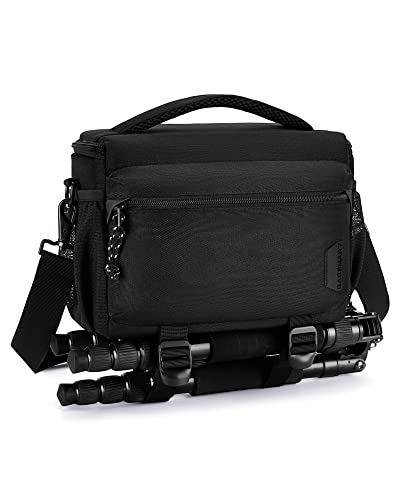
BAGSMART Camera Sling Bag with Tripod Holder & Rain Cover, Black
Chosen because it specifies Black.
View on Amazon
RAINSMORE Camera Bag, Vintage Canvas Camera Sling Bag Crossbody Camera Case
Chosen because it specifies Vintage Canvas Camera Sling Bag Crossbody Camera Case.
View on AmazonBest camera shoulder bags by shooting situation
- Best compact everyday option: Peak Design Everyday Sling 6L. It suits a small mirrorless or rangefinder body, one or two compact lenses, batteries, and personal essentials. Its curved opening gives quick access, while the internal dividers can be folded to create one larger compartment. It is less suitable for a full-frame body with a long zoom.
- Best for a larger mirrorless kit: Tenba DNA 9 or DNA 11. These messenger-style bags provide more structured camera protection than a basic sling and leave room for a tablet, notebook, or jacket. The DNA 9 is a good middle ground; the DNA 11 is preferable when carrying a full-frame body and several lenses.
- Best traditional, discreet messenger: Billingham Hadley Pro 2020. Its understated appearance does not look like a conventional camera case. The padded insert can be removed, and the waxed-canvas or synthetic-fiber construction handles everyday wear well. It favors comfort and organization over the fastest possible lens changes.
- Best for fast street access: WANDRD Rogue Sling 6L or 9L. The sling rotates from back to front without being removed, allowing access while standing. The 9L version is more practical for a camera body plus standard zoom and an additional lens, but it can feel bulky when packed with heavy glass.
- Best for a professional telephoto kit: a large shoulder messenger with a removable padded insert. Look for at least 30 cm of usable internal length and a base that remains stable when set down. A shoulder bag is quicker than a backpack for lens changes, but a backpack distributes a heavy 70–200mm setup more comfortably over a full day.
Head-to-head comparison
External dimensions are useful for judging portability, but the internal camera compartment is what determines whether your equipment actually fits. Manufacturers may measure buckles, pockets, or handles differently, so treat the figures below as practical approximate ranges rather than guaranteed clearance.
| Bag or type | Approx. external size | Useful camera capacity | Best use | Main compromise |
|---|---|---|---|---|
| Peak Design Everyday Sling 6L | Approximately 33 × 20 × 12 cm | Small mirrorless body, 1–2 compact lenses | Light travel and street photography | Limited depth for professional zooms |
| WANDRD Rogue Sling 6L | Approximately 30 × 19 × 13 cm | Mirrorless or compact full-frame body, 1–2 lenses | Fast front-of-body access | Less comfortable when heavily loaded |
| Tenba DNA 9 | Approximately 29 × 23 × 15 cm | Mirrorless or DSLR body, 2–3 lenses | Everyday messenger use | More visible and less compact than a sling |
| Tenba DNA 11 | Approximately 34 × 25 × 17 cm | Full-frame body, 3–4 lenses, tablet | Travel and event photography | Weight becomes noticeable when full |
| Billingham Hadley Pro 2020 | Approximately 35 × 25 × 13 cm | Body, several lenses, accessories | Discreet daily carry | Flap access is slower than a full-zip opening |
| Large padded messenger | Approximately 40 × 28 × 18 cm | Full-frame body, 70–200mm, 2–3 lenses | Large professional kits | Shoulder fatigue and greater bulk |
What matters more than the stated capacity
Adjustable dividers and usable clearance
Movable dividers should let you create a compartment at least 2–3 cm wider and taller than the camera body, with approximately 1–2 cm of padding clearance around the lens. That space makes it easier to remove equipment quickly and prevents a tight fit from scraping controls or lens hoods.
For a body with a mounted 24–70mm lens, measure the complete camera rather than the body alone. A bag advertised as “fits a camera and two lenses” may assume that the lens is detached. Deep, flexible dividers are particularly valuable when switching between a compact prime and a large zoom.
Access speed
A sling is generally fastest when the bag can rotate to your chest and open with one hand. A zippered top provides quicker access than a flap, but a flap is often quieter and offers better protection from light rain. Side-entry designs can be fast once adjusted correctly, although they are less convenient when the bag is sitting on a table.
For events, prioritize a wide opening and dividers that do not collapse into the center. For travel, a quieter flap and discreet exterior may matter more than saving a few seconds per lens change.
Weather protection
Water-resistant fabric and covered zippers protect against drizzle, but they are not the same as waterproof construction. Waxed canvas resists light rain and develops a distinctive patina, while coated nylon or polyester usually dries faster and weighs less. A built-in rain cover is useful for sustained rain, but it slows access and can blow loose in wind.
Check whether the base is reinforced and water-resistant. The bottom is the first part to contact wet sidewalks, dusty floors, and vehicle footwells. A bag with a padded but unprotected base may keep the camera safe from impacts while still allowing moisture to reach it.
Strap comfort and load limits
A shoulder bag weighing 2–3 kg when loaded is manageable for short outings, but carrying 4 kg on one shoulder for several hours can cause neck and back fatigue. Choose a strap at least 4–5 cm wide with a non-slip pad, and make sure its length allows the bag to rest near the opposite hip rather than directly behind the body.
A stabilizer strap is valuable for cycling, stairs, or crowded streets. It stops the bag from swinging but adds another adjustment. If you regularly carry a full-frame body, three lenses, a tablet, and a water bottle, compare the bag’s comfort with a backpack before choosing shoulder access.
Decision matrix: choose by your daily reality
| Your situation | Recommended format | Target capacity | Why |
|---|---|---|---|
| Small apartment or minimal kit | Compact sling | 4–7 L | Fits on a narrow shelf and avoids storing a large empty bag |
| Children, pets, or crowded transit | Closed-top sling with stabilizer strap | 6–9 L | Stays close to the body and reduces swinging or accidental opening |
| Rental travel and frequent walking | Light synthetic messenger | 7–11 L | Lower weight and faster drying than heavy canvas |
| Back or neck pain | Small sling or two-strap backpack | 4–8 L | Limits load; a backpack is preferable above roughly 3 kg |
| Wedding or event photographer | Structured large messenger | 10–16 L | Allows a mounted body, spare body, lenses, and batteries to remain organized |
Materials, construction, and durability trade-offs
| Construction | Advantages | Trade-offs |
|---|---|---|
| Coated nylon or polyester | Light, quick-drying, abrasion-resistant, often less expensive | Coatings can wear at folds and may feel less refined |
| Waxed canvas | Quiet, durable, discreet, attractive aging | Heavier; may transfer wax or need occasional care |
| Rigid foam-and-panel construction | Protects equipment and keeps the opening usable | Adds bulk and occupies space even when empty |
| Removable padded insert | Converts the camera bag into an ordinary messenger | Less protection if the insert is removed or poorly fitted |
The parts most likely to wear first are the strap adjuster, zipper pulls, hook-and-loop divider surfaces, and the bottom corners. Before buying, inspect whether the shoulder strap is replaceable, whether the dividers attach securely, and whether the base has stitched or molded reinforcement. A removable insert also makes cleaning easier after a dusty trip.
How to size a bag before ordering
- Measure the camera with its largest commonly mounted lens, including the lens hood reversed or extended as you normally carry it.
- Add at least 2 cm of clearance to width and height, and 3–5 cm to depth if you need quick access.
- Lay out every item on a table: body, lenses, batteries, charger, memory cards, tablet, and personal items.
- Compare that layout with the internal compartment dimensions, not the advertised liter capacity.
- Check the fully loaded weight. If the result is above about 3 kg and you walk for hours, choose a wide strap, stabilizer, or backpack.
Typical price ranges
Compact camera slings usually cost about $50–$150. Better-padded 6–10 liter slings and messenger bags generally fall between $100 and $250. Premium canvas or highly structured bags commonly range from $200 to $400, while large professional shoulder bags can exceed $400. Spending more tends to improve fabric, hardware, weather sealing, and strap design—not necessarily capacity.
Bottom line
Choose a compact sling for one camera and one or two lenses, a 9–11 liter messenger for a versatile full-frame kit, and a large shoulder bag only when rapid access outweighs the comfort of two-strap carrying. The best camera shoulder bags are not the largest ones: they provide enough clearance for your actual equipment, dividers that match your kit, weather protection appropriate to your trips, and a strap you can comfortably carry at the bag’s real loaded weight.