Key takeaways
- Side sleepers: prioritize pressure relief at the shoulder and hip, with enough underlying support to keep the spine level.
- Back sleepers: look for balanced contouring under the lumbar region and hips rather than excessive sink.
- Stomach sleepers: usually need a more supportive surface to reduce abdominal and lower-back sagging.
- Couples: consider split configurations if partners prefer different elevations or firmness levels.
What's inside
An adjustable bed can improve sleep posture, reduce pressure at the shoulders and hips, and make reading or resting more comfortable—but only when the mattress can move with the base. A mattress that is too rigid, too thick, or poorly suited to repeated bending may resist articulation, develop premature wear, or leave gaps that compromise support.
This guide explains how to choose an adjustable-bed mattress in 2026, with an emphasis on ergonomics, long-term durability, heat management, and practical compatibility. It also highlights useful configurations, including split mattresses and complete frame-and-mattress sets, so you can compare options without relying on marketing language alone.
As an Amazon Associate we earn from qualifying purchases.


Our recommended picks
🛒 Best Price Today on Amazon
Prime members get fast, free shipping on everything above, plus member-only deals. New members get a 30-day free trial — cancel anytime.
Start With Adjustable-Base Compatibility
Before comparing foam densities or coil counts, confirm that the mattress is designed for adjustable bases. It should flex repeatedly without buckling, sliding, or placing excessive force on the hinges. Most compatible mattresses are made from all-foam, latex, or flexible hybrid constructions. Always check the manufacturer’s compatibility statement, weight limits, warranty conditions, and required foundation type.
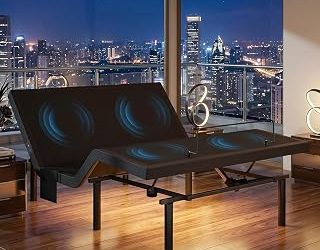
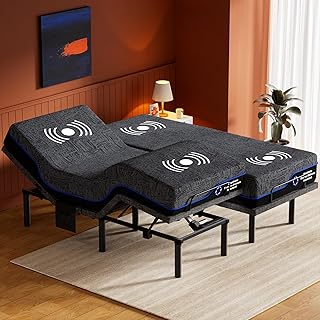
Thickness is not an automatic indicator of quality. Mattresses around 10 to 14 inches can work well, but a very tall model may feel less responsive when the head or foot section rises. A complete set such as the Amada Split King Adjustable Bed Frame and Cooling Gel Memory Foam Mattress Set simplifies compatibility because the components are selected to work together. The EGOHOME Split King Adjustable Bed Frame and 14-inch Cooling Memory Foam Mattress is another integrated option for shoppers who want coordinated controls and zero-gravity positioning.
Choose the Right Construction
Memory foam usually offers the smoothest articulation and excellent pressure distribution. It can be particularly comfortable for side sleepers, whose shoulders and hips need room to sink. Look for a supportive base layer and enough firmness to prevent the pelvis from dropping too far when the bed is elevated.
Hybrid mattresses combine foam comfort layers with individually pocketed coils. They generally provide more bounce, edge structure, and airflow than all-foam designs, although the coil unit must be flexible enough for an adjustable base. The Sleepmax Queen 14 Inch Enhanced Deep Sleep Hybrid and the Mielmoon Made in USA 10 Inch Split Queen Hybrid Memory Foam & Pocket Coil Mattress are examples of hybrid formats to investigate. The thinner Mielmoon design may be easier to articulate, while the Sleepmax offers a taller comfort profile; personal body weight and sleeping position should guide the choice.
Latex is resilient and breathable, but its springy feel is not ideal for everyone. If you prefer a buoyant surface rather than the slower response of memory foam, verify that the specific latex model is approved for powered movement.
Match Firmness to Your Body and Sleep Position
Firmness should support neutral alignment, not simply feel hard. On an adjustable bed, you may spend time on your back with the head section raised, so the mattress must support the lumbar area without forcing the lower back into an exaggerated arch. A medium to medium-firm feel is a useful starting point for many sleepers, but comfort depends on body weight, proportions, and pressure sensitivity.
- Side sleepers: prioritize pressure relief at the shoulder and hip, with enough underlying support to keep the spine level.
- Back sleepers: look for balanced contouring under the lumbar region and hips rather than excessive sink.
- Stomach sleepers: usually need a more supportive surface to reduce abdominal and lower-back sagging.
- Couples: consider split configurations if partners prefer different elevations or firmness levels.
For recreational vehicles or unusual dimensions, measure carefully. The American Made 11-inch Liberty Hybrid Cool Sleep Graphite Memory Foam Pocket Coil Mattress, listed in an RV/King size, illustrates why standard “king” terminology is not enough. Confirm the exact width, length, corner shape, and clearance around the moving mechanism.
Evaluate Durability and Heat Control
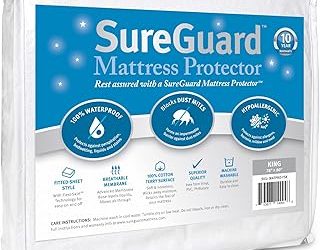
Adjustable bases create more movement than a stationary platform, so construction quality matters. Dense, resilient comfort foams are less likely to form body impressions quickly, while strong edge support helps when sitting on the side of the bed. A mattress protector can reduce wear from moisture and friction, but choose a flexible, breathable model that will not make the surface stiff.
Heat management is a system issue rather than a single-material feature. Open-cell foams, ventilated layers, pocket coils, breathable covers, and adequate bedroom airflow can all help. “Cooling” gel, graphite, or copper layers may influence the initial feel, but they cannot overcome a warm room, heavy bedding, or a mattress that allows little air exchange. The split-king sets featuring cooling memory foam and copper foam may suit warm sleepers, provided their overall comfort and support are appropriate.
Decide Between Split and One-Piece Mattresses
A split king uses two narrower mattresses, allowing each sleeper to adjust their side independently. It is often the most ergonomic choice for couples with different schedules, positions, or medical comfort needs. The trade-off is a seam in the center and the possibility of the mattresses drifting apart; a connector strap or base-specific retainer can help.
A one-piece mattress creates a more continuous sleep surface and may be simpler for solo sleepers. It can still work on an adjustable base if it is sufficiently flexible and correctly sized. Before ordering, check doorways, stairways, bedroom access, and the base’s retainer system. Bed-in-a-box models can simplify delivery, but allow the mattress to fully expand according to the manufacturer’s instructions before judging its feel.
Tips
- Measure the base, room, doorways, and mattress clearance—not just the advertised bed size.
- Test the mattress in raised positions; a surface that feels fine flat may feel unstable when inclined.
- Check the trial, return, and warranty terms, especially for impressions, sagging, and adjustable-base use.
- Use the base’s neutral or zero-gravity setting as a starting point, then make small adjustments to neck, hip, and knee angles.
Frequently Asked Questions
Can any memory-foam mattress go on an adjustable bed?
No. Many can, but compatibility depends on flexibility, thickness, weight, and the manufacturer’s warranty requirements. Confirm approval before purchase rather than assuming all memory foam will bend safely.
Is a hybrid mattress suitable for an adjustable base?
Often, yes. Choose a hybrid with individually pocketed coils and a flexible perimeter rather than a rigid connected-coil unit. The product specifications should explicitly mention adjustable-base compatibility.
Do I need a split king mattress for a split king base?
Usually, a split king base is designed for two Twin XL mattresses, but some bases support a single king mattress. Follow the base manufacturer’s instructions, and remember that a one-piece mattress will not allow fully independent left and right elevation.
How thick should an adjustable-bed mattress be?
There is no universal ideal thickness. Around 10 to 14 inches is common, but flexibility, layer design, and support matter more than the number alone. A slimmer mattress may articulate more readily, while a thicker one may provide deeper cushioning.
Conclusion
The best mattress for an adjustable bed is flexible enough to move repeatedly, supportive enough to preserve spinal alignment, and durable enough for daily repositioning. Compare construction, firmness, dimensions, heat management, and warranty terms together. Integrated sets such as Amada, EGOHOME, and other compatible split-king packages can reduce guesswork, while carefully chosen hybrid or memory-foam mattresses offer more freedom to tailor comfort to your body and sleeping habits.