The Short Answer
You need a seat depth that leaves 2 to 4 inches (5 to 10 cm) between the front edge of the cushion and the back of your knees while your lower back touches the backrest. For most adults that means a usable seat depth of 16 to 18 inches (41 to 46 cm) if you are 5 feet 2 inches to 5 feet 6 inches, 17 to 19 inches (43 to 48 cm) if you are 5 feet 7 inches to 5 feet 11 inches, and 19 to 21 inches (48 to 53 cm) if you are 6 feet or taller. Because torso and thigh proportions vary a lot at the same height, a chair with a sliding seat pan that adjusts 2 to 3 inches is the safest buy; it covers two size classes and lets you fine-tune as you change chairs, shoes, or cushions.
Standard Sizes
Seat depth is measured from the front edge of the cushion to the point where it meets the backrest, not the overall length of the seat pan. Manufacturers list either a fixed depth or an adjustable range; the table shows the common classes and the buttock-to-knee measurement each suits.
Our top picks
 ErgoSift M1 Ergonomic Office Chair with 3.1-Inch
- 3.1-INCH ADJUSTABLE SEAT DEPTH: Slide the seat forward…
- High-density molded foam balances cushioning and resilience while…
- Fine-tune the armrests for different typing and desk…
 ErgoSift Ergonomic Office Chair with Adjustable Seat
- Supportive foam cushioning helps distribute pressure across the…
- Slide the seat forward or backward to better…
- Adjust the armrests up and down, forward and…
| Product | Key specs | |
|---|---|---|
 HUANUO Ergonomic Office Chair with 6D Armrests HUANUO Ergonomic Office Chair with 6D Armrests | Check price | |
| ErgoSift M1 Ergonomic Office Chair with 3.1-Inch | 3.1-INCH ADJUSTABLE SEAT DEPTH: Slide the seat forward… High-density molded foam balances cushioning and resilience while… Fine-tune the armrests for different typing and desk… | Check price |
| ErgoSift Ergonomic Office Chair with Adjustable Seat | Supportive foam cushioning helps distribute pressure across the… Slide the seat forward or backward to better… Adjust the armrests up and down, forward and… | Check price |
 ProtoArc Flexer Ergonomic Office Chair for Women ProtoArc Flexer Ergonomic Office Chair for Women | Check price |
As an Amazon Associate we earn from qualifying purchases at no extra cost to you.
| Seat depth class | Depth | Metric | Buttock-to-knee length | Typical user height | Common on |
|---|---|---|---|---|---|
| Petite | 15 to 16.5 in | 38 to 42 cm | 18 to 20 in | 4 ft 11 in to 5 ft 4 in | Compact and “for women” task chairs |
| Small-medium | 16.5 to 17.5 in | 42 to 44 cm | 20 to 21.5 in | 5 ft 3 in to 5 ft 7 in | Most mesh task chairs under $150 |
| Medium | 17.5 to 19 in | 44 to 48 cm | 21.5 to 23 in | 5 ft 6 in to 5 ft 11 in | Standard ergonomic chairs |
| Large | 19 to 20.5 in | 48 to 52 cm | 23 to 24.5 in | 5 ft 10 in to 6 ft 3 in | Big-and-tall and executive chairs |
| Adjustable slider | 16 to 20 in range | 41 to 51 cm | 19.5 to 24 in | 5 ft 2 in to 6 ft 2 in | Mid-range ergonomic chairs |
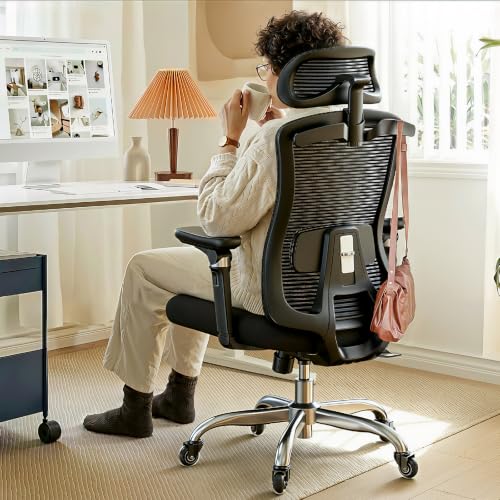
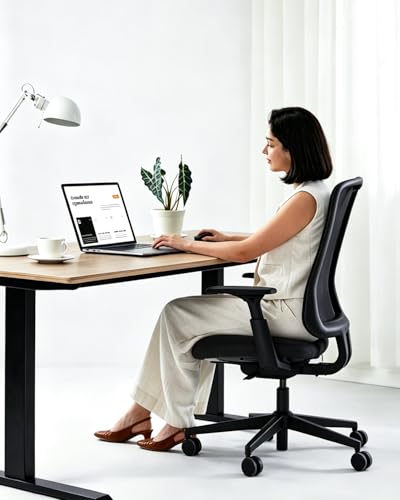
Sliding seat pans are the feature to look for. The ErgoSift M1 Ergonomic Office Chair, about $109.99, advertises a 3.1-inch adjustable seat depth, which is at the generous end of the range; its sibling, the ErgoSift Ergonomic Office Chair with Adjustable Seat Depth and 4D Armrests at about $115.99, offers the same slider. The HUANUO Ergonomic Office Chair with 6D Armrests and Lumbar Support at about $169.99 sits in the medium class, and chairs built around a shorter seat pan such as the ProtoArc Flexer Ergonomic Office Chair for Women at about $129.99 target the petite and small-medium classes. Seat width in all of these runs 19 to 21 inches, which is separate from depth and suits hips up to about 18 inches across.
How to Measure Your Space
- Sit on a firm, flat bench with your back against a wall and your feet flat, knees at 90 degrees.
- Measure buttock-to-knee length. Run a tape from the wall along your thigh to the back of your knee (the popliteal crease). Typical adults measure 19 to 25 inches.
- Subtract 2 to 4 inches. The result is your ideal seat depth. Subtract 2 if you like the seat to support most of your thigh, 4 if you prefer to move freely or have knee problems.
- Measure popliteal height. Floor to the underside of your thigh at the knee, in the shoes you wear at the desk. This is your seat height target, usually 15 to 20 inches, and confirms the chair’s height range fits too.
- Check the chair listing. Compare your number with the seat depth spec. If the listing gives only overall seat length, subtract about 1 inch for the backrest overlap.
- Test the two-finger rule when the chair arrives: with your back against the lumbar support, you should fit two to three fingers flat between the seat edge and your knee. Adjust the slider or add a lumbar cushion to close a gap that is too large.
By Room or Use Case
Users under 5 feet 4 inches
Standard chairs with 18- to 19-inch fixed seats leave shorter users perched on the front edge with no back support, which is the most common reason a “good” chair causes back pain. Look for 15.5 to 16.5 inches of depth, a seat height that goes down to 15 or 16 inches, and a slider that retracts fully. A footrest 3 to 5 inches tall rescues a chair that is slightly too deep.
Users over 6 feet
Fixed 17- to 18-inch seats end mid-thigh on long legs and shift pressure onto the sit bones. Aim for 19.5 to 21 inches of depth, a seat height range that reaches at least 21 inches, and a backrest tall enough that the lumbar pad lands at your beltline, not your ribs.
Shared chair for two people
A couple who differ by 6 inches in height cannot share a fixed-depth chair comfortably. A 2.5- to 3-inch slider covers roughly a 7-inch height difference, so both users get back support. Sliders on chairs sold in 2026 are usually a lever under the front-right of the seat and take two seconds to move.
All-day work with lumbar support
Seat depth and lumbar support are one system. If the seat is too deep you slide forward and lose the lumbar pad entirely; if it is too shallow the pad hits the wrong vertebrae. Set depth first with the two-finger gap, then move the lumbar pad up or down to sit just above your belt line.
Common Sizing Mistakes
- Choosing by height alone. Two people at 5 feet 9 inches can differ 2 inches in thigh length. Measure buttock-to-knee.
- Trusting “one size fits all.” Fixed 18-inch seats fit roughly 5 feet 7 inches to 5 feet 11 inches well and everyone else poorly.
- Ignoring the waterfall edge. A rounded front edge effectively shortens the seat by about half an inch; a squared foam edge does not.
- Confusing seat length with depth. Some listings measure the whole pan including the part hidden under the backrest, adding about an inch.
- Forgetting the slider’s minimum. An adjustable seat that only goes down to 18 inches does nothing for a petite user. Check both ends of the range.
FAQ
What is the standard seat depth on an office chair?
Most task chairs are 17 to 19 inches (43 to 48 cm) deep, sized for a user about 5 feet 7 inches to 5 feet 11 inches. Compact chairs drop to 16 inches and big-and-tall chairs reach 20 to 21 inches.
How do I know if my chair seat is too deep?
If your lower back does not reach the backrest when your knees hang naturally over the front edge, or if the edge presses into the back of your knees, the seat is too deep. You will find yourself perching forward and losing lumbar support within minutes.
Is an adjustable seat depth worth paying for?
Yes if you are outside the 5-foot-7 to 5-foot-11 window, share the chair, or have had back pain in previous chairs. It typically adds $20 to $50 to the price and is the single feature that most reliably fixes fit.
Does seat depth affect seat height?
Not directly, but they interact. A seat that is too deep pushes you forward and effectively lowers your hips, so you raise the chair to compensate and then your feet dangle. Fix depth first, then set height so your feet rest flat.