The Short Answer
For two 24-inch monitors you need a desk at least 48 inches (122 cm) wide and 24 inches (61 cm) deep. For two 27-inch monitors, 55 to 60 inches (140 to 152 cm) wide and 24 to 28 inches deep. For two 32-inch monitors, 63 to 72 inches (160 to 183 cm) wide and 28 to 30 inches deep. Those widths give the screens room to sit side by side with 2 to 4 inches to spare and leave space for a speaker or lamp at each end. Depth matters as much as width: monitors want to be 20 to 30 inches from your eyes, and a 20-inch-deep desk puts them too close unless you mount both on a monitor arm that pushes them behind the back edge.
Standard Sizes
Monitor widths below include the bezel, since that is what occupies desk space. Two identical panels side by side plus a 1-inch gap gives the minimum surface width; the recommended desk width adds room to angle the screens and keep peripherals off the edge.
Our top picks
 HUANUO FlowLift™ Dual Monitor Stand
- Compatible with Wide Screens - To ensure compatibility…
- Regarding the compatibility with desks - Your desk…
- Dual C-Clamp Hold - Worried your dual monitors…
 VIVO Dual Monitor Desk Mount
- Fits 13" to 30" Screens - Dual monitor…
- Articulation & Height Adjustment - Adjustable arm offers…
- Heavy Duty C-Clamp - Mounts to the back…
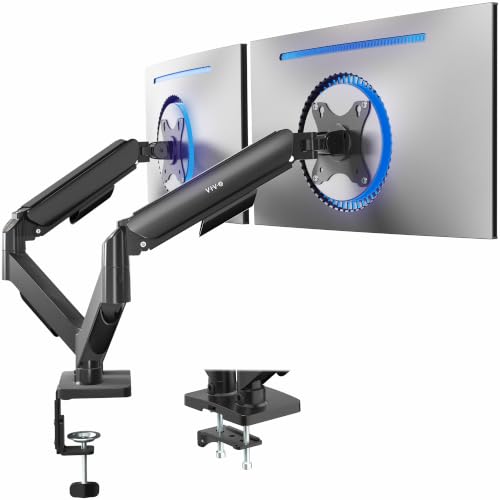 VIVO Dual Monitor Stand
- Screen Compatibility: Universally compatible with most 17-inch to…
- Mechanical Spring Adjustment: Toolless monitor placement with perfect…
- Articulation, Swivel, & Tilt: The mounting brackets offer…
| Product | Key specs | |
|---|---|---|
| HUANUO FlowLift™ Dual Monitor Stand | Compatible with Wide Screens - To ensure compatibility… Regarding the compatibility with desks - Your desk… Dual C-Clamp Hold - Worried your dual monitors… | Check price |
| VIVO Dual Monitor Desk Mount | Fits 13" to 30" Screens - Dual monitor… Articulation & Height Adjustment - Adjustable arm offers… Heavy Duty C-Clamp - Mounts to the back… | Check price |
| VIVO Dual Monitor Stand | Screen Compatibility: Universally compatible with most 17-inch to… Mechanical Spring Adjustment: Toolless monitor placement with perfect… Articulation, Swivel, & Tilt: The mounting brackets offer… | Check price |
 Philips 24 Inch Computer Monitor FHD 100Hz Philips 24 Inch Computer Monitor FHD 100Hz | Check price |
As an Amazon Associate we earn from qualifying purchases at no extra cost to you.
| Monitor pair | Combined screen width | Minimum desk width | Recommended desk | Metric (recommended) | Viewing distance |
|---|---|---|---|---|---|
| 2 x 22 in | 40 in (102 cm) | 44 in | 47 to 48 x 24 in | 120 to 122 x 61 cm | 20 to 24 in |
| 2 x 24 in | 43 in (109 cm) | 48 in | 48 to 55 x 24 in | 122 to 140 x 61 cm | 22 to 26 in |
| 2 x 27 in | 49 in (124 cm) | 55 in | 55 to 60 x 24 to 28 in | 140 to 152 x 61 to 71 cm | 24 to 30 in |
| 2 x 32 in | 57 in (145 cm) | 63 in | 63 to 72 x 28 to 30 in | 160 to 183 x 71 to 76 cm | 28 to 36 in |
| 27 in + 24 in vertical | 38 in (97 cm) | 44 in | 48 x 24 in | 122 x 61 cm | 24 to 28 in |
| 1 x 34 in ultrawide | 32 in (81 cm) | 40 in | 48 x 24 in | 122 x 61 cm | 26 to 32 in |
A dual monitor arm changes the math. Clamping a stand such as the VIVO Dual Monitor Desk Mount STAND-V002, about $34.99 for screens up to 30 inches and 22 pounds each, or the HUANUO FlowLift Dual Monitor Stand, about $59.99 for 13- to 32-inch screens at 4.4 to 19.8 pounds per arm, lifts the panels off their stands and lets them hang 2 to 4 inches behind the rear edge of the desk. That recovers roughly 8 inches of usable depth and lets a 22-inch-deep desk hold 27-inch monitors comfortably. Budget 24-inch panels such as the Philips 24 Inch 241V8LB at about $74.99 weigh roughly 6 to 8 pounds each, well inside any arm’s rating.
How to Measure Your Space
- Measure your monitors, not their spec sheet. Screen size is the diagonal. Measure the actual bezel-to-bezel width of each panel; a “27-inch” monitor is about 24 to 24.5 inches wide.
- Add them together plus 1 inch. That is the minimum flat surface the screens occupy when butted together. Add 4 to 8 inches for angling and peripherals to get your target desk width.
- Measure the wall or floor space. Corner to obstruction, minus 2 inches. If the room cannot take your target width, plan on a monitor arm or one screen in portrait to shrink the footprint.
- Set your viewing distance. Sit in your chair with elbows at 90 degrees and measure from your eyes to where the screens will stand. You want 20 to 30 inches for 24- to 27-inch panels. That number minus about 4 inches for the stand foot is the desk depth you need.
- Check the desk edge for clamps. A monitor arm needs 2 to 3.5 inches of flat, solid edge at the back and at least 0.75 inch of top thickness. Desks with a rear lip, cable tray, or modesty panel may need a grommet mount instead.
- Confirm the load. Two 27-inch monitors, an arm, a keyboard, and a laptop total 40 to 50 pounds; fine for any fixed desk, but closer to the limit of a 110-pound single-motor standing desk than it looks.
By Room or Use Case
Small bedroom or apartment office
A 48 by 24 inch desk with two 24-inch monitors on a dual arm is the most surface you can get from a room 8 to 9 feet wide. The arm keeps the desk clear for a notebook and pushes the screens back so 24 inches of depth is enough.
Dedicated home office
Go to 60 by 28 or 60 by 30 inches and run two 27-inch panels. The extra depth lets you keep the monitors on their factory stands at a proper distance, and 60 inches leaves 5 inches per side for speakers or a lamp.
Gaming or trading setup
Two 32-inch or three 27-inch panels need 66 to 72 inches of width and 30 inches of depth. Look for a top rated at least 150 pounds if a tower sits on it, and a rear edge without a lip so triple arms can clamp anywhere.
Standing desk with dual monitors
Match the width rules above but check the frame rating and the wobble. Dual-motor frames at 48 to 60 inches wide carry 220 to 265 pounds and stay steady at 45 inches; single-motor frames at 110 to 176 pounds work for two 24-inch panels but sway noticeably with two 27s on arms.
Common Sizing Mistakes
- Using the diagonal as the width. Two 27-inch monitors are about 49 inches wide together, not 54. Measure the bezel.
- Ignoring depth. A 60-inch-wide desk that is 20 inches deep puts 27-inch screens about 16 inches from your face on their stock stands.
- Forgetting the stand feet. Factory stands are 8 to 10 inches deep and often wider than the panel at the base; two of them eat the middle of a narrow desk.
- Buying a desk with a rear lip or hutch. It blocks the clamp on most arms. Check for at least 3 inches of flat, open back edge.
- Choosing arms below the monitor weight. Most 27-inch panels weigh 9 to 15 pounds without stand; 32-inch panels 12 to 20 pounds. Match the per-arm rating with margin.
- Ignoring the wall behind. Arms hang monitors 2 to 4 inches past the back edge; a desk pushed flush to the wall needs to move out that far.
FAQ
Is a 48-inch desk big enough for two monitors?
Yes for two 24-inch or smaller monitors, and for a 27-inch plus a 24-inch in portrait. Two 27-inch panels technically fit on 48 inches if they touch, but you lose all side space; 55 inches is the comfortable minimum for that pair.
How deep should a desk be for dual monitors?
24 inches (61 cm) for 24-inch monitors and 28 to 30 inches for 27- to 32-inch panels on their own stands. A dual monitor arm cuts those needs by about 4 to 6 inches by hanging the screens behind the rear edge.
Do I need a monitor arm for a dual monitor desk?
Not strictly, but it is the cheapest way to make a small desk work. A $35 to $60 dual arm frees 8 to 10 inches of depth and 200 to 300 square inches of surface that two factory stands would occupy.
What about a 60-inch L-shaped desk for dual monitors?
Put both screens on the long 60-inch wing and treat the return as storage or laptop space. Splitting monitors across the corner forces you to turn your head constantly. In 2026, corner-mounted dual arms exist for that layout, but a straight run is easier on your neck.