Standing desk height range is the spec that quietly decides whether the desk works for your body, and it is the one most buyers never check. The listing says “height adjustable,” the photos show someone standing comfortably, and the buyer assumes it will fit. Then a 6’3″ user finds the desk tops out at 46 inches, three inches below where his elbows sit, and a 5’2″ user discovers the lowest setting is 29 inches, too high for her to type seated without a footrest. The desk is adjustable, just not to the heights those two people need.
The second mistake is forgetting the desktop. Frames are specified by the height of the frame, and a 1 inch top adds an inch. The third is ignoring what sits on the desk: a keyboard tray subtracts 2 to 3 inches from the effective height, and a thick anti-fatigue mat adds 0.75 to 1 inch to your standing height. This guide gives the target heights by user height, the ranges that common desk classes actually offer, and how to check the numbers before you buy.
Our top picks
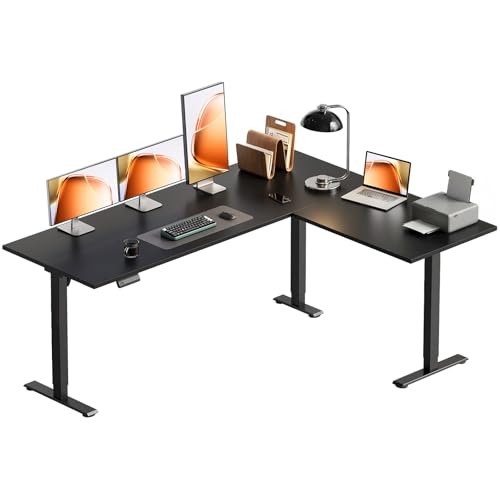
 ErGear 48 X 24 Inch Height Adjustable
Four memory presets simplify switching between heights
Aerospace-grade lifting columns aim for long-term stability
Low-VOC materials support a healthier indoor workspace
48 x 24 inch top limits room for larger multi-monitor setups
At nearly 44 pounds, assembly needs some help
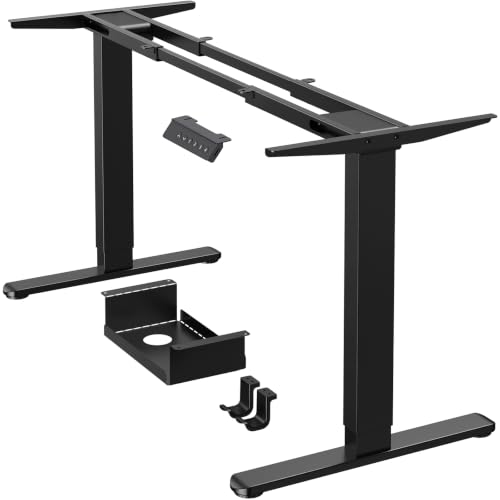 ErGear Dual Motor Standing Desk Legs for
- [Super Durable, Extremely Stable]ErGear upgraded standing desk frame…
- [Powerful Dual Motor Lifting] With over a decade…
- [Smart Control within Reach] Full electric adjustable desk…
 Veken 55 Inch Large Electric Standing Desk
Quiet motor runs under 52 decibels during height changes
Built-in cable management keeps cords tidy
55-inch desktop fits multiple monitors and gaming gear
Two-board desktop construction may show a center seam
At over 42 pounds, assembly needs some help
As an Amazon Associate we earn from qualifying purchases at no extra cost to you.
Decide These 3 Things First
1. Your elbow height, sitting and standing. Sit in your chair with feet flat and forearms parallel to the floor; measure from the floor to the bottom of your elbow. Do the same standing in the shoes or socks you work in. For most adults, seated elbow height runs 23 to 29 inches and standing elbow height runs 38 to 47 inches. Your desk surface should sit at or an inch below each of those numbers.
2. Desktop thickness. Standard tops are 0.75 to 1 inch; solid wood and bamboo tops run 1 to 1.5 inches. Add the thickness to the frame’s stated range to get the surface height. A frame rated 27 to 45 inches with a 1 inch top gives a surface of 28 to 46 inches.
3. Who else uses it. If two people of different heights share the desk, you need a range that covers both, and you need memory presets so switching is a button press. A 5’4″ and a 6’2″ pair typically need a surface range of about 25 to 47 inches, which rules out most single-stage frames.
Size: Target Heights by User Height
Rough targets for desk surface height, assuming no keyboard tray and typing directly on the surface:
- 5’0″ to 5’3″: sitting 23 to 25 inches, standing 37 to 40 inches.
- 5’4″ to 5’7″: sitting 24 to 27 inches, standing 39 to 42 inches.
- 5’8″ to 5’11”: sitting 26 to 28 inches, standing 41 to 44 inches.
- 6’0″ to 6’3″: sitting 27 to 30 inches, standing 43 to 47 inches.
- 6’4″ and taller: sitting 29 to 31 inches, standing 46 to 50 inches.
Now compare to what desks offer. Budget two-stage single-motor frames, like the ErGear 48 x 24 electric desk at around $100 or the Veken 55 inch at around $110, typically range from about 28 to 47 or 48 inches at the surface. That covers users from about 5’6″ to 6’2″ well, is slightly high for shorter users when seated, and is short for anyone over 6’3″ standing. Three-stage dual-motor frames, such as the ErGear dual motor legs rated 264 pounds at around $170, extend the range to roughly 24 or 25 to 50 inches, which covers nearly everyone. L-shaped electric desks like the OffiGo 63 inch reversible model at around $190 usually match the two-stage class at 28 to 48 inches.
Material: Legs, Stages, and Why It Matters
Standing desk legs are telescoping steel columns. Two-stage legs have two nested sections and travel about 18 to 20 inches. Three-stage legs have three sections and travel 24 to 26 inches, which is how they reach both lower and higher. Three-stage columns also have more overlap between sections at any given height, which reduces wobble at full extension.
Column wall thickness of 1.5 to 2 mm and a rectangular profile of about 2.4 x 2 inches are typical on frames rated 176 to 264 pounds. Thinner columns flex more at 47 inches and above. Foot spread, the front-to-back length of each foot, should be 24 inches or more on a desk you plan to run at 46 inches or higher.
Construction: Single vs Dual Motor and the Controller
Single-motor frames drive both legs through a connecting rod under the desk. They are cheaper and limited to two-stage columns, so their range is roughly 28 to 48 inches. Dual-motor frames put a motor in each leg, which allows three-stage columns, faster travel at 1.5 inches per second versus 1 inch, and capacities of 220 to 300 pounds versus 110 to 180.
The controller decides how usable the range is. A basic up/down paddle means holding a button for 15 to 20 seconds each transition. A controller with 3 or 4 memory presets, a height display in inches or centimeters, and a child lock is worth $20 to $40 extra. The display matters for matching your measured elbow height precisely rather than guessing.
Anti-collision sensing, standard on most frames over $150, stops the desk if it meets resistance. It matters more on desks with a wide range because a 50 inch top can reach shelves and window sills that a 46 inch desk never touches.
Performance: Stability Across the Range
Every frame is stiffest at its lowest height and wobbliest at its highest. Two-stage frames at 47 inches show noticeable side-to-side movement under typing; three-stage frames at the same height are steadier because more column is engaged. If your standing height is near a frame’s maximum, you are buying its worst stability. Choose a frame whose maximum is at least 2 inches above your standing target.
Speed matters for actually using the range. At 1 inch per second, a 19 inch sit-to-stand transition takes 19 seconds; at 1.5 inches per second, about 13. Motor noise runs 45 to 55 decibels on most frames, about the level of a quiet conversation.
Price Tiers: What Range Costs
From $90 to $130, complete desks with a 48 to 55 inch top offer two-stage single-motor frames, a surface range of about 28 to 48 inches, 110 to 180 pound capacity, and often 2 to 4 presets. From $130 to $220, you get 55 to 63 inch tops, L-shaped options, sturdier two-stage frames, and 176 pound or higher capacity, still mostly 28 to 48 inches. From $170 to $300, dual-motor three-stage frame-only kits and complete desks appear, with ranges of 24 or 25 to 50 inches, 220 to 300 pound capacity, and 4 presets. Above $300, you are paying for solid wood tops, wider desks, and commercial-grade frames rated for 350 pounds.
Warranty: Motor and Frame Are Separate
Budget frames offer 1 to 3 years on the frame and 1 to 2 on the motor and controller. Dual-motor frames in the $170 to $300 range commonly offer 5 years on the frame and 2 to 3 on electronics. The motor and control box are what fail; frame warranties of 10 years are marketing if the motor is covered for 1. Look for at least 2 years on electronics.
Delivery and Assembly: 45 to 90 Minutes
Complete desks ship in one or two boxes totaling 60 to 110 pounds. Frame-only kits weigh 50 to 70 pounds and require you to supply and drill a top 44 to 90 inches wide. Assembly is 45 to 90 minutes: feet to legs, legs to crossbar, frame to inverted top, flip, cable, and reset. Run the reset before use so the controller learns the true bottom of the range; without it, presets and the height display are off by an inch or more.
Spec Checklist
| Spec | Budget | Mid | Premium |
|---|---|---|---|
| Price (complete desk) | $90 to $130 | $130 to $220 | $220 to $500 |
| Surface height range | 28 to 47 in | 28 to 48 in | 24 to 50 in |
| Fits users | 5’6″ to 6’1″ | 5’5″ to 6’2″ | 5’0″ to 6’6″ |
| Leg stages | 2 | 2 | 3 |
| Motors | 1 | 1 or 2 | 2 |
| Speed | 1 in/sec | 1 to 1.2 in/sec | 1.5 in/sec |
| Capacity | 110 to 150 lb | 150 to 200 lb | 220 to 300 lb |
| Presets | 0 to 2 | 2 to 4 | 4 |
| Height display | Sometimes | Yes | Yes, with lock and anti-collision |
| Warranty | 1 to 2 years | 2 to 3 years | 5 years frame, 2 to 3 electronics |
Red Flags
- Height range listed without stating whether it includes the desktop. Assume frame-only and add your top’s thickness.
- A minimum height above 29 inches on a desk sold to a general audience; it excludes most users under 5’6″ for seated work.
- A maximum below 46 inches on a desk marketed for tall users.
- No height display on a desk with a range wider than 20 inches; you will never find your presets precisely.
- Two-stage legs on a frame claiming a 25 to 50 inch range. The math does not work.
- No anti-collision feature on a desk that reaches 48 inches or more.
- Reviews mentioning the desk stopping short of its stated maximum; that is usually a reset problem but sometimes a misrated frame.
FAQ
What height range do most people need?
For a single user between 5’5″ and 6’1″, a surface range of 28 to 47 inches covers seated and standing work. Users outside that band, or two people sharing a desk, generally need a three-stage dual-motor frame with a 24 to 50 inch range.
Is the lowest height as important as the highest?
Often more so. Most people sit more than they stand, and a minimum of 28 to 29 inches is too high for seated typing for anyone under about 5’8″. A frame that reaches 25 inches lets shorter users sit correctly without a keyboard tray or footrest.
Does a keyboard tray change the height I need?
Yes. A tray hangs 2 to 3 inches below the surface, so your desk can sit 2 to 3 inches higher than your elbow height and still put the keyboard in the right place. That effectively raises both ends of a frame’s usable range by the same amount, which can rescue a desk with a high minimum.
How do I check the range before buying?
Find the frame range in the spec sheet, add the desktop thickness, and compare to your measured elbow heights sitting and standing. Leave 2 inches of margin at the top. In 2026 most listings give the range in both inches and centimeters; if only one number appears with no minimum, contact the seller before ordering.