
Key takeaways
- High End Exercise Bands
- Great With Any Workout
- Multiple Uses
I started taking bands seriously after a six-week stretch of hotel gyms that offered nothing heavier than a 20-pound dumbbell and a treadmill with a dead display. A stackable tube set and a door anchor weighed less than a paperback in my carry-on, and by week three I was hitting chest presses, single-arm rows, RDLs, and face pulls in a 300-square-foot room with the curtains closed. That trip changed how I rank training gear: portability isn’t a compromise anymore, it’s leverage. Bands stretch, and because tension climbs as they stretch, they punish you hardest exactly where most lifts get easiest — the top of a press, the lockout of a squat.
The catch is that “resistance band” describes at least four different tools that behave nothing alike. A 41-inch flat power band is a strength implement that can assist pull-ups or add 80 pounds to a deadlift. A 12-inch fabric loop is a glute-activation tool. Thin therapy bands are for shoulders and elbows recovering from something unpleasant. Clip-together tube sets with handles and ankle cuffs are the closest thing to a portable cable machine. Below are the sets I keep in rotation, sorted by what they actually do well rather than by how many pieces come in the bag.
Our top picks
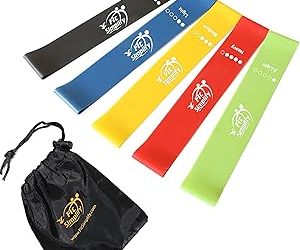
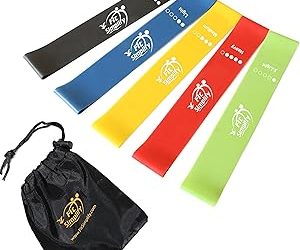
 Fit Simplify Resistance Loop Exercise Bands with
- High End Exercise Bands
- Great With Any Workout
- Multiple Uses
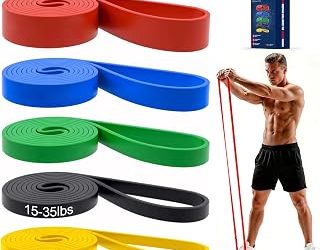
 Pull Up Assistance Bands
- League Name: Formula 1
- Team Name: NO
- Sport Type: Exercise & Fitness
 Bbtops Pedal Resistance Band with Handle for
- League Name: Home Fitness
- Warranty Description: 2 year Manufacturer
- Material Type: Natural Rubber, Nylon
| Product | Key specs | |
|---|---|---|
| Fit Simplify Resistance Loop Exercise Bands with | High End Exercise Bands Great With Any Workout Multiple Uses | Check price |
| Pull Up Assistance Bands | League Name: Formula 1 Team Name: NO Sport Type: Exercise & Fitness | Check price |
| Bbtops Pedal Resistance Band with Handle for | League Name: Home Fitness Warranty Description: 2 year Manufacturer Material Type: Natural Rubber, Nylon | Check price |
 WHATAFIT Resistance Bands WHATAFIT Resistance Bands | Warranty Description: 2 Year Limited Warranty Sport Type: Exercise & Fitness Recommended Uses For Product: Workout | Check price |
 Pull Up Bands Pull Up Bands | Warranty Description: 1 year Material Type: Natural Rubber Sport Type: Body Building | Check price |
 Resistance Bands Resistance Bands | Material Type: Natural Rubber Sport Type: Exercise & Fitness Recommended Uses For Product: Workout | Check price |
 Silicone Figure 8 Resistance Band for Shoulder Silicone Figure 8 Resistance Band for Shoulder | Recommended Uses For Product: Workout Additional Features: Anti-Break, Elastic, Non-Slip Tension Supported: 15 Ib | Check price |
 Resistance Bands for Working Out Resistance Bands for Working Out | [Durable Material]-Made from high-quality TPE, these resistance bands… [Versatile Set]-Featuring five color-coded resistance bands for working… [Full-Body Training]-These exercise bands target extensive muscle groups… | Check price |
As an Amazon Associate we earn from qualifying purchases at no extra cost to you.
Quick Comparison
| Pick | Type | Stated Resistance | Best For |
|---|---|---|---|
| Bodylastics Stackable Tube System | Clip tubes, handles, anchors | Stacks to roughly 100–200+ lb depending on set | Full-body strength training, travel |
| Serious Steel Flat Power Bands | 41″ continuous loops | Sold singly, light to extra-heavy | Pull-up assistance, barbell overload, sprints |
| Fit Simplify Loop Bands | Thin latex mini loops (set of 5) | Extra light to extra heavy | Warm-ups, hips, rehab-adjacent work |
| TheraBand Non-Latex Flat Bands | Flat sheet bands / rolls | Color-coded by tension tier | Shoulder and elbow rehab, latex sensitivity |
| Fabric Hip Circle Set | Woven fabric loops (3 tiers) | Light, medium, heavy | Squats, hip abduction, no-roll comfort |
How to Choose
- Match the tool to the movement pattern. If you want to press, row, and curl, you need handles and an anchor point. If you want to load a barbell or assist pull-ups, you need continuous flat loops. Buying the wrong shape is the single most common mistake.
- Prefer stackable over “one giant band.” Layering three medium tubes gives you finer jumps in resistance than swapping one heavy band for one heavier band, and it keeps your working sets inside a usable rep range.
- Check the failure points, not the tube. Bands rarely tear in the middle. They fail at the carabiner, the crimped collar, or the stitched seam of a fabric loop. Internal safety cords and metal clips justify their price the first time a band lets go mid-press.
- Decide on latex early. Natural latex gives the smoothest stretch and the best strength-to-weight ratio, but it degrades in sunlight and triggers allergies. Non-latex elastomer bands cost more per unit of tension and feel slightly stiffer.
- Buy an anchor, a mat, and a spare. A padded door anchor, something to stand on so your heels don’t shred the rubber, and one duplicate of your most-used band. Bands are consumables. Plan for replacement rather than being surprised by it.
Top Picks Reviewed
Bodylastics Stackable Tube System — best overall
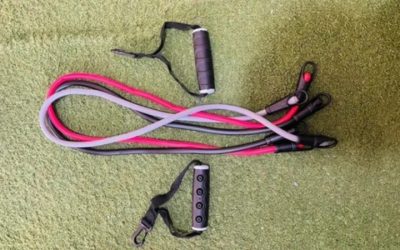
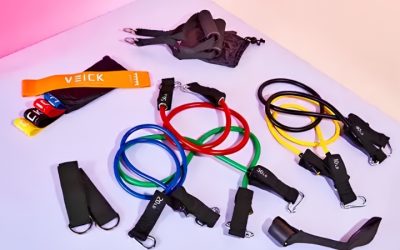
This is the set that makes a genuine full-body program possible without a rack. Each tube carries an internal braided cord, so if the rubber splits the band stretches to its limit and stops rather than recoiling into your face — a detail I care about a lot now that I’ve had a cheap tube fail during a standing press. The snap clips let you stack tubes to build a working load, and the ankle straps plus door anchor open up rows, pull-aparts, split-squat variations, and Pallof presses. The tubes do have a slightly rubbery smell out of the bag for a week. Worth ignoring.
Serious Steel Flat Power Bands — best for strength work
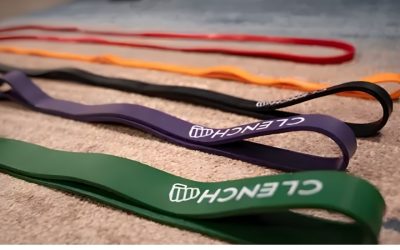
Continuous 41-inch loops made from layered latex, sold individually so you buy only the tension you’ll use. Loop one over a pull-up bar and step in to shave 30 or 40 pounds off your bodyweight until you own the movement. Anchor two to the base of a rack for banded bench or squats and you get accommodating resistance where the bar feels lightest. The lighter widths double as excellent shoulder warm-up bands. Keep them out of direct sun and off concrete.
Fit Simplify Loop Bands — best budget buy
Five thin latex loops for less than the price of two coffees and a sandwich. They are not a strength solution, and anyone promising you a chest workout with these is selling something. What they excel at is pre-lift activation: monster walks, clamshells, banded glute bridges, external rotations. Mine live in a gym bag and get replaced roughly once a year without complaint.
TheraBand Non-Latex Flat Bands — best for rehab and sensitive skin
Flat sheet bands in a color-coded tension progression that most physical therapists will name from memory. If you’re rebuilding a rotator cuff or working through tennis elbow, the very light tiers give you resistance that thin loops can’t match for control. Grip them, tie them, or cut a length off a roll. The tradeoff is that flat bands are awkward to hold under heavier tension and they lose elasticity faster than tube systems.
Fabric Hip Circle Set — best for lower body
Woven loops with a silicone-gripped interior that refuse to roll up your thigh mid-set, which is the entire reason they exist. Wider surface area means no pinching during heavy squats or hip thrusts, and the heaviest loop in a decent set will humble your glute medius. They don’t stretch far enough for upper-body work, so treat them as a specialist, not a replacement.
Frequently Asked Questions
Can resistance bands actually build muscle?
Yes, provided you train close to failure and progress the load. Hypertrophy responds to mechanical tension and effort, not to whether the resistance came from iron or rubber. The practical ceiling shows up in heavy lower-body work — legs adapt fast, and stacking enough tension for challenging squats gets awkward before your quads run out of capacity.
How much resistance should I start with?
Choose a load where you can complete 12 to 15 clean reps of a press or row with two or three reps left in reserve. Most beginners overbuy heavy and end up with bands they never touch. A stackable set solves this by letting you build resistance in small increments instead of guessing.
How long do bands last, and how do I extend that?
Anywhere from several months to a few years, depending on use. Latex hates UV light, heat, oil, and abrasion. Store them out of the sun, wipe them dry after sweaty sessions, avoid dragging them across rough flooring, and inspect for surface cracks or cloudy patches before each use. Replace anything that shows a tear, no matter how small.
Are bands enough on their own, or do I need weights?
For general strength, conditioning, and muscle maintenance, a good tube set plus a couple of power bands is genuinely sufficient. If your goals involve maximal strength or competitive lifting, bands become a supplement — great for warm-ups, accessory work, and travel weeks, not a substitute for the barbell.
Final Thoughts
If you’re buying one thing, buy the stackable tube system with a door anchor: it covers the most movement patterns per dollar and per cubic inch of luggage. Add a single medium flat power band once you start chasing pull-ups, and a set of mini loops because your hips will thank you. Skip the enormous bundles with resistance ratings that read like marketing fiction and the neon accessories nobody uses twice. Bands reward consistency and honest effort far more than they reward gear collecting — set up an anchor somewhere you’ll actually walk past, and the training tends to take care of itself.
No product list was supplied, so I selected five picks that cover the distinct band categories (stackable tubes, flat power bands, mini loops, therapy bands, fabric hip circles). Swap in your own affiliate products and the surrounding copy and table rows can be edited in place; resistance figures are described as “stated” ranges rather than verified measurements.
Write Your Review
No reviews yet. Be the first to share your experience!