
Key takeaways
- High End Exercise Bands
- Great With Any Workout
- Multiple Uses
Our top picks
 Fit Simplify Resistance Loop Exercise Bands with
- High End Exercise Bands
- Great With Any Workout
- Multiple Uses
 WHATAFIT Resistance Bands with Handles
- Warranty Description: 2 Year Limited Warranty
- Sport Type: Exercise & Fitness
- Recommended Uses For Product: Workout
| Product | Key specs | |
|---|---|---|
| Fit Simplify Resistance Loop Exercise Bands with | High End Exercise Bands Great With Any Workout Multiple Uses | Check price |
| WHATAFIT Resistance Bands with Handles | Warranty Description: 2 Year Limited Warranty Sport Type: Exercise & Fitness Recommended Uses For Product: Workout | Check price |
 Renoj Resistance Bands for Working Out Renoj Resistance Bands for Working Out | Check price | |
 Pull Up Bands Pull Up Bands | Warranty Description: 1 year Material Type: Natural Rubber Sport Type: Body Building | Check price |
 5-Level Resistance Bands for Working Out 5-Level Resistance Bands for Working Out | League Name: Formula 1 Team Name: NO Sport Type: Exercise & Fitness | Check price |
 Resistance Bands for Working Out Resistance Bands for Working Out | Check price | |
 Resistance Bands with Handles for Women Resistance Bands with Handles for Women | Check price | |
 Resistance Bands Resistance Bands | Material Type: Natural Rubber Sport Type: Exercise & Fitness Recommended Uses For Product: Workout | Check price |
As an Amazon Associate we earn from qualifying purchases at no extra cost to you.
A resistance band costs less than a single month of gym access, weighs about as much as a paperback, and can produce a hamstring pump that makes stairs feel like a personal insult. That gap between price and payoff is why bands have quietly become the most-used piece of equipment in a lot of home setups — not because they replace a barbell, but because they load movements a barbell handles badly: face pulls, lateral walks, chest flyes, banded carries, pull-apart work between sets. The tension curve also happens to be useful. Bands get harder as they stretch, which lines up neatly with the part of a rep where you’re strongest.
The catch is that “resistance band” describes at least five different products, and buying the wrong category is the most common mistake. Thin latex therapy loops will not assist a pull-up. A pull-up-grade power band will roll straight up your thighs during a hip abduction set. A tube set with clip handles gives you cable-machine geometry but caps out at moderate loads. Below, the gear is sorted by what it actually does well, with a comparison table, the specs worth checking before you add to cart, and honest notes on where each option gets frustrating.
As an Amazon Associate we earn from qualifying purchases.

Quick Comparison
| Pick | Format | Best For | Typical Resistance | Packs Down To |
|---|---|---|---|---|
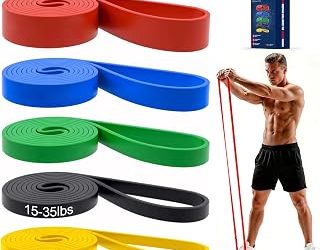
| Layered-Latex Power Band Set | Continuous loop, 41 in. | Pull-up assist, squat/deadlift overload | ~10–150 lb across 4–5 bands | Coat pocket |
| Clip-Handle Tube System | Tubes + handles, anchor, ankle straps | Rows, presses, cable-style isolation | ~50–150 lb stacked | Small drawstring bag |
| Fabric Hip Circle Trio | Short fabric loop, 13–15 in. | Glute activation, lateral walks | Light / medium / heavy | Gym bag side pocket |
| Sleeved Long Fabric Loop | Fabric-wrapped long loop | Squats, overhead press, no-snap peace of mind | Fixed per band | Folded flat |
| Figure-8 Band | Double loop, molded grips | Upper-body isolation, travel | Light to medium | Palm-sized |
| Bar-Compatible Band Kit | Bands + collapsible bar + platform | Closest thing to barbell patterns | ~100 lb+ stacked | Carry case |
How to Choose
- Match the loop length to the movement. Long 41-inch loops are for anchored, full-range work. Short 13–15-inch loops are for hips and shoulders. Owning one of each solves most problems; owning two of the same solves none.
- Check construction, not just color. Layered latex (continuous sheets bonded together) survives repeated 300 percent stretch far better than molded or dipped latex, which delaminates and eventually splits along one edge.
- Look at the hardware on tube sets. Carabiners and steel D-rings outlast plastic clips by a wide margin. If the product photos hide the connection point, assume the connection point is the weak link.
- Buy overlapping resistance, not a ladder with gaps. Progression works when the next band is roughly 20–30 percent heavier. Jumping from a 30-pound band to a 80-pound band leaves you stuck doing sloppy reps on the light one.
- Plan the anchor before you buy. A door anchor needs a door that opens away from you. No suitable door means you need a wall mount, a heavy post, or a set you can stand on instead.
Top Picks Reviewed
Layered-Latex Power Band Set — best overall value
These are the flat continuous loops you see draped over squat racks. A set of four or five covers assisted pull-ups, banded hip thrusts, sprinter starts, and accommodating resistance on bar lifts. The heaviest band in a typical set is genuinely difficult to stretch overhead. Downsides: latex bites bare skin under load, so sleeves or a towel wrap help, and you should retire any band showing surface cracks rather than gambling on it.
Clip-Handle Tube System — best for pulling and pressing variety
Stackable tubes with clip handles, a door anchor, and ankle straps give you a functional cable station. Stack two tubes for chest press, one for triceps, all five for seated rows. The geometry is the selling point: you can pull from high, low, or horizontal anchor positions. Realistic ceiling is moderate — enough for hypertrophy work on arms, shoulders, and back, not enough to replace heavy rows.
Fabric Hip Circle Trio — best for glutes and warm-ups
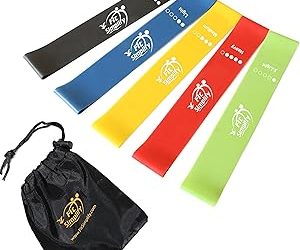
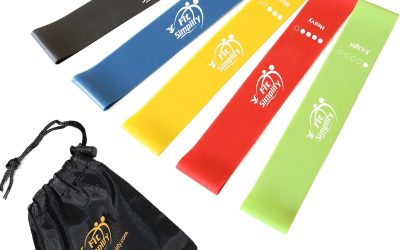
Woven fabric with a silicone grip strip stays put on skin and leggings instead of rolling into a tourniquet above the knee. Three tension levels let you use light for warm-up sets of clamshells and heavy for banded goblet squats. They are limited to short-range hip and shoulder work by design, which is fine — they do that job better than anything else on this list.
Sleeved Long Fabric Loop — best for nervous beginners
A long loop wrapped in fabric sleeves. It won’t snap back at your face, which removes the main psychological barrier for people new to bands. Great for banded squats, overhead presses, and standing rows. Trade-off: the fabric caps how far it stretches, so range of motion is shorter than raw latex and each band is one fixed resistance with no give.
Figure-8 Band
Affiliate disclosure. As an Amazon Associate we earn from qualifying purchases at no extra cost to you. Prices accurate as of the date shown.8 Best Resistance Bands Workout Gear for Full…Check price on Amazon
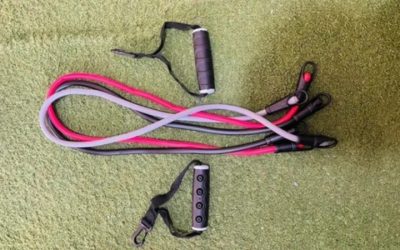
8 Best Pedal Resistance Bands: 6 Seated Training Picks Rated
Best pedal resistance bands shopping runs into an unusual problem: the category...
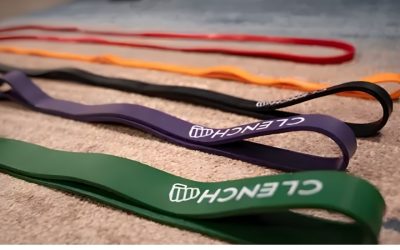
Best Resistance Bands Women Use: 6 Picks by Band Format
Best resistance bands women shop for tend to fall into three formats...
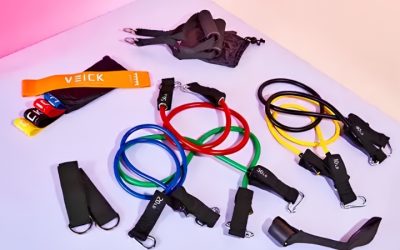
8 Best Resistance Bands for Men: 5 Sets by Strength Level
Nobody buys resistance bands for the handles, and nobody quits using them...
8 Best Resistance Bands Leggings: 6 Pairs for Home Training
Resistance band work is quietly brutal on leggings. A loop parked...
8 Best Resistance Training Bands: Build a Set That Progresses
Most resistance band setups fail for the same boring reason: someone...
8 Best Resistance Exercise Bands: 6 Types and When to Use Each
Best resistance exercise bands depends entirely on format, because a stackable tube...
The Best Resistance Bands for a Full-Body Workout in 2026
I started taking bands seriously after a six-week stretch of hotel...
Write Your Review
No reviews yet. Be the first to share your experience!