
Key takeaways
- Set Name: 3, 5, and 8 Pound Dumbbell Set
- Handle Diameter: 1.22 inch, 1.38 inch, 1.54 inch
- Number of Pieces: 6
Garages and basements are the default home for weights, and they are also the worst environment weights ever encounter. An unheated garage in a humid climate cycles through condensation twice a day, and bare cast iron picks up orange surface rust within a season. Basements add standing humidity. Neither ruins a dumbbell structurally, but both transfer rust onto hands and clothing and slowly seize any threaded mechanism you own.
The equipment answers are straightforward once you accept the environment. Coated heads resist corrosion and protect concrete. Threaded collars need occasional oil or they gall. Neoprene hardens with heat cycling and belongs indoors. And any rack sitting directly on a garage slab should be on a mat, because concrete wicks moisture upward into whatever is standing on it. Here is how six popular sets hold up against those conditions.
Our top picks
 Amazon Basics Neoprene Dumbbell Hand Weights for
- Set Name: 3, 5, and 8 Pound Dumbbell Set
- Handle Diameter: 1.22 inch, 1.38 inch, 1.54 inch
- Number of Pieces: 6
Three paired weights give a quick progression range
Included stand keeps all six dumbbells organized
Color-coded caps make weight identification quick
Fixed 3 to 8 pound range limits heavier strength training
Neoprene coating can wear with very frequent floor contact
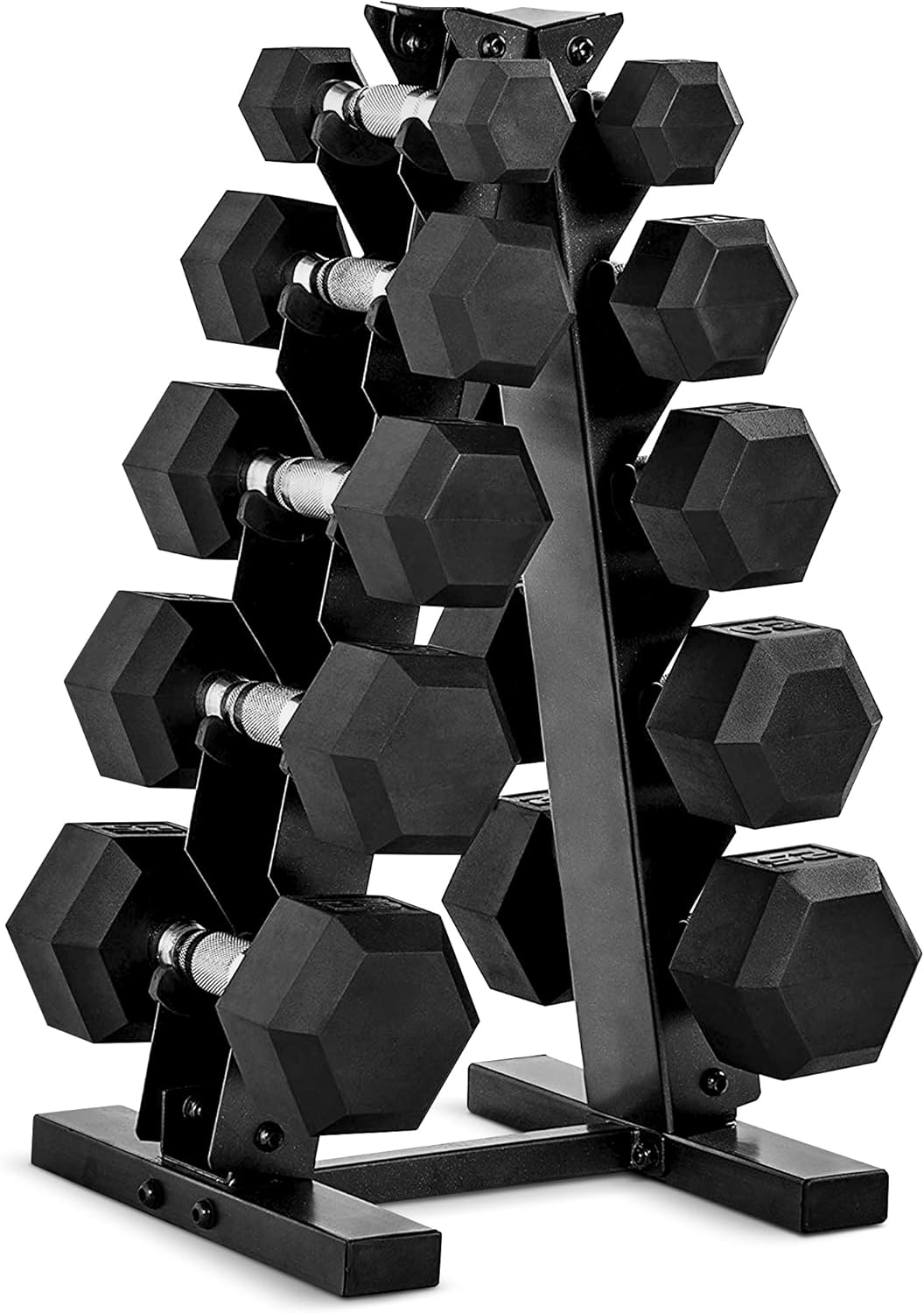 CAP Rubber Coated Hex Dumbbell Set with
- Frame Type: A-Frame
- Material: Metal
- Item Dimensions D x W x H: 12.8"D x 14.37"W x 25.98"H
Rubber-coated heads protect floors and reduce noise
A-frame rack keeps the full set organized off the floor
Knurled steel handles aid secure grip during lifts
150-pound total set offers no higher weight options
Warranty coverage runs only 30 days from purchase
| Product | Key specs | |
|---|---|---|
 Amazon Basics Neoprene Dumbbell Hand Weights for Amazon Basics Neoprene Dumbbell Hand Weights for | Check price | |
| Amazon Basics Neoprene Dumbbell Hand Weights for | Set Name: 3, 5, and 8 Pound Dumbbell Set Handle Diameter: 1.22 inch, 1.38 inch, 1.54 inch Number of Pieces: 6 | Check price |
| CAP Rubber Coated Hex Dumbbell Set with | Frame Type: A-Frame Material: Metal Item Dimensions D x W x H: 12.8"D x 14.37"W x 25.98"H | Check price |
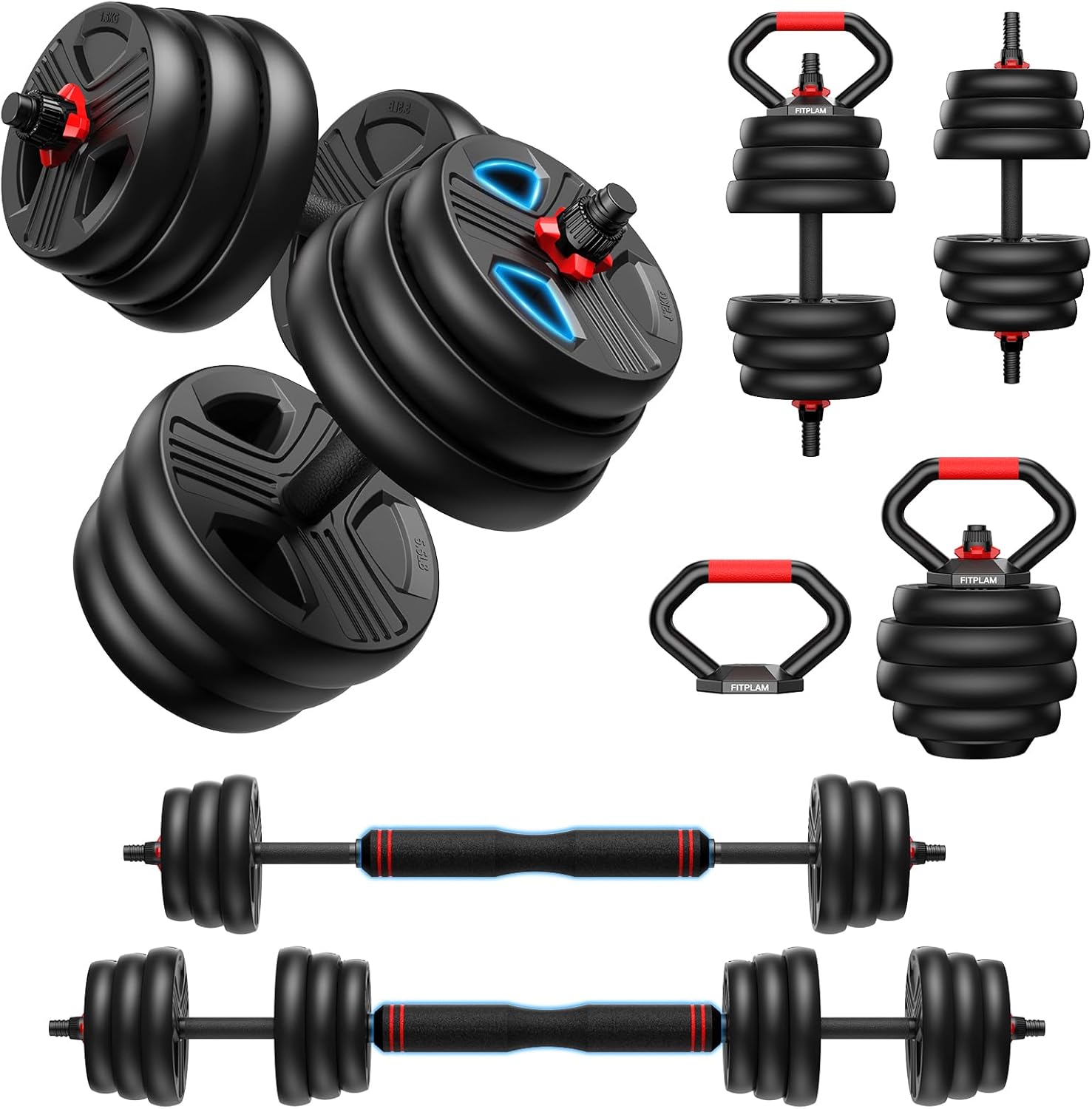 FITPLAM Adjustable dumbbell set FITPLAM Adjustable dumbbell set | Material: Alloy Steel, Iron, Polyethylene (PE) | Check price |
 Adjustable Dumbbell set Adjustable Dumbbell set | Check price | |
 Amazon Basics Neoprene Dumbbell Hand Weights for Amazon Basics Neoprene Dumbbell Hand Weights for | Set Name: Pair Item Dimensions L x W: 7.05"L x 3.21"W Handle Diameter: 3 inch | Check price |
 2026 FDB2 Updated Adjustable Dumbbell Set of 2026 FDB2 Updated Adjustable Dumbbell Set of | Check price | |
 Adjustable Dumbbell Adjustable Dumbbell | Set Name: Adjustable Weights Dumbbells Set Other Special Features of the Product: Adjustable Weight Target Use Body Part: Body | Check price |
As an Amazon Associate we earn from qualifying purchases at no extra cost to you.
Quick Comparison
| Product | Best For | Standout Feature | Watch Out For |
|---|---|---|---|
| CAP Hex Set with Rack | Garage gyms | Rubber coating resists corrosion | Bare handle still needs wiping |
| FITPLAM 5-in-1 Adjustable Set | Wide range in a cold space | Six loads up to 90 lb | Threads need occasional oiling |
| 5-in-1 Connector Dumbbell Set | Concrete-floor training | Bar mode for heavy pulls | Long bar needs clear slab space |
| 4-in-1 Free Weight Set | Low-maintenance storage | Few parts to corrode | Coarse steps between loads |
| FDB2 Set with Storage Box | Keeping plates off the floor | Enclosed box limits moisture | Lower ceiling than rivals |
| Amazon Basics Neoprene Weights | Indoor light work | Sealed, rust-proof coating | Coating splits in hot storage |
How to Choose
- Prefer coated heads in damp spaces: Rubber and neoprene seal the iron and stop the rust that makes bare dumbbells dirty to handle. In a garage, this is the single most consequential specification.
- Get everything off the concrete: Slabs wick moisture continuously. A rubber mat or a pallet under a rack or plate stack prevents the rust ring that otherwise appears within a year.
- Oil threaded parts twice a year: Spin-lock collars and adjustment nuts seize slowly in humidity. A wipe of light machine oil on the threads takes two minutes and prevents the most common failure in cold-storage sets.
- Keep neoprene indoors: Heat cycling in an uninsulated garage hardens the coating until it cracks along the seam. If neoprene pairs are part of your setup, store them in the house.
- Allow for cold-weather warm-ups: Metal at 40 degrees is unpleasant and grip strength drops in the cold. Plan an extra five minutes of movement before loading heavy, particularly on pulling lifts.
Top Picks Reviewed
Best for Garages: CAP Hex Set with Rack
Rubber-coated hex heads are close to ideal for a garage: no rust on the mass of the dumbbell, no chipped concrete when you set them down, and a compact upright rack that keeps 100 to 210 lb organised against a wall.
The handle itself is still bare metal and will develop light surface rust in a humid space, so wipe it down periodically. New coating also carries a strong smell that is much more noticeable in a closed garage than an open one.
Best Range: FITPLAM 5-in-1 Adjustable Set
Six settings at 20, 35, 45, 55, 70 and 90 lb make this the most complete option for a garage where you want one purchase to cover everything from lateral raises to heavy rows. The upgraded nut holds tension better than generic spin-lock hardware.
Threads are the maintenance item. In an unheated space they want a light oil twice a year, otherwise tightening becomes progressively stiffer until a collar eventually galls. It is a five-minute job that people forget until it is a problem.
Best for Heavy Pulls: 5-in-1 Connector Dumbbell Set
A garage slab is the right place for barbell rows and hip thrusts, and joining the two handles gives you up to 90 lb in bar form. There is no floor-load concern on concrete, so this is where the connector design shines.
The assembled bar is long and needs clear space, which competes with whatever else lives in the garage. Set-down on bare concrete also chips plates over time, so a mat is not optional.
Lowest Maintenance: 4-in-1 Free Weight Set
Fewer components means fewer things to corrode, seize or lose in a cluttered garage. Four configurations from 20 up to 90 lb cover a wide span with minimal fiddling.
The steps are coarse enough that structured progression is difficult. It suits general strength work rather than a programme where you add small amounts of weight each week.
Best Protected Storage: FDB2 Set with Storage Box
An enclosed box keeps plates and collars off a damp slab and away from dust, which extends the life of every metal part. For a garage that is also used for actual garage things, containment is genuinely valuable.
The top weight is moderate, so heavy lower-body work will outgrow it. It is a conditioning set stored sensibly rather than a strength set.
Best Kept Indoors: Amazon Basics Neoprene Weights
The sealed neoprene shell is completely rust-proof and comfortable in cold hands, which makes these useful for warm-ups and shoulder work at the start of a garage session.
Do not store them there. Repeated heat and cold cycling hardens the coating until it splits at the seam, exposing the cast core. Kept inside the house they last effectively forever.
Frequently Asked Questions
Will dumbbells rust in an unheated garage?
Bare cast iron will develop surface rust within a season in most climates. It is cosmetic rather than structural, but it transfers to hands and clothing. Rubber-coated heads avoid the problem entirely.
How do I stop threaded collars from seizing?
Wipe the threads with a light machine oil a couple of times a year and always hand-tighten rather than forcing with a tool. Most seized collars are the result of dirt plus corrosion, both of which are preventable.
Do I need a mat on a concrete floor?
Yes, for two reasons. Concrete wicks moisture into anything standing on it, and it chips plates and coating on set-down. A basic rubber mat solves both and costs little.
Is a basement or a garage better for a home gym?
Basements are more temperature stable but often more humid; garages swing in temperature but ventilate better. A dehumidifier fixes the basement problem, and coated equipment fixes most of the garage problem.
Final Thoughts
For a garage setup that will still look and work well in five years, the CAP Hex Set with Rack is the most durable option here thanks to its coated heads and lack of any mechanism. If space or budget rules that out, the FITPLAM 5-in-1 Adjustable Set gives the widest range and only asks for occasional thread maintenance, with the 5-in-1 Connector Dumbbell Set the better choice if heavy rows and hip thrusts are your priority.




Write Your Review
No reviews yet. Be the first to share your experience!