
Durability in a weight bench rarely fails dramatically. It fails in inches: a seat pad that dishes out under repeated 225-pound sets, a ladder bracket that starts to rattle at the 30-degree notch, a pop-pin that develops enough slop to let the backrest shift a half-inch mid-rep. Buyers who rate benches highly after two or three years of use tend to describe the same handful of traits — thick-walled steel, welded rather than bolted stress points, and upholstery dense enough that you can still feel your shoulder blades pinned to the pad instead of sinking into it.
This roundup organizes the market by the archetypes that actually hold up, because the spec sheet numbers that matter are not always the ones printed largest. A 1,000-pound rated bench built from 14-gauge tube with four bolted junctions can flex more than a 700-pound bench welded from 11-gauge. Below, the comparison table maps each type against frame weight, adjustment mechanism, and footprint, followed by a buying checklist and detailed notes on where each design earns — or loses — its reputation.
Our top picks
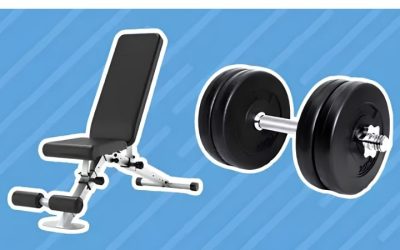
 NICEPEOPLE Adjustable Weight Bench for Home Gym
660-pound capacity on a reinforced steel frame
Eight backrest angles cover incline, decline, and flat training
Folds in one step for compact storage
29.3-inch backrest may be long for smaller rooms
Leather-style padding needs periodic wiping to resist wear
 YOLEO Adjustable Weight Bench for Home Gym
ASTM-certified for an 827-pound capacity limit
84 adjustable positions cover incline, decline, and flat training
Folds down for storage under a bed or sofa
User weight is capped lower at 330 pounds
28-inch backrest may be excessive for smaller spaces
| Product | Key specs | |
|---|---|---|
| NICEPEOPLE Adjustable Weight Bench for Home Gym | Check price | |
| YOLEO Adjustable Weight Bench for Home Gym | Check price | |
 MAIDOMA Foldable 1500LBS Capacity 8 IN 1 MAIDOMA Foldable 1500LBS Capacity 8 IN 1 | Check price | |
 Yagud Weight Bench Press Yagud Weight Bench Press | Item Dimensions D x W x H: 9.84"D x 12.6"W x 31.5"H Material: Alloy Steel | Check price |
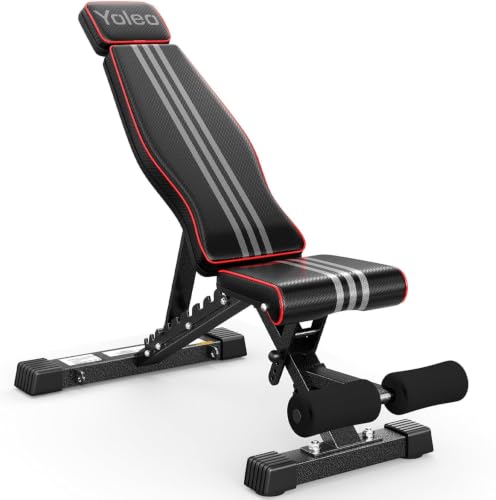 YOLEO Adjustable Weight Bench for Home Gym YOLEO Adjustable Weight Bench for Home Gym | 【827LB Weight Capacity】Yoleo weight bench is crafted with… 【90 Adjustable Options and 90 Degrees Vertical】Our adjustable… 【Extended Head and Spine Support】Yoleo incline weight bench… | Check price |
 FLYBIRD WB5 Weight Bench FLYBIRD WB5 Weight Bench | Certified & 800lbs Heavy-Duty Support: Its elongated thickened… 144 Adjustable Positions for Full-Body Training: With a… Extended Padding for Comfortable Workout Support: Designed with… | Check price |
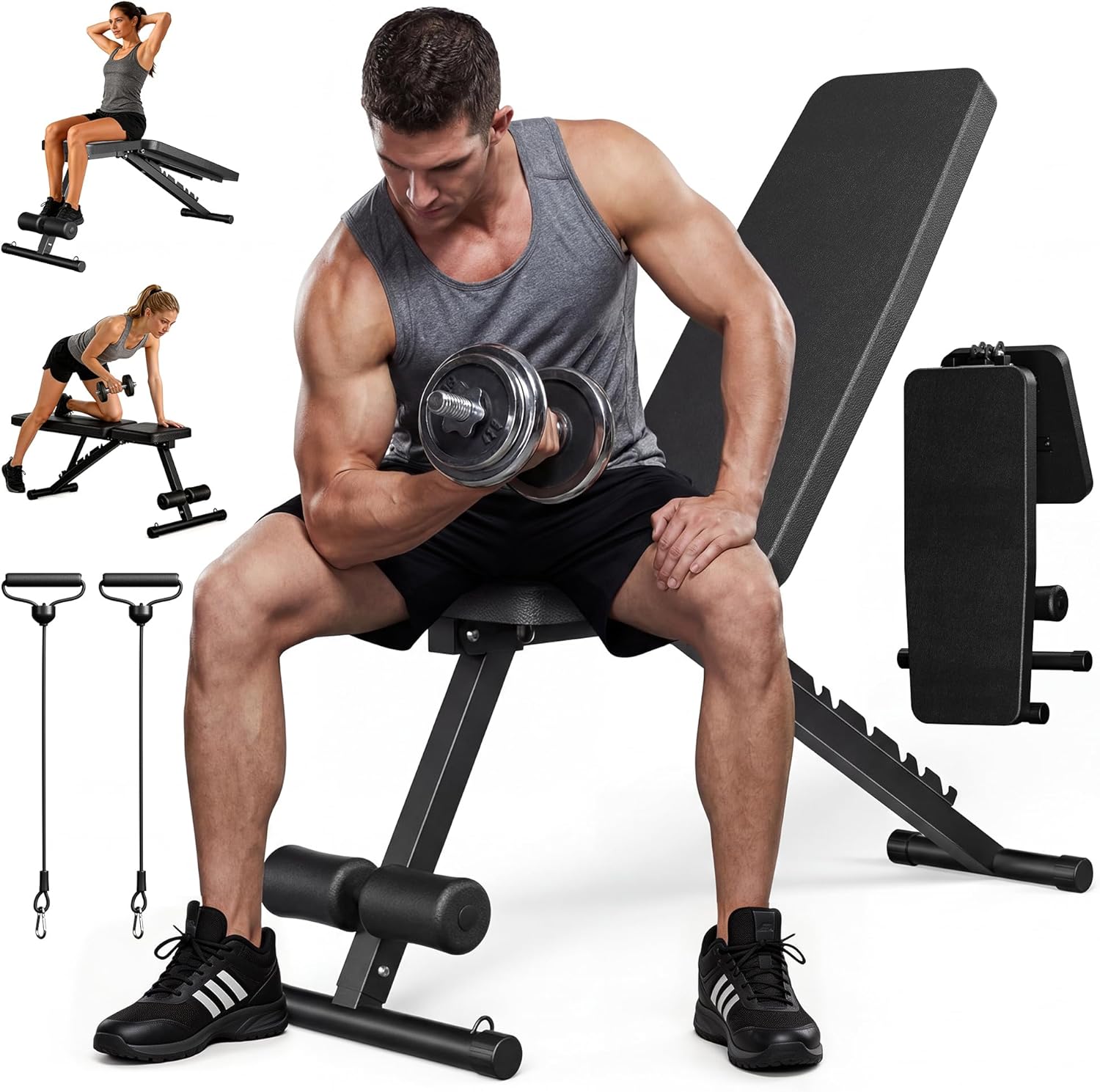 Adjustable Weight Bench for Home Gym Adjustable Weight Bench for Home Gym | Item Dimensions D x W x H: 44.9"D x 16.7"W x 17.7"H Material: Alloy Steel | Check price |
 Weight Bench Set Weight Bench Set | 【ALL-IN-ONE HOME GYM SOLUTION】Maximize your training with the… 【Rock-Solid Stability & Safety Assurance】Engineered for intense training,… 【QUICK-ADJUST FOR THE PERFECT SETUP】Customize your workout in… | Check price |
As an Amazon Associate we earn from qualifying purchases at no extra cost to you.
Quick Comparison
| Bench Type | Best For | Frame & Rated Load | Adjustment | Storage |
|---|---|---|---|---|
| Commercial FID bench | Heavy pressing, long-term garage gyms | 11-gauge steel, ~1,000 lb combined | Ladder, 7 back / 3 seat positions | Wheels and handle, stands upright |
| Flat utility bench | Powerlifting, maximum stability | Fully welded, 600–1,000 lb | None (fixed 17″ pad height) | Slides under a rack |
| Folding adjustable bench | Apartments and shared rooms | 14-gauge steel, 600–800 lb | Pop-pin or ladder, 4–6 angles | Folds flat to roughly 8″ deep |
| Bench-and-rack combo | One-purchase home setups | Mixed gauge, 500–700 lb | Multi-angle with leg developer | Fixed footprint, ~6 x 4 ft |
| Zero-gap incline bench | Upper-chest and shoulder work | Heavy-gauge, 700–1,000 lb | Ladder, no seat/back gap | Rear transport wheels |
| Value adjustable bench | First home gym, dumbbell training | 14-gauge, 500–660 lb | Pop-pin, 6–8 positions | Partial fold, upright park |
How to Choose
- Read the steel, not just the rating. Wall thickness is the honest number. Eleven-gauge tube (about 3 mm) resists denting and twisting; 14-gauge is adequate for dumbbell work but will telegraph flex under a loaded barbell. Total shipping weight is a useful proxy — a bench under 45 pounds is not built for 300-pound presses.
- Check the seat-to-back gap. On adjustable benches, a gap wider than about two inches puts a hard edge under your lower back at incline angles. Zero-gap or overlapping designs cost more and are the single upgrade most buyers say they would make first.
- Prefer ladder adjustment over pop-pins for heavy work. Ladder brackets carry load through the bracket itself rather than a single pin, and they do not develop the rattle that pin holes acquire as they wear. Pop-pins are faster and fine for dumbbell circuits.
- Measure pad height and width against your body. Seventeen inches is the standard that lets most lifters plant their heels. Pad width of 10 to 12 inches supports the torso without blocking shoulder-blade retraction; wider pads suit bigger frames but restrict arch position.
- Confirm the feet and the floor contact. Rubber or urethane feet with a wide stance stop the walk-and-creep that plagues cheap benches on concrete. Tripod bases save space but shift more under uneven loading than four-point bases.
Top Picks Reviewed
Commercial FID Bench
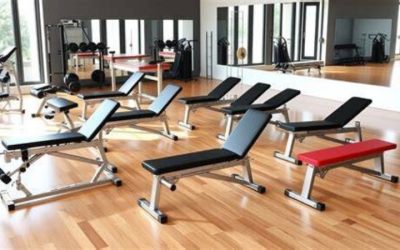
The flat-incline-decline design with a full ladder mechanism is what most long-term owners land on eventually. Expect 70 to 90 pounds of frame weight, a three-position seat that keeps you from sliding at steep angles, and decline leg rollers that come off with a single pin. The compromise is footprint: even upright, these need a dedicated corner, and the decline hardware adds a foot of length behind the pad.
Flat Utility Bench
Nothing outlasts a bench with no moving parts. A welded flat bench with a tripod or four-post base gives the firmest platform for bench pressing, and the pad — usually 11 to 12 inches wide and stitched vinyl over high-density foam — holds shape for years because load spreads evenly instead of concentrating at a hinge. If your training is barbell-centric and your dumbbell work is limited, this is the most durable dollar in the category.
Folding Adjustable Bench
The compromise design has improved sharply. Modern folding benches use a hinge locked by the frame’s own geometry rather than a latch, which removes the historic weak point. Rated loads in the 600 to 800-pound range are realistic for dumbbell pressing and rows. Buyers consistently flag two things: verify the folded depth fits your closet, and expect a slight pad step where the fold occurs.
Bench-and-Rack Combo
These bundle a multi-angle bench with barbell catches, a leg developer, and sometimes a preacher curl pad. They earn their keep in basements where floor space is fixed and the alternative is buying three pieces. Durability is uneven — the bench frame usually holds, while leg developer bushings and cable pulleys wear first. Treat the listed capacity as a limit for the rack uprights, not an invitation to max out.
Zero-Gap Incline Bench
Built for lifters who train upper chest and overhead pressing seriously, this design eliminates the lumbar pinch entirely by overlapping the seat and back pads. Adjustment is typically a rear ladder with a lift-and-set motion, and the best versions include a vertical 90-degree stop for seated shoulder work. It costs more than a comparable gapped bench, and the payoff is a pad you can arch on without a hard edge in the way.
Value Adjustable Bench
Entry-level benches in the 500 to 660-pound range work well for dumbbell training if you accept the tradeoffs: pop-pin adjustment, a visible seat gap, and foam that compresses noticeably in the first six months. Look for models with four-point bases and steel that feels cold and heavy rather than light and hollow. The failure mode to avoid is a bench that flexes side to side when you push off a single dumbbell.
Frequently Asked Questions
How much weight capacity do I actually need?
Add your body weight to your heaviest planned lift, then add a safety margin of at least 40 percent. A 190-pound lifter pressing 300 pounds should shop at 700 pounds or higher, because static ratings do not account for the dynamic load of unracking and the uneven force of pushing off one side.
Does a wobbly bench mean it is defective?
Usually not. Most side-to-side play traces to under-torqued hardware or an uneven floor. Retighten every bolt after the first week of use, then again at a month — new frames settle. If play remains after that, check whether the fasteners pass through slotted holes, which is a design limitation rather than an assembly problem.
Is a flat bench enough, or should I buy adjustable?
If you train mostly with a barbell, a flat bench is sturdier, cheaper, and easier to store. Adjustable becomes worth it once dumbbell incline pressing, seated shoulder work, or supported rows are regular parts of your program, since those angles are difficult to approximate otherwise.
What causes upholstery to fail first?
Sweat and sunlight, in that order. Salt breaks down vinyl seams from the underside, and UV exposure through a garage window stiffens the material until it cracks. Wipe the pad down after each session and keep the bench out of direct light; double-stitched seams and closed-cell foam add years.
Final Thoughts
The benches buyers still praise after heavy use share an unglamorous profile: thick steel, few moving parts, wide feet, and a pad that stays firm. If your budget is fixed, spend it on frame quality and accept fewer adjustment positions rather than buying a feature-rich bench built from thin tube. Match the archetype to how you actually train — a flat bench for barbell work, a zero-gap or FID design for varied angles, a folding model if the bench must disappear between sessions — and check the wall gauge, seat gap, and pad height before the rated load. Those four numbers predict how a bench will feel in its third year better than any headline capacity figure.
Write Your Review
No reviews yet. Be the first to share your experience!