
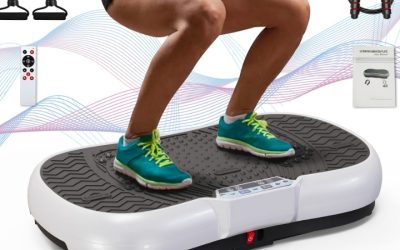
The gap between people who get something out of a vibration plate and people who do not comes down to a single decision: whether they stand on it or train on it. Standing still on a moving platform produces a sensation and very little else. Holding a squat at 45 degrees for 45 seconds on that same platform, then a plank, then a set of banded rows, produces a session that genuinely raises heart rate and loads muscle. Same machine, entirely different outcome.
Which means the buying criteria change completely. Deck size stops being cosmetic and becomes the constraint on what positions you can hold. Weight capacity stops being about your body weight and starts being about the dynamic load of moving on the platform. Band anchors stop being an accessory and become the thing that lets you train the upper body at all. Here is how the six plates below stack up when you plan to use them as an exercise surface rather than a wellness gadget.
Our top picks


As an Amazon Associate we earn from qualifying purchases at no extra cost to you.
Quick Comparison
| Product | Best For | Standout Feature | Watch Out For |
|---|---|---|---|
| HVX Vibration Platform | Full exercise routines on the deck | Wide platform fits planks and wide squats | Occupies serious floor space |
| Lifepro Waver | Adding upper-body resistance work | Anchored bands for rows and presses | Band tension is fixed and fairly light |
| SEDOZIK Vibration Plate | Loaded squats and holds | 450 lb capacity absorbs dynamic loading | Deck texture gets slippery when damp |
| MERACH CV30 Pro Curved | Standing lower-body work | Curved deck aids calf and balance work | Curve limits hands-and-knees positions |
| Renoj 3D Vibration Platform | Mobility work between strength sets | Multi-plane motion suits stretching | Not the firmest base for heavy holds |
| 130-Level Vibration Plate | Simple standing circuits | Easy speed changes between exercises | Small deck restricts exercise selection |
How to Choose
- Measure the deck against a squat stance: You want at least shoulder-width plus a few inches on each side. A narrow platform forces a stance that is neither comfortable nor strong, which limits every lower-body exercise you might do.
- Confirm the surface grips when damp: Once you are working hard enough to sweat, a smooth deck becomes genuinely unsafe. Deep texture or a rubberized surface is a requirement, not a preference, for exercise use.
- Look for real band anchors: Without a way to load the upper body, a plate trains legs only. Anchors bolted into the frame, not clipped to plastic trim, are what make rows and presses possible.
- Buy capacity for dynamic load: Moving on a plate momentarily generates forces well above your static body weight. A capacity rating with substantial headroom is what stops the motor bogging down mid-set.
- Build a circuit, not a stand: Alternate 45 seconds of squat hold, plank, calf raises and banded rows with short rests for four rounds. That structure turns a ten-minute session into something that actually elevates heart rate.
Top Picks Reviewed
Best Training Surface: HVX Vibration Platform
The wide 450-pound-rated deck is the only one here that comfortably accommodates a plank with hands on the platform, a wide squat stance, and kneeling work. That range is what lets you build a real circuit.
It claims a substantial rectangle of floor permanently. In a small room, the versatility comes at a cost you feel every day you walk around it.
Best Upper-Body Option: Lifepro Waver
Anchored bands turn the plate into a full-body station. Standing on the moving deck while performing rows adds a stability demand that makes light resistance feel considerably harder than it looks.
The bands are relatively light and not adjustable in tension. Anyone with existing strength will outgrow them and need to supply their own heavier set.
Best Under Load: SEDOZIK Vibration Plate
The high capacity means the motor holds its speed when you drop into a squat or shift weight quickly, which is where lighter plates audibly struggle.
The deck texture loses grip once you start sweating. Keep a towel nearby and check your footing before any single-leg work.
Best for Standing Work: MERACH CV30 Pro Curved
The curved surface encourages active foot and calf engagement, which makes standing balance work and calf raises more productive than they are on a flat deck.
Anything involving hands or knees on the platform is compromised by the curve. Plan a routine built around standing exercises if you choose this one.
Best Between-Sets Tool: Renoj 3D Vibration Platform
Placed next to a rack or a bench, it works well for 60 seconds of hip or calf mobility between strength sets without interrupting your session.
It is not the firmest base for holding a hard squat under real tension. As a primary training surface it is outclassed by the heavier platforms.
Best Simple Circuit Base: 130-Level Vibration Plate
Quick speed changes between exercises let you run an easy circuit of holds and calf raises without stopping to fight the controls.
The deck is small enough that exercise selection is limited to standing positions. It caps what your routine can become as you get fitter.
Frequently Asked Questions
What exercises actually work on a vibration plate?
Squat holds, calf raises, split-stance holds, planks with hands or forearms on the deck, glute bridges with feet on the platform, and banded rows or presses while standing on it.
How long should a training session on a plate last?
Ten to fifteen minutes structured as a circuit is plenty. The stability demand fatigues stabilizing muscles faster than the same exercises on solid ground.
Can a plate replace strength training?
No. It adds a stability and vibration stimulus to bodyweight movements, which is useful, but it does not provide the progressive external load that builds strength over time.
Should I wear shoes on a vibration plate?
Barefoot gives better grip and foot engagement for standing work. For circuits with dynamic movement, a flat grippy shoe reduces the chance of slipping once the deck gets damp.
Final Thoughts
If you intend to exercise on the plate rather than stand on it, buy deck size, grip and capacity, then add band anchors. A wide, high-capacity platform with a textured surface supports a genuine circuit; a small, slick deck limits you to standing there. Build a four-exercise rotation, run it for ten focused minutes, and the machine starts earning its floor space.

Write Your Review
No reviews yet. Be the first to share your experience!