
Key takeaways
- Target Use Body Part: Ankle, Wrist
- Target Audience: men, teenager, women
- Specific Uses For Product: Physical Therapy, Strength Training
Ankle weights show up in home exercise programmes far more often than in gyms, and the reason is that clinicians prescribe them. Straight leg raises after a knee procedure, hip abduction work for a cranky IT band, seated knee extensions to rebuild quad control — these all call for small, precisely repeatable loads applied close to the joint. That is a very different requirement from general fitness. You are not chasing a training stimulus; you are following a number someone wrote on a sheet, and the equipment has to hit that number reliably.
Which makes two specifications matter far more than usual. First, whether the cuff can be set to a known weight rather than an approximate one, because “about three pounds” is not a prescription. Second, whether it can be fastened one-handed while seated, since a lot of the people using ankle weights this way cannot comfortably bend to the floor. The options below are assessed against those constraints, alongside the usual comfort and durability questions.
Our top picks
 Sportneer Adjustable Ankle Weights
- Target Use Body Part: Ankle, Wrist
- Target Audience: men, teenager, women
- Specific Uses For Product: Physical Therapy, Strength Training
 BAGAIL Ankle Wrist Weights for Women &
- Target Use Body Part: Ankle, Arm, Legs, Wrist
- Product Style: 2 Lb Pair (1 Lb Each)
- Material: Lycra-SBR Fabric, iron sand


 Ankle Weights for Women
- Target Use Body Part: Ankle
- Recommended Uses For Product: Gym, Gymnas, Strength Training
- Product Style: 4Lbs Pair (2lb x 2) - Blue
As an Amazon Associate we earn from qualifying purchases at no extra cost to you.
Quick Comparison
| Product | Best For | Standout Feature | Watch Out For |
|---|---|---|---|
| Sportneer Adjustable Ankle Weights (2–10 lb Pair) | Following a progressive programme | Known bar count gives a repeatable setting | Bar handling needs dexterity and two hands |
| BAGAIL Ankle & Wrist Weights, Set of 2 | Exact prescribed loads | Fixed weights from 0.5 lb upward, no ambiguity | New load means a new purchase |
| Amazon Basics Adjustable Ankle Weights | Seated self-application | Simple wrap that closes without fiddling | Minimal padding under a bony ankle |
| Sportneer Removable-Weight Cuff | Weekly load increases | Add one bar per side to step up gradually | Easy to lose track of the current setting |
| Sportneer Neoprene Adjustable Pair | Sensitive or fragile skin | Smooth face with no hard internal edges | Needs airing between daily sessions |
| Adjustable Ankle Weights, 1–20 lb Pair | Later-stage strength rebuilding | Continues well past typical rehab loads | Bulk at heavier settings limits knee flexion |
How to Choose
- Repeatable settings: You need to reproduce the same load next week. Countable bars or a stated fixed weight both work; a vaguely adjustable cuff does not.
- One-handed fastening: Try closing it while seated in a chair without bending far. If that is awkward in the shop, it will be worse on a bad day.
- Cuff height: A tall cuff can interfere with knee bend during seated extensions. Lower-profile designs keep the movement clean.
- Weight placement: Load sitting evenly around the leg keeps the resistance in the plane you intend. Bunched weight adds a small rotational pull you did not ask for.
- Skin contact: Older or medicated skin marks easily. A smooth neoprene face with no exposed seams inside is worth prioritising over any other feature.
Top Picks Reviewed
Best for Programmed Progression: Sportneer Adjustable Ankle Weights
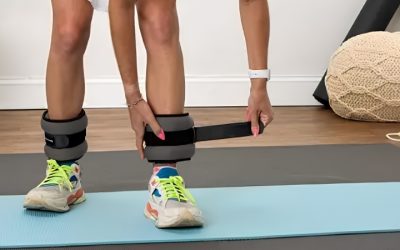
When a programme says to increase load every fortnight, a cuff with countable bars turns that into a simple instruction: add one per side. The span from roughly 2 lb to 10 lb per pair covers most of the range a lower-limb rehabilitation programme travels through, all in one item.
The honest constraint is manual dexterity. Sliding bars in and out of fabric channels takes two working hands and reasonable grip strength. If that is part of what you are recovering from, set the weight while someone can help and leave it alone between reviews.
Best for Exact Prescribed Loads: BAGAIL Ankle and Wrist Weights
When the instruction is precisely one pound, a sealed one-pound cuff removes all doubt. The half-pound option is particularly useful for early-stage shoulder and arm work, where increments most fitness gear ignores are exactly what the programme calls for.
The obvious limitation is that these do not adjust. A programme that steps from 1 lb to 2 lb to 3 lb means owning three cuffs, though for a fixed short-term protocol that may still be the simplest route.
Easiest to Put On: Amazon Basics Adjustable Ankle Weights
A plain wrap with a broad closure is the least demanding cuff to fasten while sitting in a chair. There is no threading, no buckle to line up, and no small parts to drop on the floor — which is a genuine advantage when the alternative is asking someone for help every session.
Padding is minimal, and over a prominent ankle bone that can become uncomfortable during longer sets. A crew sock beneath the cuff solves it entirely and costs nothing.
Best for Later-Stage Loading: Adjustable Ankle Weights, 1–20 lb Pair
Rehabilitation eventually becomes strength training, and at that point 5 lb per ankle stops being enough. Steps through 6, 8, 10, 12, 15 and 20 lb per pair mean the same equipment carries you from early-stage control work to genuine loading.
The tradeoff is physical bulk. A heavily loaded cuff sits tall on the leg and can bump the back of the thigh during deep knee flexion, which changes the exercise you were trying to do. Use the lower settings for seated work and save the heavy end for standing drills.
Frequently Asked Questions
Where exactly should the cuff sit for leg raises?
Just above the ankle bone unless your programme says otherwise. Moving it higher up the shin shortens the lever and reduces the effective load, which quietly makes the exercise easier than prescribed.
Can I substitute a heavier cuff for more reps?
Ask whoever wrote the programme. Load and repetitions are chosen together for a reason after an injury, and swapping one for the other changes the tissue stress in ways that are not always obvious.
Is it normal to feel it in the knee rather than the hip?
During straight leg raises some knee sensation is common, but sharp or increasing pain is not. Reduce the load, confirm the cuff position, and raise it with the clinician who set the programme.
How do I keep them clean for daily use?
Wipe the inside face with mild soap and water and let it dry fully before the next session. Daily use without drying is what turns a comfortable neoprene cuff into an irritating one within a few weeks.
Final Thoughts
For programme-driven use, choose repeatability first. A fixed BAGAIL cuff at the exact prescribed weight removes ambiguity, a bar-and-channel Sportneer pair makes scheduled increases easy, and the 1–20 lb ladder is there for when the work turns into ordinary strength training. Whatever you pick, position it consistently just above the ankle bone — the lever length matters as much as the number printed on the cuff.
Write Your Review
No reviews yet. Be the first to share your experience!