
Key takeaways
- Frame Type: A-Frame
- Material: Metal
- Item Dimensions D x W x H: 12.8"D x 14.37"W x 25.98"H
The triceps take up about two-thirds of your upper arm, and the long head — the slab that runs down the back and actually crosses the shoulder joint — only gets fully stretched when your elbow is overhead. That single anatomical detail explains why a person can grind through hundreds of cable pushdowns and still have arms that look flat from the side. Dumbbells fix it, because they let you get into positions a bar or a machine won’t allow: a genuine overhead extension, a bench-supported skull crusher with your forearms tracking independently, a Tate press where the weights meet on your chest, kickbacks held at lockout until the muscle burns out.
The catch is load. Skull crushers and close-grip presses eat weight fast, while single-arm kickbacks want something in the 8–15 lb range, and the jump between those two happens in the same workout. A pair of fixed 30s gets you nowhere. What actually works is either a broad-range adjustable pair with small steps between settings, or a rack of cheap fixed hex dumbbells if you have the floor space. Below are six pieces of equipment that cover both routes, plus the bench that makes half these movements possible in the first place.
Our top picks
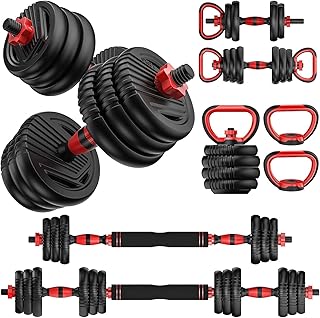


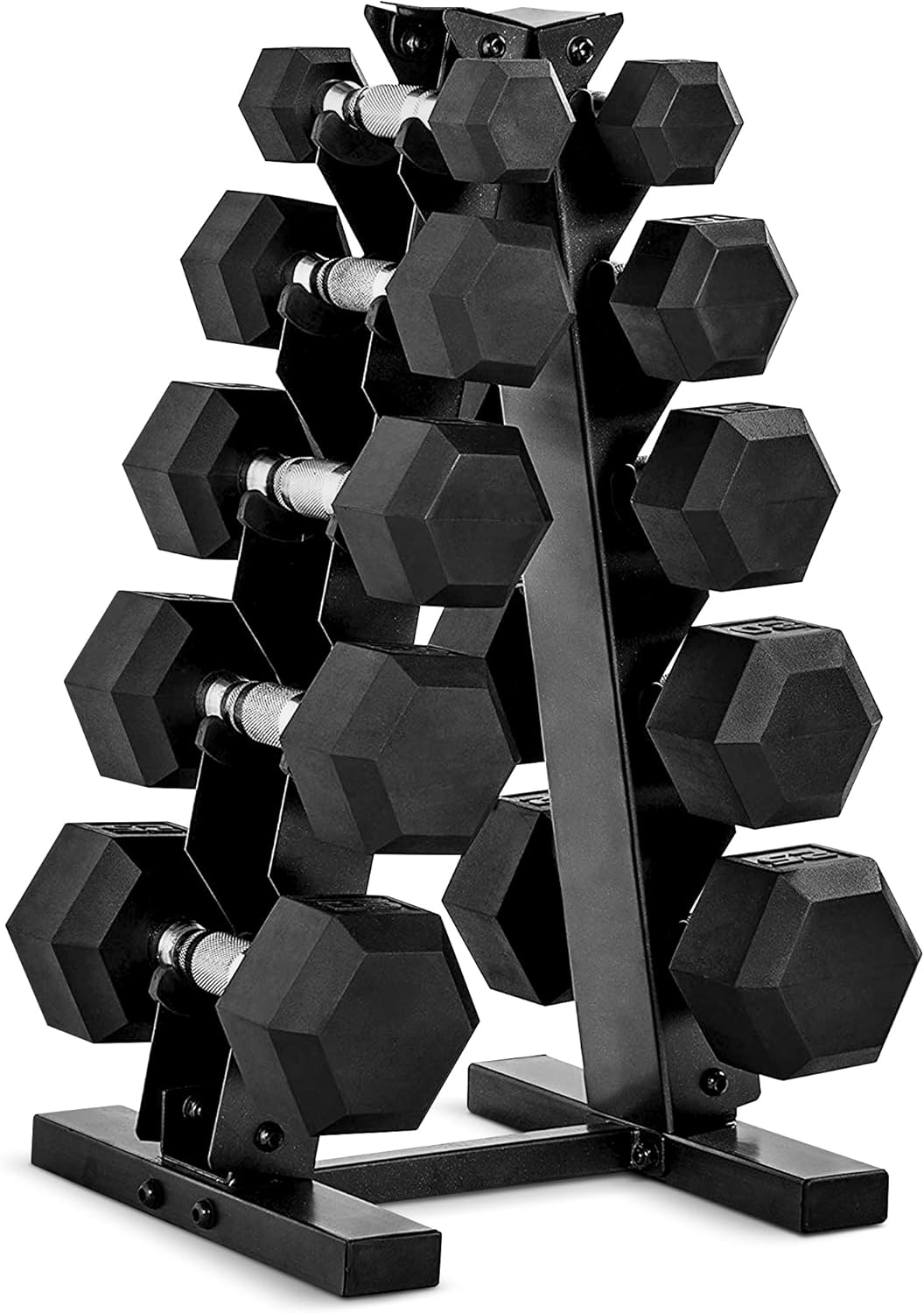 CAP Rubber Coated Hex Dumbbell Set with
- Frame Type: A-Frame
- Material: Metal
- Item Dimensions D x W x H: 12.8"D x 14.37"W x 25.98"H
Rubber-coated heads protect floors and reduce noise
A-frame rack keeps the full set organized off the floor
Knurled steel handles aid secure grip during lifts
150-pound total set offers no higher weight options
Warranty coverage runs only 30 days from purchase

As an Amazon Associate we earn from qualifying purchases at no extra cost to you.
As an Amazon Associate we earn from qualifying purchases.

Quick Comparison
| Pick | Type | Weight Range (per hand) | Adjustment Style | Best For |
|---|---|---|---|---|
| Bowflex SelectTech 552 | Dial adjustable | 5–52.5 lb | Twin dials, 2.5 lb steps early | Balanced all-round home setup |
| NÜOBELL 80 lb Classic | Twist-handle adjustable | 5–80 lb | Rotate handle in cradle | Heavy close-grip and floor pressing |
| PowerBlock Elite EXP | Selector-pin block | 5–50 lb (expandable) | Pin plus adder weights | Smallest footprint, fastest changes |
| Amazon Basics Rubber Hex | Fixed | Sold singly, 5–50 lb | None | Kickbacks and drop sets |
| Yes4All Spinlock Set | Plate-loaded | Varies by plates owned | Threaded collars | Tight budgets, micro-loading |
| FLYBIRD Adjustable Bench | Bench | — | Ladder-pin incline/decline | Skull crushers, presses, seated overhead |
How to Choose
- Check the increment, not just the ceiling. Triceps isolation progresses in small jumps. A pair that leaps from 20 to 30 lb forces you to stall for weeks; 2.5–5 lb steps in the lower half of the range matter far more than a headline 80 lb maximum.
- Measure the handle length and end-cap width. Adjustable dumbbells are long. For a close-grip press or a two-hand overhead extension, wide end caps collide with each other or with your forearms. Fixed hexes and blocks are the most forgiving here.
- Think about the drop. Overhead extensions fail overhead, and skull crushers fail near your forehead. Selector-mechanism dumbbells should not be dumped on concrete, so plan on lighter singles for the risky sets or train near a mat.
- Count how often you’ll change weight. A superset of skull crushers into kickbacks means two weight changes per round. Dial and pin systems handle that in seconds; spinlock collars will cost you a minute each time and wreck the pace.
- Budget for the bench before the third dumbbell purchase. Lying extensions, decline skull crushers, and bench-supported single-arm work all need a stable surface. A wobbly bench limits how much weight you’ll trust yourself with, which caps the whole program.
Top Picks Reviewed
Bowflex SelectTech 552 — the default for a reason
Two dials, fifteen settings, 5 to 52.5 lb per hand with 2.5 lb steps through the lighter half. That granularity is exactly what triceps work wants: you can nudge a single-arm overhead extension up by two and a half pounds instead of guessing. The trade-off is length — these are long dumbbells, and pressing them close-grip takes some getting used to. Set the dials fully before lifting; a half-seated plate rattles, and that’s your cue to reseat it in the tray.
NÜOBELL 80 lb Classic — for the heavy end
You grab the handle, twist it, and lift. No dials, no pins, and the whole cycle takes about two seconds, which makes it the best of this group for descending sets. The 80 lb ceiling per hand means close-grip dumbbell presses and neutral-grip floor presses stay challenging for years. Steps are 5 lb across the range, so pair it with a light fixed dumbbell if you want finer control on kickbacks. It must return to its cradle to change weight, so the stands aren’t optional storage — they’re part of the mechanism.
PowerBlock Elite EXP — the footprint winner
The cage-and-pin design keeps the weight compact and close to your hand, which is genuinely useful for overhead work: less mass hanging out past your wrist means less shoulder wobble at the top. Selecting a weight is a single pin pull. Expansion kits push it well past 50 lb per hand later. Some people never warm to the rectangular handle opening, so check clearance for your knuckles if you have large hands or lift in gloves.
Amazon Basics Rubber Encased Hex — buy singles, not sets
The smartest use of these isn’t as your main pair. Buy two or three individual weights in the 10–25 lb range and use them for kickbacks, single-arm overhead extensions, and the tail end of drop sets. The rubber coating protects floors, the hex heads don’t roll, and you can drop them without a second thought. Cheap, indestructible, and they let your adjustable pair stay parked at one heavy setting.
Yes4All Adjustable Spinlock — the low-cost route
Threaded handles with cast-iron plates and screw-on collars. Slow to change, and you’ll spend part of every session spinning collars, but the price per pound is unbeatable and you can micro-load with small plates in a way no selector dumbbell allows. Tighten the collars hard — a plate sliding mid-skull-crusher is the one failure mode worth being genuinely careful about. Best suited to a program with few weight changes per session.
FLYBIRD Adjustable Bench — the piece that unlocks everything
Multiple back positions plus a seat that adjusts, a high stated load capacity, and it folds flat against a wall when you’re finished. Set it to a slight decline for skull crushers and the long head gets loaded harder than it does flat; sit it upright with back support for seated overhead extensions and your lower back stops being the limiting factor. Assembly is short, and the pad is firm enough that it doesn’t sink under a heavy press.
Frequently Asked Questions
Which dumbbell triceps exercise builds the most size?
Overhead extensions have the strongest case, because they place the long head under load in a lengthened position — and the long head is the largest of the three heads. Pair one overhead movement with one pressing movement, like a close-grip or neutral-grip dumbbell press, and you’ve covered the muscle properly.
How heavy should my dumbbells be for triceps work?
Most people need less than they expect for isolation and more than they expect for pressing. Kickbacks are effective at 10–20 lb; lying extensions typically land in the 20–35 lb range per hand; close-grip presses can climb far past that. That spread is the argument for an adjustable pair with a wide range.
Can I train triceps with dumbbells and no bench?
Yes. Floor presses, standing or seated overhead extensions, and bent-over kickbacks all work without a bench, and the floor press has a built-in safety stop for your elbows. You’ll lose decline skull crushers and the incline variations, which is a real gap but not a fatal one.
How often should I train triceps?
Two sessions a week, with 6–10 hard sets spread across them, suits most lifters — and remember that pressing for chest and shoulders already taxes the triceps. If your elbows feel tender, cut the skull crushers before you cut the volume; they’re usually the culprit.
Final Thoughts
If you want one purchase to solve this, get a wide-range adjustable pair and a bench, then add two cheap fixed hex dumbbells in the light range for kickbacks and drop sets. The SelectTech 552 wins on increment size, the NÜOBELL on speed and ceiling, the PowerBlock on space. None of them will out-train an honest program: one overhead movement, one press, controlled eccentrics, and enough patience to add 2.5 lb at a time. The equipment removes the excuses — the arms come from showing up.
8 Best Ab Workouts with Dumbbells: 6 Support Picks Compared
Best ab workouts with dumbbells are limited more often by position than...
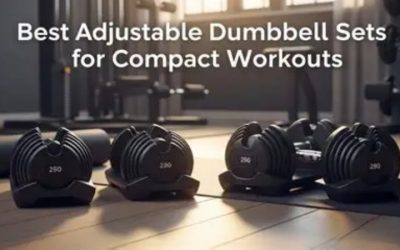
Best Budget Adjustable Dumbbell: 6 Picks and Trade-Offs
Best budget adjustable dumbbell shopping is really a question about what you...
Best Abs Exercise with Dumbbells: 6 Picks by Coating Type
Best abs exercise with dumbbells movements rest the weight against your chest,...
Best Abs Workout with Dumbbells: 6 Picks for Fast Circuits
Best abs workout with dumbbells formats are almost always circuits, and circuits...
Best at Home Dumbbells: 6 Picks for Sharing a Household
Best at home dumbbells guides assume one user. Most households have two,...
Best Dumbbells Home Gyms Use: 6 Picks Ranked by Delivery
Best dumbbells home buyers compare weight ranges and then discover the real...
8 Best Ab Exercises with Dumbbells: 6 Floor-Friendly Picks
Best ab exercise with dumbbells options are mostly done lying down, which...
Best Dumbbell Set for Home Gym: 5 Picks Ranked by Space
Best dumbbell set for home gym shopping starts with a definition problem....
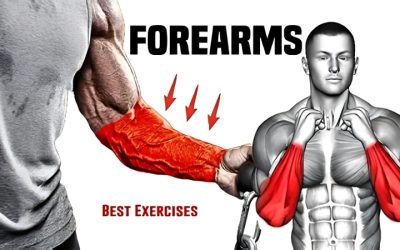
8 Best Workouts for Forearms with Dumbbells: 5 Gear Choices
Best workout for forearms with dumbbells depends less on the exercise list...
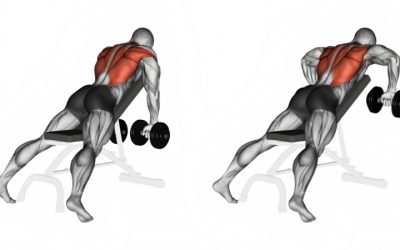
Best Lat Exercises Dumbbells: 6 Picks for Heavy Row Work
Best lat exercises dumbbells face a problem arm work never does: the...
Write Your Review
No reviews yet. Be the first to share your experience!