Key takeaways
- Tooth count: Use roughly 40–50 teeth for versatile ripping and crosscutting; choose este 80 teeth for exceptionally clean crosscuts, with slower feed rates.
- Tooth geometry: ATB teeth excel at crosscutting and edge quality, while combination grinds balance rip performance with cleaner crosscuts.
- Kerf: A thin-kerf blade removes less material and demands less motor power, but it can deflect more readily if the plate lacks adequate stiffness.
- Carbide and sharpening: Dense, well-ground carbide lasts longer in abrasive hardwood and can usually be sharpened several times before replacement.
- Vibration control: Laser-cut expansion slots and stabilizing features reduce ringing, tooth chatter, and heat buildup—important for repeatable furniture-grade cuts.
What's inside
Hardwood exposes every weakness in a table-saw blade. A dull or poorly balanced blade can leave burn marks, chipped edges, excessive noise, and a cut surface that requires laborious sanding. The wrong tooth geometry can also make a blade feel harsh in dense maple, oak, walnut, or hickory, particularly when the saw is underpowered or the stock is wide.
This guide focuses on the practical details that matter in a home furniture shop: carbide quality, tooth configuration, vibration control, kerf, cut speed, and how well each blade suits ripping, crosscutting, or general-purpose work. The recommendations cover premium combination blades as well as economical fine-finish options, so you can match the blade to both your projects and your table saw.
As an Amazon Associate we earn from qualifying purchases.




🛒 Best Price Today on Amazon
Prime members get fast, free shipping on everything above, plus member-only deals. New members get a 30-day free trial — cancel anytime.
How to Choose a Table Saw Blade For Hardwood (2026)
- Tooth count: Use roughly 40–50 teeth for versatile ripping and crosscutting; choose este 80 teeth for exceptionally clean crosscuts, with slower feed rates.
- Tooth geometry: ATB teeth excel at crosscutting and edge quality, while combination grinds balance rip performance with cleaner crosscuts.
- Kerf: A thin-kerf blade removes less material and demands less motor power, but it can deflect more readily if the plate lacks adequate stiffness.
- Carbide and sharpening: Dense, well-ground carbide lasts longer in abrasive hardwood and can usually be sharpened several times before replacement.
- Vibration control: Laser-cut expansion slots and stabilizing features reduce ringing, tooth chatter, and heat buildup—important for repeatable furniture-grade cuts.
The Best Table Saw Blade For Hardwood (2026)s Reviewed
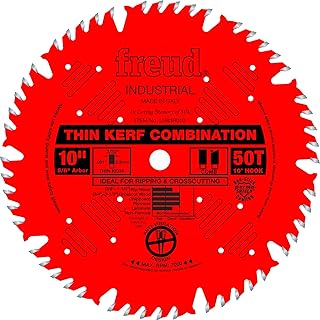
Freud LU83R010 Industrial Combination Blade
The Freud LU83R010 is a strong all-rounder for furniture builders who want one blade to handle both ripping and crosscutting. Its 50-tooth combination grind, thin kerf, TiCo high-density carbide, and laser-cut anti-vibration slots make it a particularly sensible choice for portable or modestly powered saws. It balances efficient stock removal with an edge clean enough for most joinery.
CMT Orange Tools 256.050.10 Combination Blade
CMT’s 50-tooth blade uses an ATB-and-flat-tooth combination pattern that gives it useful versatility without becoming overly aggressive. It is well suited to hardwood panels, cabinet parts, and general workshop work where a smooth crosscut and reasonable ripping speed are both valuable. Its 5/8-inch arbor fits most standard 10-inch table saws, but always verify arbor and guard compatibility first.
Freud LU85R010 Crosscutting Blade
The Freud LU85R010 is the better specialist option when clean crosscuts matter more than rapid ripping. Its carbide-tipped teeth are designed to leave hardwood ends crisp and minimize splintering, making it a good companion for face frames, trim components, and cut-to-length operations. For long rips, however, a lower-tooth-count combination or rip blade will generally feed more comfortably.
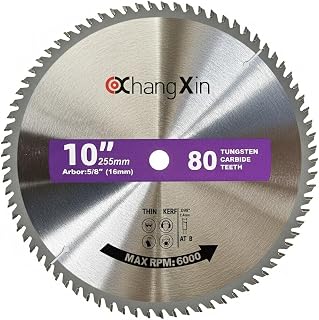
10-Inch 80T Premium Carbide Wood-Cutting Blade
This 80-tooth blade targets smooth crosscutting in both hardwood and softwood, making it useful for visible furniture parts where sanding should be minimal. The high tooth count naturally trades cutting speed for surface quality, so it is best used with a controlled feed and properly supported stock. Check the blade’s maximum RPM and kerf before fitting it to a table saw.
WEN BL1080 80-Tooth Ultra-Fine Finish Blade
The WEN BL1080 offers an accessible route to very clean crosscuts on a table saw or miter saw. Its 80-tooth carbide-tipped layout is appropriate for delicate hardwood edges, plywood faces, and small components, though it is not the efficient choice for repeated deep ripping. A steady feed and a clean, accurately aligned saw will help this blade deliver its intended finish.
Frequently Asked Questions
Is a 40- or 50-tooth blade better for hardwood?
For most furniture work, a quality 40- or 50-tooth combination blade is the most practical starting point. It can rip boards without excessive effort while still producing respectable crosscuts. An 80-tooth blade is preferable when crosscut appearance takes priority.
Can an 80-tooth blade rip hardwood?
It can, but it is usually inefficient. The closely spaced teeth remove less material per tooth, which slows feeding and increases the chance of heat buildup or burning. Use it for short rips only, and choose a combination or dedicated rip blade for long cuts.
Should I choose thin kerf for a home table saw?
Often, yes. Thin kerf reduces the power required to push hardwood through the cut, which benefits compact saws. The trade-off is greater sensitivity to blade deflection, so maintain a sharp blade, align the fence carefully, and avoid forcing stock sideways.
How often should a hardwood blade be sharpened?
Sharpening frequency depends on footage, wood species, adhesives, and cutting technique. Dullness, burning, rough edges, and increased feed pressure are practical warning signs. Have a reputable sharpening service assess the blade rather than waiting until carbide teeth are damaged.
Final Thoughts
For a dependable everyday choice, the Freud LU83R010 is the strongest balance of durability, low vibration, and versatile cutting. Choose the CMT Orange Tools combination blade when you want similar all-purpose flexibility, or the Freud LU85R010 when pristine hardwood crosscuts are the main priority.