Key takeaways
- Rail design and travel feel: Push the head through its full stroke before committing. Linear bearings on hardened rails should glide with even resistance from front to back. Any stiction, gritty patches, or vertical play translates directly into a stepped, out-of-square cut face on 10-inch stock.
- Control placement over control count: The bevel lock, miter detent override, and slide lock should all be reachable without shifting your stance or letting go of the workpiece. Rear-mounted bevel levers force you to lean over the blade path, which is both a fatigue and a safety problem across a long session.
- Fence height and clamp geometry: Tall sliding fences support crown and wide case sides upright, but they must retract cleanly for steep bevels. Check that the included hold-down clamp actually reaches your typical stock thickness rather than bottoming out on the table.
- Weight versus mobility: A heavier cast base damps vibration and holds calibration, but 55 to 65 pounds is a genuine two-hand lift. If the saw moves between a stand and a shelf, prioritize a balanced carry handle and a head that locks down securely for transport.
- Serviceability and dust capture: Look for accessible brush caps, replaceable bearings, and a shroud that channels waste efficiently. Dust collection is a durability issue as much as a health one, since fine hardwood grit is what eventually roughens rails and clogs detent plates.
What's inside
Most miter saw shopping goes wrong in the same way: buyers compare blade diameter and amperage, get the saw home, and then spend the next three years fighting the machine instead of the wood. The complaints are rarely about power. They’re about a bevel lock buried behind the motor, a slide action that binds halfway through a wide crosscut, a trigger that demands a full-hand squeeze while your left arm holds a 6-foot walnut board flat, and a detent plate that has drifted a half-degree by the second season. Those are ergonomic and durability failures, and they show up in your joinery long before they show up in a spec sheet.
This guide evaluates sliding miter saws the way a shop that runs one daily would: how the controls fall under your hands, how the rails behave when they’re dirty, how the head resists deflection during a bevel cut, and which parts are serviceable when something eventually wears. It’s written for people building furniture in a garage or basement, where the saw gets moved, bumped, and asked to hold tight tolerances on hardwood. Below are the models worth your attention this year, followed by the criteria that separate a saw you tolerate from one you trust.
As an Amazon Associate we earn from qualifying purchases.


🛒 Best Price Today on Amazon
Prime members get fast, free shipping on everything above, plus member-only deals. New members get a 30-day free trial — cancel anytime.
How to Choose a Sliding Miter Saw (2026)
- Rail design and travel feel: Push the head through its full stroke before committing. Linear bearings on hardened rails should glide with even resistance from front to back. Any stiction, gritty patches, or vertical play translates directly into a stepped, out-of-square cut face on 10-inch stock.
- Control placement over control count: The bevel lock, miter detent override, and slide lock should all be reachable without shifting your stance or letting go of the workpiece. Rear-mounted bevel levers force you to lean over the blade path, which is both a fatigue and a safety problem across a long session.
- Fence height and clamp geometry: Tall sliding fences support crown and wide case sides upright, but they must retract cleanly for steep bevels. Check that the included hold-down clamp actually reaches your typical stock thickness rather than bottoming out on the table.
- Weight versus mobility: A heavier cast base damps vibration and holds calibration, but 55 to 65 pounds is a genuine two-hand lift. If the saw moves between a stand and a shelf, prioritize a balanced carry handle and a head that locks down securely for transport.
- Serviceability and dust capture: Look for accessible brush caps, replaceable bearings, and a shroud that channels waste efficiently. Dust collection is a durability issue as much as a health one, since fine hardwood grit is what eventually roughens rails and clogs detent plates.
The Best Sliding Miter Saws (2026), Reviewed
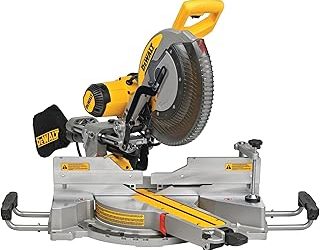
DEWALT DWS780 12-Inch Double Bevel Sliding Compound
The benchmark for a reason: the rail action stays consistent under load, the double bevel range is genuinely usable from the operator side, and the XPS shadow line beats any laser for repeatable layout because it shows actual blade width rather than an approximation. Expect real weight and plan a permanent station for it.
DEWALT DWS779 12-Inch Double Bevel Sliding Compound
Mechanically close to the DWS780 with the same crosscut capacity and a strong 3,800 RPM motor, trading the shadow light for a lower price. If you already work under good task lighting and mark your cuts carefully, this is the value pick in the full-size sliding class.
DOVAMAN 10-Inch Sliding Miter Saw
The ambidextrous control layout is the standout here, letting left-handed users work without reaching across the blade, and the dual-speed motor plus three included TCT blades make it flexible for mixed materials. Capacity is respectable at 3.5 by 13.4 inches, though the lighter frame rewards a rigid stand.
12-Inch Dual Bevel Slider with Extension Table
A budget-conscious dual bevel option with an 80-tooth blade, laser guide, and integrated extension wings that reduce the need for outboard supports on longer furniture parts. Verify the wings sit dead flat with the table before your first precision cut, and treat the supplied blade as adequate rather than final.
DEWALT DWS715 12-Inch Single Bevel Compound
Not a slider, and that’s the point. If your work is dominated by narrow stock like rails, stiles, and legs, this compound saw offers less to knock out of alignment, a smaller footprint, and excellent long-term stability at a fraction of the price of a full sliding rig.
Frequently Asked Questions
Is a 12-inch slider always better than a 10-inch?
No. Twelve-inch saws add vertical capacity and crosscut width, but they cost more per blade, spin slower at the rim, and weigh noticeably more. For furniture parts under roughly 3.5 inches thick, a good 10-inch slider is easier to handle and just as accurate.
How often should I check calibration?
Verify 90 and 45 degrees with a machinist square monthly under regular use, and always after transporting the saw. Detents feel positive long after they’ve drifted, so trust the square rather than the click.
Do I need a dust extractor?
The bag catches a fraction of what a saw produces. Connecting a shop vacuum with an appropriate filter dramatically improves both air quality and long-term mechanical cleanliness.
What blade should I upgrade to for furniture work?
A quality 60- to 80-tooth fine crosscut blade with a negative or low positive hook angle will reduce tearout on veneer and figured hardwood far more than any spec upgrade on the saw itself.
Final Thoughts
For a shop that expects the saw to outlast the projects, the DEWALT DWS780 remains the most refined package in terms of control reach, rail consistency, and layout accuracy, with the DWS779 delivering nearly identical mechanics for less. If your bench space or budget is tight and your stock is narrow, the DWS715 is the honest, durable answer, while the DOVAMAN 10-inch slider is the pick for left-handed users who want sliding capacity without the full-size weight penalty.