Key takeaways
- Kerf versus motor: Thin kerf (roughly .095″–.102″) removes less material, so a 1–1.75 HP contractor or jobsite saw stops bogging and you stop shoving. On a 3 HP cabinet saw, a full .125″ plate resists deflection better and tracks straighter through 8/4 stock.
- Vibration control: Laser-cut expansion slots, copper-filled or resin-filled joints, and a thick, tensioned plate are what keep buzz out of your palms. This is the single most underrated comfort spec on any blade.
- Carbide grade and tooth mass: Fine-grain, high-density carbide holds a keen edge through more board feet, and generous tooth bodies survive three or four sharpenings. A cheap blade replaced twice a year costs more in money and setup time than one good blade resharpened.
- Grind geometry: A 50-tooth 4+1 ATB configuration (four alternate-bevel teeth plus a flat raker, in gullet groups) is the classic combination layout: clean crosscuts without choking on rips. Straight 48–50T ATB grinds cut smoothly but clear sawdust more slowly in thick hardwood.
- Coatings and hook angle: Anti-friction coatings cut pitch buildup, and buildup is what silently raises feed force week over week. A moderate 15° hook keeps the blade pulling without grabbing thin stock.
What's inside
Most blade shopping goes wrong in the same quiet way: the buyer compares tooth counts, picks the highest number that fits the budget, and never considers what the blade does to their body over a four-hour session. Feed pressure is the tell. A dull or badly matched combination blade forces you to lean into the fence, which pushes your wrists out of neutral, loads your shoulders, and turns a controlled cut into a wrestling match. Add the low-frequency buzz of a thin, unstiffened plate and you finish the afternoon with numb fingertips and a stack of parts that need sanding anyway.
This guide looks at 10-inch combination blades through two lenses that rarely show up in spec sheets: how much effort the blade asks of your hands and arms, and how long it holds that behavior before the carbide rounds over. I’ve weighted plate flatness, anti-vibration design, kerf width relative to saw horsepower, carbide grade, and resharpenability. Prices and availability shift, so the cards below carry the current details.
As an Amazon Associate we earn from qualifying purchases.




🛒 Best Price Today on Amazon
Prime members get fast, free shipping on everything above, plus member-only deals. New members get a 30-day free trial — cancel anytime.
How to Choose a/an 10-Inch Combination Table Saw Blade (2026)
- Kerf versus motor: Thin kerf (roughly .095″–.102″) removes less material, so a 1–1.75 HP contractor or jobsite saw stops bogging and you stop shoving. On a 3 HP cabinet saw, a full .125″ plate resists deflection better and tracks straighter through 8/4 stock.
- Vibration control: Laser-cut expansion slots, copper-filled or resin-filled joints, and a thick, tensioned plate are what keep buzz out of your palms. This is the single most underrated comfort spec on any blade.
- Carbide grade and tooth mass: Fine-grain, high-density carbide holds a keen edge through more board feet, and generous tooth bodies survive three or four sharpenings. A cheap blade replaced twice a year costs more in money and setup time than one good blade resharpened.
- Grind geometry: A 50-tooth 4+1 ATB configuration (four alternate-bevel teeth plus a flat raker, in gullet groups) is the classic combination layout: clean crosscuts without choking on rips. Straight 48–50T ATB grinds cut smoothly but clear sawdust more slowly in thick hardwood.
- Coatings and hook angle: Anti-friction coatings cut pitch buildup, and buildup is what silently raises feed force week over week. A moderate 15° hook keeps the blade pulling without grabbing thin stock.
The Best 10-Inch Combination Table Saw Blade (2026)s Reviewed
Diablo D1050X
At .098″ kerf with a .071″ plate and Perma-Shield coating, this is the easiest-feeding blade here on underpowered saws, and the low-friction surface means the effort you feel in month six is close to the effort you felt on day one. Laser-cut stabilizer vents keep the plate quiet enough that long ripping sessions stay comfortable.
CMT Orange Tools 256.050.10
The 4+1 ATB grind and .102″ kerf on a .071″ plate strike a genuinely balanced compromise, giving glue-ready crosscuts without demanding a heavy push through hardwood rips. CMT’s plate flatness is consistently excellent, which shows up as less side-load fatigue on tall resaw-adjacent cuts.
Freud LU83R010
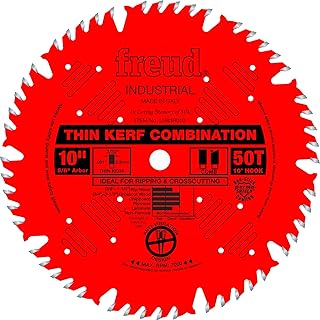
Freud’s TiCo hi-density carbide is the durability standout: edges stay crisp well past where budget carbide starts burnishing, and the teeth carry enough mass for multiple sharpenings. Anti-vibration slots make it one of the smoothest-running thin-kerf blades I’ve measured by feel.
US1048ATBFK 48T Combination
A USA-made full 1/8″ kerf blade for saws with the horsepower to use it, this one rewards you with rock-solid tracking and almost no deflection when you’re pushing wide panels. The 48-tooth count clears chips a bit better than 50T grinds in thick maple, so feed pressure stays predictable.
50T Thin Kerf ATB Combination Blade
A sensible value pick: 50 ATB carbide teeth, thin kerf, nonstick coating, and a 6,000 RPM rating cover general shop work without drama. Expect a shorter sharp-edge window than the premium options, which makes it a good second blade rather than a daily driver.
Frequently Asked Questions
Is a combination blade good enough, or do I need separate rip and crosscut blades?
For furniture work with mixed operations, a quality 50T combination blade handles both well and saves you the blade changes that eat time and encourage shortcuts. Dedicated 24T rip and 80T crosscut blades still win on their specialty tasks.
Does thin kerf sacrifice cut quality?
Only when the plate is underbuilt or the saw’s arbor runs out of true. A properly tensioned thin-kerf blade with expansion slots cuts as cleanly as a full-kerf blade on stock up to about 1-1/2″ thick.
How do I know when to sharpen?
Watch your hands, not the wood. If you’re pushing noticeably harder than you did last month, or you see burning on cuts that used to come out clean, the edges have rounded. Two to four sharpenings are typical on premium carbide.
Will an 80-tooth blade like the FOXBC replace a combination blade?
No. An 80T blade is a finish crosscut and plywood specialist. Rip solid hardwood with it and you’ll build heat, burn edges, and fight the feed.
Final Thoughts
If you want maximum working life and the least vibration reaching your hands, the Freud LU83R010 is the pick. Underpowered saw owners should start with the Diablo D1050X for its low feed effort and pitch-resistant coating, while the CMT 256.050.10 remains the most balanced all-round combination grind for a well-tuned shop saw.