Key takeaways
- Frame and table: Favor a rigid cast-iron or heavily braced frame and a broad table that resists deflection when supporting large panels. A smooth, durable surface also makes controlled feeding easier.
- Motor and speed: Match power to your material. Resawing thick hardwood demands more sustained torque, while dual-speed operation is useful when switching between wood types or blade applications.
- Blade tracking: Look for accessible upper and lower guides, reliable tracking adjustment, and tool-free or low-effort tension controls. Good alignment reduces wandering and premature blade wear.
- Resaw capacity: Throat depth and cutting height determine whether the saw can handle furniture components, veneers, and wide stock. Check both measurements rather than relying on the 14-inch label alone.
- Workshop ergonomics: Consider dust collection, handwheel placement, door access, noise, footprint, and whether the stand puts the table at a comfortable working height. These details affect accuracy and fatigue on long projects.
What's inside
Choosing a 14-inch band saw for a home workshop is less straightforward than comparing horsepower figures. A machine may look impressive on paper yet introduce vibration, awkward blade changes, limited resaw clearance, or a table that gradually loses alignment. Those shortcomings become especially noticeable when milling furniture parts, cutting hardwood, or repeating precise curves.
This guide evaluates the leading 14-inch models from an ergonomics-and-durability perspective. The emphasis is on stable cutting, practical adjustments, motor performance, serviceable construction, operator comfort, and the features most likely to matter after years of woodworking rather than during a quick showroom inspection.
As an Amazon Associate we earn from qualifying purchases.


🛒 Best Price Today on Amazon
Prime members get fast, free shipping on everything above, plus member-only deals. New members get a 30-day free trial — cancel anytime.
How to Choose a/an 14 Band Saw (2026)
- Frame and table: Favor a rigid cast-iron or heavily braced frame and a broad table that resists deflection when supporting large panels. A smooth, durable surface also makes controlled feeding easier.
- Motor and speed: Match power to your material. Resawing thick hardwood demands more sustained torque, while dual-speed operation is useful when switching between wood types or blade applications.
- Blade tracking: Look for accessible upper and lower guides, reliable tracking adjustment, and tool-free or low-effort tension controls. Good alignment reduces wandering and premature blade wear.
- Resaw capacity: Throat depth and cutting height determine whether the saw can handle furniture components, veneers, and wide stock. Check both measurements rather than relying on the 14-inch label alone.
- Workshop ergonomics: Consider dust collection, handwheel placement, door access, noise, footprint, and whether the stand puts the table at a comfortable working height. These details affect accuracy and fatigue on long projects.
The Best 14 Band Saw (2026)s Reviewed
JET JWBS-14SFX-BLK 14-Inch Band Saw
The JET Black 14-Inch Woodworking Band Saw is a strong choice for furniture makers who want substantial capacity without stepping into a production-size machine. Its 1.75 HP motor and rigid construction suit demanding resaw work, while the generously proportioned working area supports steady, low-strain material handling. It is the best all-around pick when durability and control matter more than minimizing footprint.
Powermatic PWBS-14CS
Powermatic’s 14-Inch Woodworking Bandsaw brings a reassuringly solid, workshop-grade feel to detailed cutting and thicker stock. The 1-1/2 HP motor provides useful reserve power, and the machine’s robust build helps damp vibration that can telegraph into delicate furniture parts. Choose it for long-term ownership and a premium, confidence-inspiring platform.
WEN BA1411 Industrial Band Saw
The WEN Industrial Band Saw offers practical versatility through its 1 HP dual-voltage motor and two-speed operation. It is well suited to serious home workshops that need flexibility for both routine curves and occasional resawing, although careful setup of the guides and tension remains essential. Its industrial styling and sensible capacity make it a compelling value-oriented option.
JET JWBS-14CS 14-Inch Band Saw
The JET JWBS-14CS is a sensible middle ground for hobbyists who want dependable construction without the greater motor capacity of JET’s higher-output model. Its 1 HP motor is appropriate for furniture components, joinery templates, and moderate hardwood work when the blade is sharp and feed pressure is controlled. It is especially attractive where predictable operation and a manageable workshop footprint take priority.
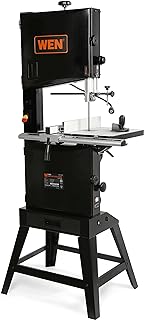
WEN BA1487 Band Saw with Stand
The WEN BA1487 combines a 14-inch saw with a dedicated stand, simplifying installation for buyers who do not already have a stable base. Its two-speed design adds useful material flexibility, while the stand can improve posture compared with placing a benchtop machine on an improvised surface. It is a practical entry point, provided the owner takes time to square the table and tune the guides.
Frequently Asked Questions
Is a 14-inch band saw large enough for furniture making?
For most home furniture projects, yes. A 14-inch model typically offers useful throat depth and cutting height for curves, tenons, small resawing jobs, and cabinet components, but verify the manufacturer’s actual capacity before buying.
How much motor power do I need?
A 1 HP motor is adequate for general woodworking with sensible feed rates and sharp blades. If you regularly resaw thick hardwood or work for extended periods, a 1-1/2 HP or 1.75 HP model provides more comfortable reserve power and reduces the temptation to force the cut.
Does dual-speed operation matter for wood?
It can. Variable or dual-speed capability lets you tailor blade speed to the stock and cut, though blade selection, tension, tracking, and feed technique usually have a greater effect on finish quality than speed alone.
What should I do before making the first cut?
Secure the saw on a rigid, level base, install the correct blade, check tracking and tension, square the table, set the guides close to the work, and connect dust collection if available. A short calibration routine improves safety, accuracy, and blade life.
Final Thoughts
The JET JWBS-14SFX-BLK is the strongest all-around choice for demanding home furniture work, while the Powermatic PWBS-14CS is appealing for buyers prioritizing heavy-duty longevity. For a more economical and flexible setup, the WEN BA1411 delivers useful dual-voltage, two-speed capability in a capable 14-inch format.