Key takeaways
- Air demand: Check the spray gun’s required CFM against your compressor’s delivered CFM, not merely its advertised peak. A compressor that cannot keep up causes pulsing, uneven coverage, and unnecessary fatigue.
- HVLP or LVLP: HVLP guns are familiar and efficient at moderate pressure, while LVLP models generally use less air and can be friendlier to smaller compressors. Neither is automatically better; the match to your compressor matters most.
- Nozzle flexibility: Smaller nozzles suit stains, dyes, and thinner finishes; medium sizes are useful for paint and clear coats; larger openings help with heavier primers. Interchangeable tips make one gun more versatile.
- Handling and controls: A balanced gravity-feed cup, smooth trigger, readable regulator, and easy-to-reach adjustment knobs reduce wrist strain. These details matter more than flashy accessory counts during a multi-hour project.
- Cleaning and durability: Look for corrosion-resistant fluid passages, replaceable seals, a sturdy cup, and a wrench that fits securely. Thorough cleaning after every use is essential, especially when switching between primer, color, and clear coat.
What's inside
Choosing a paint spray gun for an air compressor is less straightforward than it looks. A gun that produces a beautiful finish on a cabinet may struggle with thick primer, while an impressive-looking kit can become uncomfortable, wasteful, or difficult to clean after a long project. The right match depends on compressor capacity, nozzle size, coating viscosity, and how much control you need at the trigger.
This guide focuses on ergonomics, spray consistency, adjustability, and long-term practicality for furniture makers, DIY renovators, and careful home users. The recommendations cover HVLP and LVLP designs, with attention to regulator placement, grip comfort, included nozzle options, maintenance, and the realistic demands of painting furniture, trim, cabinets, and occasional automotive parts.
As an Amazon Associate we earn from qualifying purchases.



🛒 Best Price Today on Amazon
Prime members get fast, free shipping on everything above, plus member-only deals. New members get a 30-day free trial — cancel anytime.
How to Choose a/an Paint Spray Gun For Air Compressor (2026)
- Air demand: Check the spray gun’s required CFM against your compressor’s delivered CFM, not merely its advertised peak. A compressor that cannot keep up causes pulsing, uneven coverage, and unnecessary fatigue.
- HVLP or LVLP: HVLP guns are familiar and efficient at moderate pressure, while LVLP models generally use less air and can be friendlier to smaller compressors. Neither is automatically better; the match to your compressor matters most.
- Nozzle flexibility: Smaller nozzles suit stains, dyes, and thinner finishes; medium sizes are useful for paint and clear coats; larger openings help with heavier primers. Interchangeable tips make one gun more versatile.
- Handling and controls: A balanced gravity-feed cup, smooth trigger, readable regulator, and easy-to-reach adjustment knobs reduce wrist strain. These details matter more than flashy accessory counts during a multi-hour project.
- Cleaning and durability: Look for corrosion-resistant fluid passages, replaceable seals, a sturdy cup, and a wrench that fits securely. Thorough cleaning after every use is essential, especially when switching between primer, color, and clear coat.
The Best Paint Spray Gun For Air Compressor (2026)s Reviewed
Best Versatile Starter Kit: HVLP Air Spray Gun
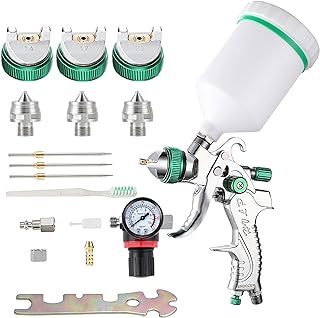
This HVLP spray gun stands out for its broad nozzle selection, regulator, and generous collection of mixing cups and lids. The 1.4, 1.7, and 2mm options give furniture users room to move from thinner finishes toward heavier coatings, although careful thinning and straining remain necessary. Its accessory-heavy format is practical for beginners who want fewer separate purchases, but the added parts make organized cleaning and storage especially important.
Best Low-Air Option: LVLP Gravity Spray Gun Set
This LVLP set is a sensible choice when the available compressor is capable but not especially large. Its 1.3, 1.5, and 1.7mm nozzles cover common automotive and furniture applications, while the gravity-feed layout helps keep the gun compact and balanced. The regulator improves control, but users should still test fan width and fluid flow on scrap material before approaching a visible panel.
Best for Controlled Finishes: AEROPRO Tools R500 LVLP
The AEROPRO R500 LVLP is a focused option for users who value predictable handling over a sprawling accessory bundle. Its multiple nozzle sizes and included air regulator support work ranging from furniture varnish and top coat to automotive refinishing. The lighter-air LVLP approach can reduce compressor cycling, though steady technique and the correct hose setup remain essential for a uniform finish.
Best User-Friendly Kit: InoKraft D1 LVLP
The InoKraft D1 is designed around approachable DIY use, making it attractive for house projects and occasional car work. Its 1.3, 1.5, and 1.7mm tips provide useful adjustment without overwhelming a new sprayer, and the included accessories help shorten the setup process. For durability, treat the fluid nozzle and needle as precision parts: avoid overtightening, remove residue promptly, and store the gun dry.
Best for Conventional HVLP Work: ENDOZER Professional HVLP
The ENDOZER combines a gravity-feed cup, regulator gauge, and three nozzle sizes in a format suited to primer, clear coat, and touch-up work. It is explicitly not suitable for latex paint, so it is better viewed as a finishing tool than a universal house-painting solution. Its gauge can help users establish repeatable settings, but the gun still rewards properly prepared material and deliberate passes.
The TCP Global G6600-13 is another worthwhile option for buyers specifically seeking a 1.8mm HVLP gun for basecoat, clearcoat, and primer. Its more specialized nozzle size makes it less flexible for very fine furniture details, but it may suit users who prefer a straightforward automotive-oriented setup.
Frequently Asked Questions
What size compressor does a paint spray gun need?
There is no single answer because air requirements vary by gun and pressure setting. Compare the manufacturer’s CFM requirement with your compressor’s continuous delivered CFM, leaving a margin rather than operating at the absolute limit.
Is HVLP or LVLP better for furniture?
Both can produce excellent furniture finishes. HVLP is widely supported and easy to understand, while LVLP can be advantageous when your compressor has limited air output. Surface preparation, coating reduction, gun distance, and overlap usually influence the result more than the label.
Can these spray guns apply latex paint?
Only when the specific gun and coating instructions allow it. Latex is comparatively heavy and may require substantial thinning, a larger nozzle, and a compressor capable of sustained airflow. The ENDOZER model listed above specifically states that it is not suitable for latex paint.
How do I prevent spray patterns from becoming uneven?
Clean the air cap and fluid tip, strain the coating, verify compressor pressure, and make a test pass on cardboard or scrap wood. Keep the gun perpendicular to the surface, maintain a consistent distance, and overlap each pass by roughly half the fan width.
Final Thoughts
For broad versatility, the HVLP Air Spray Gun with multiple nozzles and cups is a practical starting point. The AEROPRO R500 is the stronger choice for controlled LVLP work, while the InoKraft D1 offers an approachable balance for home projects. Whichever model you choose, compressor compatibility and disciplined cleaning will do more for durability and finish quality than any accessory bundle.