Key takeaways
- Sustained CFM, not peak: Match the compressor’s rating at 40 PSI to your gun’s requirement, then add roughly 30% headroom. An LVLP gun drawing 4 CFM on a unit rated 4 CFM will run the motor nonstop and never recover between passes.
- Tank as a buffer, not a substitute: Six to eight gallons smooths out pressure swings across a long panel. Smaller tanks still work if the pump keeps up, but you’ll hear it cycle far more often.
- Pump construction and duty cycle: Oil-free aluminum pumps are lighter and maintenance-free; cast-iron and twin-stack designs run cooler and last longer under repeated cycling. Look for a stated duty cycle above 50% if you spray full projects in one session.
- Handling geometry: Check where the handle sits relative to the tank’s center of mass. A grip that’s offset forward forces you to counterbalance with your wrist, and that’s what turns a 55-pound unit into a two-person job.
- Thermal and electrical protection: Overload protection with a manual reset saves motors during long spray sessions on marginal circuits. Also confirm the amp draw fits your shop’s breaker before you commit.
What's inside
Spraying finish on furniture punishes a compressor in a way nail guns never do. A brad gun asks for a half-second burst every few seconds; an HVLP or LVLP gun asks for continuous air at a stable pressure for as long as it takes to lay a wet edge across a tabletop. Undersized units respond by cycling constantly, heating up, and pushing warm, moisture-laden air into your finish. The result shows up as orange peel, dry spray, or a pressure sag halfway down a panel that no amount of technique can hide.
This guide looks at the problem the way a durability tester would: sustained CFM at the pressure your gun actually needs, pump construction and duty cycle, thermal protection, and the physical details that decide whether you dread moving the thing. Noise matters too, because a 90 dBA pancake in a garage bay changes how long you’re willing to work. Below are the compressors that hold up best for furniture-scale spray work in 2026.
As an Amazon Associate we earn from qualifying purchases.



🛒 Best Price Today on Amazon
Prime members get fast, free shipping on everything above, plus member-only deals. New members get a 30-day free trial — cancel anytime.
How to Choose a/an Air Compressor For Spray Gun (2026)
- Sustained CFM, not peak: Match the compressor’s rating at 40 PSI to your gun’s requirement, then add roughly 30% headroom. An LVLP gun drawing 4 CFM on a unit rated 4 CFM will run the motor nonstop and never recover between passes.
- Tank as a buffer, not a substitute: Six to eight gallons smooths out pressure swings across a long panel. Smaller tanks still work if the pump keeps up, but you’ll hear it cycle far more often.
- Pump construction and duty cycle: Oil-free aluminum pumps are lighter and maintenance-free; cast-iron and twin-stack designs run cooler and last longer under repeated cycling. Look for a stated duty cycle above 50% if you spray full projects in one session.
- Handling geometry: Check where the handle sits relative to the tank’s center of mass. A grip that’s offset forward forces you to counterbalance with your wrist, and that’s what turns a 55-pound unit into a two-person job.
- Thermal and electrical protection: Overload protection with a manual reset saves motors during long spray sessions on marginal circuits. Also confirm the amp draw fits your shop’s breaker before you commit.
The Best Air Compressor For Spray Gun (2026)s Reviewed
California Air Tools 8010 PK with LVLP Kit
The 60 dBA rating is the headline, but the durability story is the low-RPM 1,680 motor, which runs cooler and wears more slowly than the screaming universal motors on jobsite units. Paired with the included LVLP gun and an 8-gallon steel tank on wheels, it’s the most complete furniture-finishing package here, and the upright footprint keeps it out of your walking path.
Rolair FC2002 Twin Stack
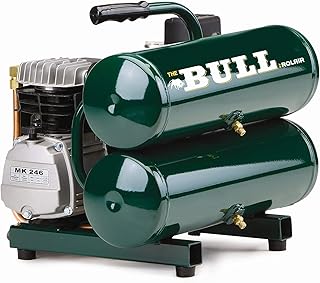
This is the one I’d buy if I sprayed weekly for years. The cast-iron pump, twin-stack tank geometry, and overload protection with manual reset are all designed around repeated thermal cycling, and the low-profile stacked layout carries far more comfortably than its weight suggests.
Rolair JC10 Plus
A 2.5-gallon compressor that punches well above its class thanks to a genuinely robust pump and a roll cage that survives being tossed in a truck bed. Best suited to touch-ups, detail guns, and smaller pieces rather than full dining tables, but the build quality is exceptional for the size.
Metabo HPT EC914S Pancake
Four CFM and 200 PSI storage give this pancake real staying power, and the oil-free pump means no maintenance schedule to forget. The tradeoff is noise and a wide, low profile that’s awkward to carry one-handed up stairs, so treat it as a stationary shop unit.
MZB 2.4 Gallon Ultra Quiet
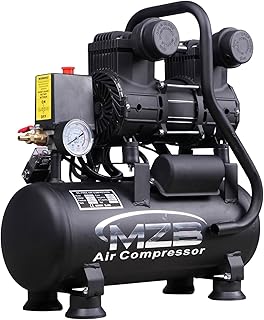
At 5.65 CFM from a 70 dB oil-free pump, this is the value pick for anyone spraying cabinet doors and small case goods. Dual steel tanks keep the footprint tight, though the 115 PSI ceiling means less reserve than the larger units when you’re chasing a long wet edge.
Frequently Asked Questions
How many CFM do I need for furniture spraying?
Most LVLP guns need 2 to 4 CFM at 40 PSI, while conventional HVLP guns can ask for 8 or more. Check your gun’s spec sheet, then choose a compressor rated at least 30% higher.
Does an oil-free pump hurt my finish?
No. Oil-free pumps eliminate the risk of oil carryover into your air line entirely, which is one less contamination source when spraying clear coats.
Do I still need a moisture trap?
Yes. Compression creates condensate regardless of pump type, and water in the line causes fisheyes and blushing. Use an inline desiccant filter at the gun, and drain the tank after every session.
Is a quiet compressor worth the premium?
For shop work, yes. Sub-70 dB units let you spray without hearing protection and typically use slower-turning motors that last longer.
Final Thoughts
For most furniture makers, the California Air Tools 8010 PK is the sensible starting point: quiet, wheeled, and bundled with a capable LVLP gun. If you’re spraying often enough that longevity outweighs price, the Rolair FC2002 is the more durable machine, and the MZB 2.4 Gallon delivers surprising CFM for smaller projects on a tighter budget.