Key takeaways
- Match CFM to your gun, not your tank: Check your spray gun’s requirement at its working pressure, then look for a compressor delivering at least 1.5 times that figure at 90 PSI. Most LVLP guns want 2 to 4 CFM; gravity-feed HVLP guns can ask for 10 or more, which rules out small hand-carry units.
- Treat 70dB as your comfort ceiling: Induction-motor oil-free pumps in the 60 to 70dB range let you hold a conversation and skip ear defenders, which matters when a single coat takes twenty minutes. Direct-drive pancake compressors often sit near 90dB and turn a pleasant afternoon into an endurance test.
- Weigh the carry, then check where your hands go: Anything above roughly 45 pounds wants wheels or a two-person lift. Look for a padded or wide-diameter tube handle centered over the mass, and on wheeled units, a pull bar tall enough that you are not bent forward while dragging it across a shop floor.
- Prioritize serviceable wear parts: Piston rings, reed valves, pressure switches, and regulators all fail eventually. Brands with published parts diagrams and available rebuild kits stay useful for a decade; sealed units usually get replaced instead of repaired.
- Plan for water before it reaches the finish: A tank drain valve you can actually reach, plus a downstream filter or desiccant dryer, prevents the moisture blush that ruins a clear coat. Vertical tanks drain more completely than horizontal ones and take up less floor space.
What's inside
Spraying a finish on a dresser or a set of cabinet doors punishes a compressor in a way that nail guns never do. A brad nailer sips air in short bursts; an HVLP or LVLP gun draws continuously, sometimes for ten or fifteen minutes at a stretch, which means the pump barely stops cycling. Buyers who shop on tank size alone end up with a machine that keeps up on paper and then stutters mid-pass, leaving pressure dips that read as orange peel, dry spray, or a witness line straight down the middle of a table leg. Add the noise of a direct-drive pump running nonstop in an attached garage and the whole project starts to feel like something you do when the neighbors are out.
This guide looks at the problem from a different seat: how the machine feels over a long session and how it holds up over years of them. That means sustained CFM at 40 to 60 PSI rather than peak numbers, handle geometry and carry weight, wheel and foot design on rolling units, vibration transmitted into the floor, decibel figures you can live beside without hearing protection, and the parts most likely to fail first. Below are six compressors that suit furniture finishing, from grab-and-go quiet units to upright tanks that let you spray a full kitchen’s worth of doors without waiting on recovery.
As an Amazon Associate we earn from qualifying purchases.


🛒 Best Price Today on Amazon
Prime members get fast, free shipping on everything above, plus member-only deals. New members get a 30-day free trial — cancel anytime.
How to Choose a/an Air Compressor For Spray Painting (2026)
- Match CFM to your gun, not your tank: Check your spray gun’s requirement at its working pressure, then look for a compressor delivering at least 1.5 times that figure at 90 PSI. Most LVLP guns want 2 to 4 CFM; gravity-feed HVLP guns can ask for 10 or more, which rules out small hand-carry units.
- Treat 70dB as your comfort ceiling: Induction-motor oil-free pumps in the 60 to 70dB range let you hold a conversation and skip ear defenders, which matters when a single coat takes twenty minutes. Direct-drive pancake compressors often sit near 90dB and turn a pleasant afternoon into an endurance test.
- Weigh the carry, then check where your hands go: Anything above roughly 45 pounds wants wheels or a two-person lift. Look for a padded or wide-diameter tube handle centered over the mass, and on wheeled units, a pull bar tall enough that you are not bent forward while dragging it across a shop floor.
- Prioritize serviceable wear parts: Piston rings, reed valves, pressure switches, and regulators all fail eventually. Brands with published parts diagrams and available rebuild kits stay useful for a decade; sealed units usually get replaced instead of repaired.
- Plan for water before it reaches the finish: A tank drain valve you can actually reach, plus a downstream filter or desiccant dryer, prevents the moisture blush that ruins a clear coat. Vertical tanks drain more completely than horizontal ones and take up less floor space.
The Best Air Compressor For Spray Painting (2026)s Reviewed
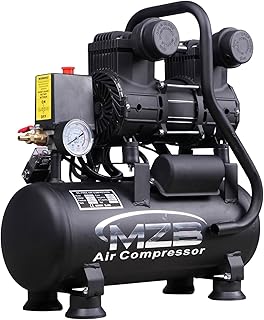
MZB 2.4 Gallon Ultra Quiet Oil-Free Compressor
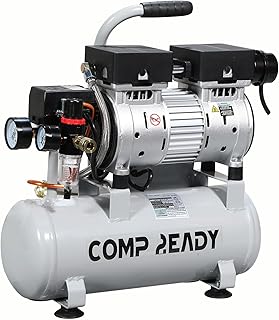
At 5.65 CFM from a 1.2HP oil-free pump, this punches well above its 2.4-gallon tank size, making it a sensible pick for LVLP work on small pieces where recovery speed matters more than storage. The 70dB rating and light frame mean you can set it beside a bench and move it single-handed, though the short tank cycle keeps the motor busy on longer sessions.
VEVOR 13-Gallon Wheeled Compressor
The 13-gallon tank and 4.6 SCFM at 90 PSI give you enough reserve to spray a full cabinet door without the pump chattering behind you, and the thickened steel body absorbs vibration instead of walking across the floor. Wheels and a pull handle are essential here given the weight, and the 66dB operation is genuinely livable in a shared garage.
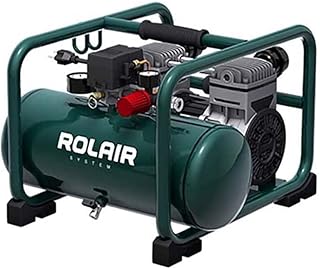
Rolair JC20 Super Quiet Hand Carry
This is the durability benchmark in the hand-carry class: a cast-iron pump, an accessible pressure switch, and a parts catalog that means you rebuild rather than replace. At 70dB and roughly 40 pounds, the centered steel handle makes it the most comfortable compressor here to actually carry up a basement stair.
Rolair FC2002 Twin Stack
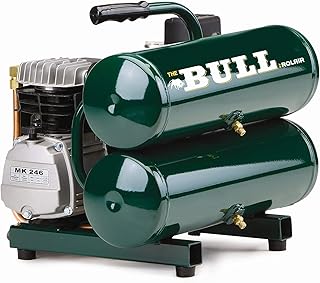
Twin stacked tanks double the air reserve without widening the footprint, and the overload protection with manual reset saves the motor when an extension cord sags voltage. It runs louder than the JC20, so pair it with hearing protection, but the extra stored air suits multi-coat schedules on larger furniture.
MZB 18.5-Gallon Upright Oil-Free
The upright 18.5-gallon tank is the practical choice for anyone finishing a full kitchen or a run of built-ins, since it holds enough air to keep pressure flat across long passes. Vertical orientation also drains condensate more completely and frees up floor space, at the cost of easy portability.
Frequently Asked Questions
How much CFM do I really need for spray painting furniture?
Most LVLP and mini-HVLP guns used on furniture need 2 to 4 CFM at 25 to 40 PSI, so a compressor rated 4 CFM or better at 90 PSI has comfortable headroom. Full-size gravity HVLP guns can demand 10 to 13 CFM and require a much larger machine.
Is a small tank with high CFM better than a big tank with low CFM?
For continuous spraying, sustained output matters more than storage, because any tank eventually empties and you are then living off the pump’s flow rate. A larger tank simply buys quieter, less frequent cycling and smoother pressure between refills.
Do oil-free compressors last as long as oil-lubricated ones?
Oil-free pumps use coated cylinders and PTFE rings that wear faster under heavy duty cycles, so an oil-lubricated cast-iron pump generally wins on lifespan. For a few dozen hours of finishing per year, a quality oil-free unit will serve fine and skips oil changes entirely.
What accessories keep moisture out of my finish?
Fit a water separator and particulate filter at the tank outlet, add a desiccant dryer near the gun for humid days, and drain the tank after every session. A short length of copper or a hose loop before the filter also helps condense moisture before it reaches your regulator.
Final Thoughts
For most furniture builders, the Rolair JC20 is the one to buy and forget about: quiet, comfortable to carry, and rebuildable years down the line. If you spray multi-door batches and want fewer pauses, the VEVOR 13-gallon offers the best reserve-to-noise balance on wheels, while the MZB 18.5-gallon upright makes sense for shops with the floor space and a long finishing queue.