Key takeaways
- Match support to sleeping posture: Side sleepers need enough surface give for the shoulder and hip to sink so the spine stays level; back and stomach sleepers need a firmer transition layer that stops the pelvis from rotating downward. Medium-firm suits combination sleepers because it compromises in the right direction.
- Read the layer stack, not the height: A 16-inch bed is not automatically better than a 12-inch one. What matters is whether there’s a dedicated transition foam between the soft top and the base, since that layer absorbs the load your comfort layer can’t and prevents early body impressions.
- Treat zoning as an ergonomic feature: 5-zone and 7-zone constructions vary firmness along the length of the mattress, reinforcing the lumbar region while softening the shoulder area. It’s the same logic as a chair with independent lumbar adjustment, and it matters most for people who wake with lower back stiffness.
- Check thermal pathways: Memory foam traps heat by nature, so look for genuine mitigation — copper or graphene infusions that conduct warmth away, open-cell structures, or a coil unit that lets air move vertically. Hybrids almost always run cooler than all-foam builds.
- Use the trial as a durability signal: Certifications like CertiPUR-US and fiberglass-free construction are baseline safety, not quality proof. A 365-night trial tells you the manufacturer expects the bed to survive a full seasonal cycle without sagging, which is the window when weak foam usually shows itself.
What's inside
Shopping for a mattress online means judging a load-bearing piece of furniture you cannot lie on first. Spec sheets lean hard on comfort words — plush, cloud-like, hotel-grade — while staying quiet about the things that actually determine whether a bed still supports your hips in year four: foam density, transition-layer thickness, coil gauge, and how the perimeter behaves when you sit on it to tie your shoes. Meanwhile, the failure most people describe isn’t discomfort on night one. It’s the slow dip that forms under the heaviest part of the body and quietly throws the lumbar spine out of neutral.
I evaluate sleep surfaces the way I’d evaluate a task chair: posture first, then how that posture holds up under thousands of hours of compression. This guide looks at six of the strongest mattresses currently sold on Amazon through that lens — pressure distribution across shoulders and hips, zoned versus uniform support, thermal behavior of the cover and comfort layers, edge integrity, and what the trial window tells you about a brand’s confidence in its own build.
As an Amazon Associate we earn from qualifying purchases.


🛒 Best Price Today on Amazon
Prime members get fast, free shipping on everything above, plus member-only deals. New members get a 30-day free trial — cancel anytime.
How to Choose a/an Mattress On Amazon (2026)
- Match support to sleeping posture: Side sleepers need enough surface give for the shoulder and hip to sink so the spine stays level; back and stomach sleepers need a firmer transition layer that stops the pelvis from rotating downward. Medium-firm suits combination sleepers because it compromises in the right direction.
- Read the layer stack, not the height: A 16-inch bed is not automatically better than a 12-inch one. What matters is whether there’s a dedicated transition foam between the soft top and the base, since that layer absorbs the load your comfort layer can’t and prevents early body impressions.
- Treat zoning as an ergonomic feature: 5-zone and 7-zone constructions vary firmness along the length of the mattress, reinforcing the lumbar region while softening the shoulder area. It’s the same logic as a chair with independent lumbar adjustment, and it matters most for people who wake with lower back stiffness.
- Check thermal pathways: Memory foam traps heat by nature, so look for genuine mitigation — copper or graphene infusions that conduct warmth away, open-cell structures, or a coil unit that lets air move vertically. Hybrids almost always run cooler than all-foam builds.
- Use the trial as a durability signal: Certifications like CertiPUR-US and fiberglass-free construction are baseline safety, not quality proof. A 365-night trial tells you the manufacturer expects the bed to survive a full seasonal cycle without sagging, which is the window when weak foam usually shows itself.
The Best Mattress On Amazon (2026)s Reviewed
EGOHOME 14″ Copper Gel Memory Foam
This is the most posture-focused all-foam option here: the medium-firm profile keeps the pelvis from tipping while the copper-gel infusion and graphene cover work as conductive heat sinks rather than marketing garnish. The ICA endorsement and fiberglass-free build add credibility, and motion isolation is excellent for couples with mismatched schedules.
Sweetnight CoolNest 14″
The 5-zone ergonomic layout is the reason to buy this one — firmer through the midsection, more compliant under the shoulders, which keeps the cervical and lumbar curves closer to neutral for side sleepers. Breathability is well handled for an all-foam king, though heavier sleepers may want the extra reinforcement of a coil unit.
Nectar 12″ Memory Foam
Nectar remains the reliable benchmark: a medium-firm feel that suits most body types, consistent foam quality, and a year-long trial that few competitors match. It’s the low-risk pick if you want proven longevity over novel materials.
Sleepmax 14″ Hybrid
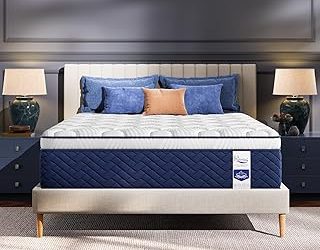
A well-balanced hybrid for back and side sleepers, pairing pressure-relieving foam with a spring core that keeps the perimeter usable and airflow moving. The 365-night trial and fiberglass-free construction back up a build that should resist body impressions better than comparable all-foam beds.
16″ Luxury Hybrid with 7-Zone Support
The tallest option reviewed, and the most generous in comfort-layer depth without giving up structure thanks to seven zoned support regions. Worth considering for heavier sleepers or anyone who wants a plusher surface that still holds the spine in line — just budget for deep-pocket sheets.
Frequently Asked Questions
How long should a quality mattress last?
Expect seven to ten years from a well-built hybrid and roughly six to eight from a quality all-foam bed. Rotating it head-to-foot every three to six months distributes compression and meaningfully extends that range.
Is a hybrid better than all-foam for back pain?
Not inherently — zoned support and correct firmness matter more than the core material. That said, hybrids resist sagging longer and offer stronger edge support, which helps if you sit on the bed’s perimeter often.
How long does a mattress in a box take to expand?
Most reach usable shape within a few hours and full loft in 24 to 72 hours. Give it the full window before judging firmness, since compressed foam reads stiffer than it will settle at.
Do I need a new foundation?
Foam and hybrid beds need continuous, evenly spaced support. Slats wider than about three inches apart allow localized sagging, so use a solid platform or add a bunkie board.
Final Thoughts
For most sleepers, the EGOHOME 14-inch memory foam offers the best combination of neutral-spine support and heat management at its price, while the Sleepmax 14-inch hybrid is the smarter long-term investment if you want coil-backed edge support and slower wear. Choose the Nectar 12-inch if you’d rather bet on a track record than a spec sheet — its trial period alone makes it the lowest-risk purchase in this group.