Our Top Picks

Corner TV units solve a real problem: a lot of living rooms don’t have a clean wall run long enough for a standard console, but they do have a dead corner that’s otherwise just collecting floor lamps and plant stands. The trade-off is that corner units limit you on TV size and viewing angle more than people expect going in. Get the geometry right first, then worry about finish and storage.
Measure the corner before you shop
A corner unit is defined by its diagonal front edge, not its width. When a listing says “58 inches,” that’s almost always the diagonal distance across the front, not how far it sticks into the room. Measure from where the two walls meet out to where you want the front edge to sit, usually 20-24 inches for most units. Then sit in your main viewing spot and check the angle. Corner placement works fine up to about 12-15 degrees off dead-center; past that, you get keystone distortion on OLED and VA panels, and off-axis color shift is worse on cheaper LED panels. If your sofa is directly across from the corner rather than at an angle to it, a corner unit is going to look wrong no matter how good the furniture is.
TV size limits are real
Corner stands top out lower than standard consoles because the usable surface shrinks as you go up in height, and because manufacturers have to keep the base narrow enough to actually fit in a corner. Most corner units are rated for TVs up to 55-65 inches. Past 65 inches, you’re better off with a corner wall mount and a separate low console pushed into the corner for components, because stands rated for 70-80 inch TVs in a corner footprint get top-heavy fast. If you’ve already got a 75-inch TV and were hoping to tuck it into a corner stand, don’t — mount it instead and use the corner floor space for storage furniture.
Material and build quality
Most corner TV units in the $100-250 range are particleboard with a laminate or veneer wrap, held together with cam locks and dowels. That’s fine for a TV under 50 inches and under 40 lbs. Above that, check the weight rating on the top shelf specifically — some units quote a total unit weight that includes the base, which is misleading. The failure mode here isn’t catastrophic collapse, it’s the top shelf bowing over 6-12 months under a heavier TV, especially in humid climates. If you’re in that heavier bracket, look for a unit with a glass or veneered plywood top rather than straight MDF, or one with a metal frame reinforcing the top shelf. You can browse a reasonable range of corner TV stands and filter by weight capacity before anything else — that spec matters more than finish.
Cable management is where cheap units actually fail
The thing nobody mentions in reviews: corner units have less back access than rectangular consoles because the back is a tight V-shape against two walls. If the unit doesn’t have a cutout or notch in the back panel, you’re pulling it away from the wall every time you need to adjust a cable, which is annoying in a corner because you’ve got two walls to clear instead of one. Check photos for a cable cutout before buying. Open-back or no-back designs solve this entirely and are usually cheaper too, at the cost of looking less finished from the side.
Comparing the three common types
| Type | Best TV size | Typical price | Main trade-off |
|---|---|---|---|
| Low corner console (2-3 shelf) | Up to 55″ | $90-200 | Limited storage depth, but easiest to fit and move |
| Tall corner cabinet/armoire | Up to 60″ | $200-450 | Great hidden storage, but can look bulky in small rooms |
| Corner wall mount + low console | 60″+ | $150-350 combined | Best for large TVs, but needs stud-anchored mounting and separate component storage |
Matching style to the rest of the room
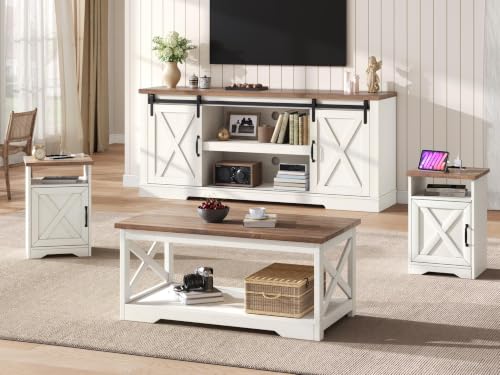
Corner units sit in sightlines differently than wall-run consoles because they’re on a diagonal, so busy grain patterns or dark high-gloss finishes tend to dominate a small room more than you’d expect from photos. In a living room under 150 square feet, a lighter wood tone or matte finish reads calmer. If your entryway furniture or existing console tables are already a specific finish — walnut, black oak, white oak — try to match that tone rather than the TV unit’s own undertone, since the corner piece is usually the largest piece of furniture in the room after the sofa and it’ll clash fastest. For anyone furnishing a room from scratch, it’s worth looking at living room furniture sets that include matching console tables, since buying pieces separately over time is how finish mismatches happen.
When to skip the corner unit entirely
If your room has a usable wall run of at least 48 inches, even an awkward one broken up by a doorway or window, a standard rectangular console will almost always give you better viewing angle and more storage per dollar than a corner piece. Corner units are a solution for rooms that genuinely lack wall space, not a style preference. If you’re unsure which you need, measure both options against your seating position before buying — a $150 mistake in a corner unit that doesn’t fit the angle is harder to return once assembled than most people expect, since many ship flat-pack and lose return eligibility once built.
Where it’s fine to go cheap
If the TV is under 50 inches and under 30 lbs, a $90-120 particleboard corner stand will hold up fine for years as long as you’re not sliding it across hard flooring repeatedly, which stresses the leg joints. Spend the extra money on build quality only when you’re pushing toward the 55-65 inch range or putting a soundbar and streaming box on the same shelf, since that’s when weight and heat buildup start mattering. For anything smaller, the cheaper option isn’t a compromise, it’s just the right call.