Our Top Picks
 Dell Latitude 5420 14" Laptop Core i5-1145G7 512GBi5 11th Gen | 16GB | 512GB12.65 x 0.82 x 8.35 inches3.88 poundsCheck on Amazon
The best 16GB RAM laptops in 2026 are the Apple MacBook Air 13-inch for quiet everyday work, the Microsoft Surface Laptop 13.8-inch for Windows portability, the Lenovo ThinkPad T14 for business durability, and the ASUS ROG Zephyrus G14 for gaming without carrying a bulky desktop replacement.
Best 16GB RAM laptops at a glance
| Laptop type and example | Best for | Approx. weight | Battery expectation | Typical price range |
|---|---|---|---|---|
| Apple MacBook Air 13-inch, M4, 16GB | Study, office work, travel | About 2.7 lb | Up to 15–18 hours of mixed use | Usually $900–$1,200 |
| Microsoft Surface Laptop, Snapdragon X, 16GB | Windows productivity and portability | About 2.7–3.1 lb | About 12–18 hours of mixed use | Usually $900–$1,400 |
| Lenovo ThinkPad T14, 16GB | Business work and frequent travel | About 3.2–3.4 lb | About 9–14 hours, depending on configuration | Usually $1,000–$1,800 |
| Framework Laptop 13, 16GB | Repairability and upgrades | About 2.9 lb | About 8–12 hours | Usually $900–$1,500 |
| ASUS ROG Zephyrus G14, 16GB | Gaming, creative work, and portability | About 3.3–3.5 lb | About 5–10 hours away from an outlet | Usually $1,500–$2,300 |
Battery figures vary with screen brightness, processor, software, and graphics workload. Gaming laptops in particular can lose most of their battery capacity while playing demanding games, so treat their battery as a mobility feature rather than a replacement for a charger.

HP OmniBook 3 17.3 inch Laptop PC, FHD Display, Intel Core Ultra 5 225U, 8 GB RAM, 512 GB SSD, Intel Graphics, Windows 11 Home, Glacier Silver, 17-dg0099nr
Chosen because it specifies FHD Display and Intel Core Ultra 5 225U.
View on Amazon
HP 255 G10 Business Laptop, AMD Quad-core CPU, 16GB RAM, 512GB SSD, W11 Pro
Chosen because it specifies AMD Quad-core CPU and 16GB RAM.
View on Amazon
Apple 2026 MacBook Air 13-inch Laptop with M5 chip: Built for AI, 13.6-inch Liquid Retina Display, 16GB Unified Memory, 512GB SSD, 12MP Center Stage Camera, Touch ID, Wi-Fi 7; Midnight
Chosen because it specifies 13.6-inch Liquid Retina Display and 16GB Unified Memory.
View on AmazonDell Latitude 5420 14" Laptop Core i5-1145G7 512GB PCIe SSD 16GB RAM FHD (1920x1080) Non Touch Win 11 Pro (Renewed)
Picked as a relevant option in this category.
View on AmazonWhich 16GB laptop should you choose?
Choose the MacBook Air for quiet, all-day general work
The 13-inch MacBook Air with an M4 chip and 16GB of unified memory is a strong match for students, writers, office workers, and people who want a light computer with no fan noise during ordinary use. Its processor is fast for web browsing, documents, video calls, photo editing, and light coding. The sharp 13.6-inch display has a 2560-by-1664 resolution and excellent color quality, although its 60Hz refresh rate is less fluid than many gaming screens.
The main limitations are fixed memory and storage: you cannot add RAM later, and the base storage configuration can fill quickly with photos, games, or video projects. Choose at least 512GB of storage if you expect to keep large files locally. It also runs macOS, so check that your required business, engineering, or gaming software is available before buying.
Choose the Surface Laptop for a portable Windows computer
The current Surface Laptop family with Snapdragon X processors combines a bright 3:2 touchscreen, a comfortable keyboard, and very good battery life in a relatively slim body. The taller screen is useful for documents, spreadsheets, and research because it shows more vertical content than a typical 16:9 panel. A 13.8-inch version is easier to carry, while the 15-inch model gives more workspace but adds weight and cost.
Performance is well suited to office applications, study, browsing, programming, and video calls. Compatibility has improved substantially through Windows on Arm, but specialized older utilities, device drivers, and some games may still work better on an Intel or AMD Windows laptop. The RAM is not normally user-upgradeable, so select 16GB or more at purchase.
Choose the ThinkPad T14 for work durability
A 16GB Lenovo ThinkPad T14 is the practical choice for business users who value a reliable keyboard, many ports, repair access, and strong security features over the thinnest possible design. Depending on the generation and configuration, it may use an Intel Core Ultra or AMD Ryzen Pro processor. Either platform handles office multitasking, large spreadsheets, browser tabs, and video meetings comfortably.
Look carefully at the screen option. A low-power 1920-by-1200 panel generally maximizes battery life, while a higher-resolution or brighter display improves visual quality but uses more power. Some configurations permit memory expansion or include partially upgradeable memory, but specifications differ by generation. Confirm the exact service manual before assuming RAM can be added.
Choose the Framework Laptop 13 when upgradeability matters
The Framework Laptop 13 stands apart because its memory, storage, battery, keyboard, ports, and many other parts are designed to be replaceable. That makes it appealing to renters, students on a budget, and owners who would rather replace a failed component than discard the whole computer. A 16GB configuration is suitable for normal work now, and compatible memory can be replaced later if your workload grows.
Its 13.5-inch 3:2 display is productive for documents, and the modular expansion cards let you select ports such as USB-C, USB-A, HDMI, or additional storage. The trade-off is that maximum battery life, speakers, and chassis refinement may not match the best sealed premium laptops. Its long-term value comes from repairability rather than the lowest initial price.
Choose the ROG Zephyrus G14 for gaming in a small space
The ASUS ROG Zephyrus G14 is one of the better choices for someone who needs a gaming GPU but does not want a heavy 16-inch machine. Configurations commonly combine a high-performance AMD processor, NVIDIA GeForce RTX graphics, 16GB or more of RAM, and a high-refresh-rate OLED display. The screen is excellent for games, movies, and creative work, with much smoother motion than a standard 60Hz office panel.
Sixteen gigabytes is enough for current gaming, schoolwork, and ordinary content creation, but 32GB is a more comfortable choice for modern games played alongside streaming software, large texture packs, or video editing. Gaming laptops also run hot and loud under load. Use them on a hard surface with open vents; a bed or soft couch can restrict airflow and reduce performance.
How 16GB of RAM affects real workloads
- Study and office work: 16GB comfortably supports browser tabs, word processing, presentations, video calls, and music at the same time.
- Programming: 16GB works well for typical web development and one moderate virtual machine. Multiple virtual machines or large software projects justify 32GB.
- Photo editing: 16GB is adequate for ordinary Lightroom or Photoshop work, but large RAW files and layered documents benefit from more memory.
- Gaming: 16GB remains a sensible minimum. The graphics processor, cooling system, and screen refresh rate usually influence game performance more than moving from 16GB to 32GB.
- Video editing and 3D: Choose 32GB or more if you regularly edit 4K footage, use complex effects, or render large projects.
Screen, processor, and weight trade-offs
For reading and spreadsheets, a 3:2 display such as the Surface Laptop or Framework Laptop 13 provides useful vertical space. A 16:10 screen, common on ThinkPads and gaming laptops, is a good compromise between productivity and entertainment. OLED screens deliver deeper blacks and stronger contrast, but they can consume more power and may require sensible brightness and sleep settings for long-term use.
Processor names alone do not determine the experience. Apple silicon and Snapdragon chips are particularly efficient, while Intel Core Ultra and AMD Ryzen processors offer broad Windows compatibility. For gaming, prioritize the dedicated GPU and cooling design. For office work, a lower-power processor with a good keyboard and long battery life may be more useful than a high-performance chip you rarely stress.
| Use situation | Recommended specification | Practical fit |
|---|---|---|
| Small desk or shared apartment | 13–14 inch screen, under 3.5 lb, USB-C charging | MacBook Air, Surface Laptop, or Framework Laptop 13 |
| Daily commuting or campus travel | 2.7–3.3 lb, 10-hour-class battery, durable hinge | MacBook Air, Surface Laptop, or ThinkPad T14 |
| Gaming and creative work | Dedicated GPU, 120Hz-or-faster screen, 1TB SSD preferred | ROG Zephyrus G14 or another compact gaming laptop |
| Long-term ownership | Replaceable RAM or memory modules, accessible SSD and battery | Framework Laptop 13 or a business-class laptop with documented service access |
Desk and carrying considerations
A laptop may weigh only 3 pounds, but the charger can add another 0.5–1.5 pounds, especially for gaming models. For a compact desk, allow at least 24 inches of width and 18 inches of depth for a laptop, mouse, and comfortable wrist position. A 14-inch laptop usually fits more easily beside a notebook or desk lamp than a 16-inch gaming model.
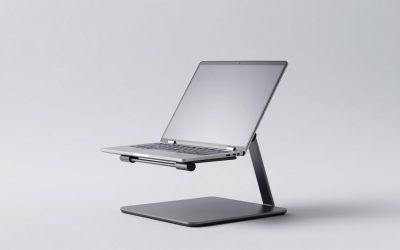
Raise the screen so its top edge is near eye level when possible, then use an external keyboard and mouse. This is especially helpful for long study or work sessions because a laptop placed flat on a desk encourages neck bending. Before buying a large model, measure the desk depth, backpack sleeve, and the space between the charger and wall.
Final buying advice
For most people, 16GB is the right balance of capability and cost in 2026. Buy the MacBook Air for the lightest quiet everyday experience, the Surface Laptop for efficient Windows portability, the ThinkPad T14 for business use, the Framework Laptop 13 for repairability, or the ROG Zephyrus G14 for portable gaming. Prioritize the processor and screen for your workload, confirm whether memory is upgradeable, and choose storage carefully because a full SSD becomes inconvenient long before a laptop’s processor becomes obsolete.