Key takeaways
- Tooth count vs. feed effort: 80T and 100T blades leave glassy edges but remove less material per tooth, so they demand slower, steadier arm travel. If you find yourself pushing to keep momentum, you’ve over-toothed for the job; 48–60T handles thick stock with far less strain on your shoulder and the motor.
- Plate thickness and kerf: Thin-kerf plates cut with noticeably less resistance, which matters on 10-amp saws and during repetitive cutting. Full-kerf plates resist deflection better in dense hardwood. Choose based on your saw’s power, not the price tag.
- Vibration control features: Laser-cut expansion slots, copper plugs, and anti-vibration stabilizer vents reduce the high-frequency buzz that transmits into your wrist and leaves chatter marks on end grain. This is the single most underrated comfort spec on a blade.
- Carbide grade and tip volume: Look for micrograin or hi-density carbide with visibly generous brazed tips. More carbide means more resharpening cycles before the teeth run out of body, which is where long-term value actually lives.
- Grind geometry for your material: ATB (alternate top bevel) shears cross-grain fibers cleanly for solid wood and veneered panels. TCG or high-ATB with a triple-chip pattern holds up better on melamine, MDF, and abrasive engineered sheet goods.
What's inside
A dull or poorly matched 12-inch blade doesn’t announce itself with a dramatic failure. It shows up as sore shoulders after a day of trim work, as a burn line down the face of a mitered leg, as the tiny hesitation you feel when the arm wants to bog halfway through a hardwood apron. Most people blame the saw. Usually it’s the blade, and specifically the mismatch between tooth geometry, plate stiffness, and the amount of force your body is being asked to supply to compensate.
This guide looks at 12-inch miter saw blades through two lenses that rarely make it into spec sheets: how the blade behaves under your hands over a long session, and how gracefully it ages across dozens of resharpenings and thousands of crosscuts. I’ve weighted plate flatness, vibration damping, carbide volume at the tooth, and feed effort at least as heavily as first-cut smoothness — because a blade that cuts beautifully for a month and then wanders is not a good blade. Below you’ll find picks for furniture-grade finish work, high-volume construction cutting, and the underrated middle ground where one blade has to do everything.
As an Amazon Associate we earn from qualifying purchases.


🛒 Best Price Today on Amazon
Prime members get fast, free shipping on everything above, plus member-only deals. New members get a 30-day free trial — cancel anytime.
How to Choose a 12-Inch Miter Saw Blade (2026)
- Tooth count vs. feed effort: 80T and 100T blades leave glassy edges but remove less material per tooth, so they demand slower, steadier arm travel. If you find yourself pushing to keep momentum, you’ve over-toothed for the job; 48–60T handles thick stock with far less strain on your shoulder and the motor.
- Plate thickness and kerf: Thin-kerf plates cut with noticeably less resistance, which matters on 10-amp saws and during repetitive cutting. Full-kerf plates resist deflection better in dense hardwood. Choose based on your saw’s power, not the price tag.
- Vibration control features: Laser-cut expansion slots, copper plugs, and anti-vibration stabilizer vents reduce the high-frequency buzz that transmits into your wrist and leaves chatter marks on end grain. This is the single most underrated comfort spec on a blade.
- Carbide grade and tip volume: Look for micrograin or hi-density carbide with visibly generous brazed tips. More carbide means more resharpening cycles before the teeth run out of body, which is where long-term value actually lives.
- Grind geometry for your material: ATB (alternate top bevel) shears cross-grain fibers cleanly for solid wood and veneered panels. TCG or high-ATB with a triple-chip pattern holds up better on melamine, MDF, and abrasive engineered sheet goods.
The Best 12-Inch Miter Saw Blade (2026)s Reviewed
DEWALT 100-Tooth Fine Finish (DWA112100)
The tensioning on this plate is consistently good out of the box, which translates directly into a cut that tracks straight without you muscling the head down. Tooth wear stays even across the circumference — a strong sign of quality brazing — making it a dependable choice for face frames and exposed miters.
Diablo D1280X 80-Tooth Fine Finish
At 80 teeth with hi-density carbide and a Perma-Shield coating, this is the sweet spot for furniture builders who cut a mix of hardwood and sheet goods. The reduced tooth count means noticeably lighter feed pressure than a 100T blade while still leaving edges that need only a whisper of sanding.
Makita B-67000 100T Max Efficiency
Makita’s thinner plate and optimized gullet design pull the amp draw down, which you feel as smoother, less grabby entry into the cut. It’s the most fatigue-friendly high-tooth-count blade here, though the slimmer plate rewards a well-tuned saw with minimal bearing play.
Freud LU86R012 48T Thin Kerf
This is the blade I’d mount if I could only own one. Forty-eight ATB teeth on a thin kerf plate glide through 2x stock and 4/4 hardwood with genuinely low resistance, and the finish is clean enough for most joinery without a second pass.
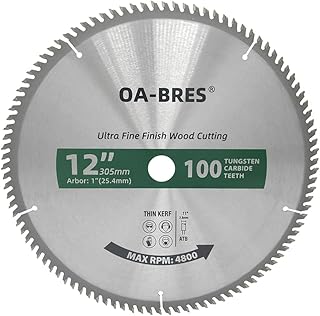
FOXBC 100-Tooth Polished Finish
A sensible budget entry with respectable runout and a polished plate that resists pitch buildup better than expected at this tier. Treat it as a dedicated finish blade for clean, dry stock rather than a general-purpose workhorse.
Frequently Asked Questions
Does a higher tooth count always mean a better cut?
No. Beyond a point, extra teeth mainly reduce chip clearance, which increases heat, burning, and the effort needed to advance the head. Match tooth count to stock thickness and material.
How often should a 12-inch blade be resharpened?
Watch for symptoms rather than counting cuts: rising feed resistance, faint burn marks, or fuzzy end grain. For a hobby shop that’s typically once or twice a year; production users may sharpen quarterly.
Are thin-kerf blades less durable?
Not inherently, but they deflect more under side load. Keep the saw’s fence square, let the blade reach full speed before contact, and avoid twisting the head mid-cut.
Can I use these blades on a table saw?
Some 12-inch blades are rated for both, but miter saw blades often use a negative or low hook angle that makes ripping slow and grabby. Always check the manufacturer’s rating first.
Final Thoughts
For all-day comfort and the widest useful range, the Freud LU86R012 is the blade I keep returning to, with the Diablo D1280X close behind when finish quality outranks speed. If your work is almost entirely fine crosscuts on visible furniture parts, the Makita B-67000 delivers that finish with the lightest feed effort of any 100-tooth blade in this group.