Our Top Picks
 TVU 5 Tiers Wooden Bookshelf11.8" D x 31.5" W x 65.2" H11.8 x 31.5 x 65.2 inches32 poundsCheck on Amazon
The best wood bookcase is a solid wood or plywood unit with shelves no longer than 32 inches between supports, a back panel that is screwed or nailed rather than stapled, and an anti-tip wall anchor. For most rooms that means a 30 to 36 inch wide, 72 inch tall case with adjustable shelves; solid wood for heirloom pieces, veneered plywood for good value, and particleboard only for light loads.
Shelf Span and Load: The Numbers That Prevent Sagging
Shelf sag depends on span, thickness and material far more than on how nice the finish looks. A 3/4 inch thick shelf of solid wood or plywood can carry roughly 25 to 30 pounds per foot of length when it spans 30 inches or less. Particleboard at the same thickness starts to bow near 15 to 20 pounds per foot. A full row of hardcovers weighs about 20 to 25 pounds per foot, so particleboard shelves wider than 28 inches will bend over time.
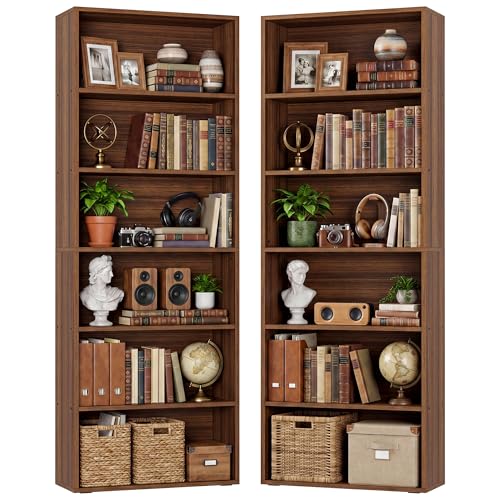
IRONCK Bookshelf and Bookcases 70" Tall, 6 Tiers Display Storage Shelves | Bookshelves Set of 2, Wood Bookcase with Open Display Shelves for Home Office, Living Room, Library, Walnut
Chosen because it specifies 6 Tiers Display Storage Shelves and Bookshelves Set of 2.
View on AmazonTVU 5 Tiers Wooden Bookshelf, 65.2" Tall Farmhouse Style Open Bookcase, 31.5" Wide Standing Book Shelf with Storage for Study Room, Living Room, Walnut Brown
Chosen because it specifies 65.2" Tall Farmhouse Style Open Bookcase and 31.5" Wide Standing Book Shelf with Storage for Study Room.
View on Amazon
Sauder Miscellaneous Storage 3-Shelf Bookcase/ Book shelf, Select Cherry finish
Chosen because it specifies Select Cherry finish.
View on Amazon
Shaker Style 4 Shelf Bookcase / Solid Wood / 48" High / Adjustable Shelving / Closed Back / Display Bookshelf for Living Room, Bedroom, Home and Office, Cherry
Chosen because it specifies Bedroom and Home and Office.
View on Amazon| Shelf material | Recommended max span | Safe load per foot | Notes |
|---|---|---|---|
| Solid hardwood, 3/4 in | 36 in | 30 lb | Most durable, heaviest |
| Plywood, 3/4 in | 32 to 36 in | 25 to 30 lb | Stable, edges may need banding |
| Solid pine, 3/4 in | 30 in | 20 to 25 lb | Soft; dents easily |
| MDF, 3/4 in | 28 in | 15 to 20 lb | Smooth finish, sags over time |
| Particleboard, 5/8 in | 24 to 26 in | 10 to 15 lb | Fine for paperbacks and décor |
Standard Sizes and Fit
| Type | Width | Depth | Height | Best use |
|---|---|---|---|---|
| Standard bookcase | 30 to 36 in | 11 to 13 in | 60 to 84 in | Books and photos |
| Wide bookcase | 40 to 48 in | 12 to 14 in | 30 to 40 in | Low wall under windows |
| Narrow or ladder bookcase | 20 to 26 in | 12 to 16 in | 60 to 72 in | Small rooms, corners |
| Barrister (glass doors) | 30 to 36 in | 12 to 14 in | 50 to 70 in | Collectibles, dust control |
Most hardcovers are 9 to 10 inches tall and 6 to 7 inches deep, so a 10 to 11 inch shelf depth suits them. Art books and binders need 12 to 14 inches. A 12 inch depth with 12 inch shelf-to-shelf clearance holds most mixed collections. Leave at least 36 inches of floor space in front for browsing and 24 inches to open any doors.
Solid Wood vs Plywood vs Engineered
- Solid wood (oak, walnut, maple, ash): weighs 90 to 160 pounds for a 72 inch case, can be refinished, and lasts decades. It also shifts with humidity, so tight-fitting doors may stick in summer.
- Plywood with hardwood veneer: 3/4 inch Baltic birch or cabinet-grade plywood is rigid and stable and costs less than solid wood. Look for edge banding to hide the layers.
- MDF or particleboard with wood veneer or laminate: lowest cost and lightest, but weaker at the screws; it will not survive repeated disassembly.
Furniture sold as “wood” can mean any of the three. A listing that names the shelf material (solid, plywood, MDF) and the shelf thickness gives you what you need; those that only list “wood finish” usually mean engineered boards.
Picks by Situation
Best for heavy book collections: solid hardwood or plywood, fixed center support
Choose 3/4 inch shelves with a middle vertical divider so no shelf spans more than 30 inches. Brands like Bush Furniture, Hooker and Sauder at the lower end sell varied constructions, while IKEA’s Billy (about 31 1/2 inches wide and 11 inches deep in its standard size) remains a widely used, adjustable-shelf reference point for budget shelving.
Best for small rooms: narrow 24 inch case
Narrow cases use floor space of about 2 to 3 square feet. Keep depth near 10 to 12 inches so the unit does not poke into walkways.
Best for kids’ rooms: low, wide, anchored
A 30 to 36 inch tall case is hard to tip and keeps books within reach. Wall anchoring is still required; furniture tip-over is a major source of injuries to children.
Best for dust-prone or display use: glass-door barrister
Doors keep dust off, but glass adds weight and the hinges are the first part to loosen. Look for tempered glass and metal hinges.
Assembly, Moving and Durability
- A 72 inch solid wood bookcase may ship at 80 to 140 pounds; a flat-pack engineered one is 55 to 90 pounds across two boxes. Count on two people to stand it up.
- Measure the diagonal: a 72 inch tall case on a typical 96 inch ceiling clears easily, but crown molding or a low basement ceiling can block tilting it upright.
- Cam-lock fittings loosen. Retighten them after the first month of use.
- The back panel provides most of the frame’s rigidity. A thin fiberboard back held with staples allows the case to rack; screwed or nailed 1/4 inch backs hold square.
- Anchor to a stud with the included strap; nearly all quality cases ship with one, and it should be used even on the wood ones.
Decision Matrix
| Your situation | Choose | Skip |
|---|---|---|
| Hundreds of hardcovers | Plywood or hardwood, 30 in spans | Particleboard shelves wider than 28 in |
| Rental, moves yearly | Light solid pine or flat-pack with cam locks | Heavy cases above 120 lb |
| Kids and pets | Low case, wall anchor | Tall narrow ladder shelves |
| Dusty climate | Glass-door barrister | Open shelving with heavy décor |
| Home office wall | Wide modular units | One tall unit alone |
Frequently Asked Questions
How deep should a bookcase be?
Eleven to thirteen inches suits nearly all hardcovers and paperbacks. Go to 14 inches only for large art books, binders or baskets.
How much weight can a bookshelf hold?
A 3/4 inch plywood or hardwood shelf holds about 25 to 30 pounds per foot over a 30 inch span. Particleboard holds roughly half that before sagging.
Is solid wood worth it for a bookcase?
If you plan to keep it for ten or more years or move it several times, yes. For light use, veneered plywood offers 80 percent of the benefit at lower weight.
Do bookcases need to be anchored?
Yes. Anchor to a wall stud with a strap or bracket, especially in homes with children or pets.
How do I stop shelves from sagging?
Reduce the span with a vertical divider, flip the shelf so the bow faces up, or add a 1 by 2 inch hardwood strip along the front edge.
More from Amazon
Programs that pair well with the guide above. Offers and eligibility are set by Amazon and may change.
Collect the home and kitchen items you want in one registry that guests can shop from.
Create a wedding registrySet up recurring deliveries of everyday items on eligible products. Terms and savings are set by Amazon.
Explore Subscribe & SaveFree shipping on eligible items, Prime Video and more. Eligible new members can start with a free trial.
Start a Prime free trialAudiobooks and podcasts to listen to on the go. Eligible new members can start with a free trial.
Try Audible freeAs an Amazon Associate we earn from qualifying purchases.