Key takeaways
- Clamping directly to glass with the stock rubber pads. The pads are 3 x 3 inches at most and concentrate the load at the edge.
- Overtightening. Glass fails from clamp pressure more often than from monitor weight.
- Clamping on an unsupported overhang. Without a frame rail within about 2 inches, the glass flexes and cracks.
- Extending the monitor far forward. A screen 20 inches in front of the clamp triples the twisting load compared with one directly over the desk.
- Using a clamp on glass under 0.4 inches thick.
- Mounting on a chipped or scratched edge. Existing damage is where the crack starts.
- Skipping the pads between metal plates and glass. Metal-on-glass contact grinds and creates micro-fractures.
- Assuming non-tempered glass behaves like tempered. Annealed glass has a fraction of the strength and should never be clamped.
Glass desks and monitor arms have a bad history. A C-clamp designed for a wood desktop concentrates the load of a 25 pound ultrawide, multiplied several times by the arm’s leverage, onto two small pads at the very edge of the glass. Tempered glass is strong under evenly distributed loads and fragile under point loads at the edge. The result is either a chip at the clamp that spreads over weeks, or a sudden fracture when someone pulls the monitor forward. Even when the glass survives, the clamp slips on the smooth surface and the whole arm rotates under load.
The right approach depends on the desk. Glass with a factory grommet hole, glass over a steel frame with a rear rail, and thick tempered glass of 0.5 inches or more can each take a heavy arm with the correct hardware and load spreading. Thin 0.25 inch glass and any glass with no edge support should not take a clamp at all, and a freestanding stand with a weighted base is the safe path. The steps below walk through both routes, with the numbers that decide which you need.
Our top picks

As an Amazon Associate we earn from qualifying purchases at no extra cost to you.
What You Need
| Item | Why | Optional? |
|---|---|---|
| Calipers or a ruler to measure glass thickness | Under 0.4 in, do not clamp; 0.4 to 0.5 in, clamp only with plates; 0.5 in or more, clamp with plates is generally safe | No |
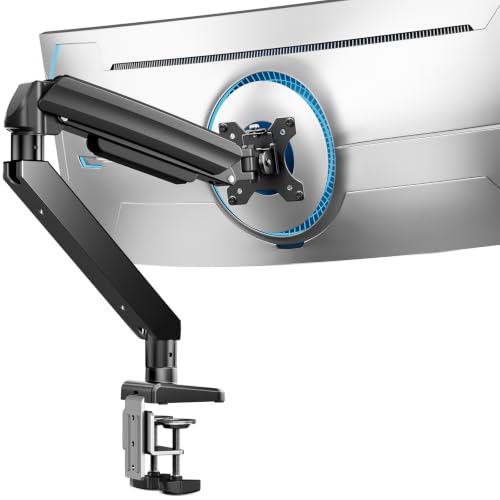
| Heavy-duty arm with a dual C-clamp or grommet option, rated at least 20 percent above your screen | Dual clamps spread load; a grommet mount avoids edge loading entirely. Arms like the 37.4 lb ErGear heavy duty at around $36 ship with both | No for clamp route |
| Two steel or aluminum reinforcement plates, at least 4 x 6 in and 2 to 3 mm thick | One above and one below the glass to turn a point load into an area load | No for clamp route |
| Rubber or silicone pads, 1/8 in thick, cut to plate size | Prevent metal-on-glass contact and stop slipping | No for clamp route |
| Freestanding stand with a weighted base, such as a glass-base dual stand rated 22 lb per arm at around $60 | Alternative that puts zero stress on the desk edge | Only if not clamping |
| Torque awareness: hand-tighten only, no power tools | Overtightening is the main cause of glass failure at the clamp | No |
| Microfiber cloth and glass cleaner | Clean contact area so pads grip and no grit is trapped under the plates | No |
| A helper | To hold a 20 to 30 lb monitor while you align the VESA plate | Recommended |
Step-by-Step
1. Measure the glass and inspect the edge (5 minutes)
Measure thickness at the rear edge where the clamp would go. Look closely at the edge for chips, cracks, or a rough ground finish; any existing chip disqualifies that spot. Confirm the glass is tempered by finding the small etched stamp in a corner. Check what supports the glass beneath: a steel frame rail running along the rear edge within 2 inches of the clamp position is what makes clamping viable. Glass that overhangs its frame by more than 3 inches at the rear edge should not be clamped.
2. Choose the route (2 minutes)
Clamp with plates if the glass is 0.4 inches or thicker, tempered, supported by a frame rail within 2 inches of the clamp position, and your total load, arm plus monitor, is under about 40 pounds. Use a grommet mount if the desk has a factory hole, typically 2 to 2.4 inches, since the grommet spreads load over a ring away from the edge. Use a freestanding weighted stand if the glass is thinner than 0.4 inches, unsupported at the edge, or already chipped, or if you are mounting two heavy screens totaling more than 40 pounds.
3. Weigh the load (2 minutes)
Find the monitor’s weight without stand from the spec sheet. A 34 inch ultrawide is 14 to 22 pounds; a 49 inch is 25 to 35. Add 3 to 6 pounds for the arm itself. Confirm the arm’s rating exceeds the monitor weight by 20 percent and that the total is within what you decided in step 2.
4. Clean and position the plates (3 minutes)
Clean the top and underside of the glass where the clamp will sit. Place a rubber pad on the glass, then a steel plate on the pad, positioned so the plate extends at least 1.5 inches inward from the edge and is centered over the frame rail below. Repeat underneath with the second pad and plate. Grit trapped between glass and pad creates a stress point, so wipe again just before assembly.
5. Set the clamp and hand-tighten (5 minutes)
Set the arm’s C-clamp so its upper pad rests on the top plate and its lower pad on the bottom plate. Tighten the clamp screw by hand until the arm base does not rock when you push it. Then stop. Do not use a drill or wrench extension. The correct tension is snug, not crushing; the plates and pads are doing the work of holding position, not clamp force. For a dual C-clamp arm, tighten both screws alternately in quarter turns so pressure stays even.
6. Grommet route: install through the hole (5 minutes)
If using a grommet mount, fit the arm’s threaded post through the hole with the top plate and a rubber washer above and the grommet plate and washer below. Tighten the nut by hand until firm. The load bears on a ring around the hole, 2 to 3 inches from any edge, which glass tolerates far better than edge clamping.
7. Freestanding route: place and load the base (3 minutes)
Set the base plate flat on the desk with a rubber or felt sheet beneath it to prevent slipping and scratching. Position it at the rear edge, centered on where the monitors will sit. The base spreads 40 to 60 pounds over 150 to 250 square inches, which is well within what any tempered glass handles. Nothing needs tightening to the desk.
8. Mount the monitor and tune tension (10 minutes)
Attach the VESA plate to the monitor, then with a helper, hang the monitor on the arm. Adjust spring tension per the arm’s instructions until the screen holds at mid-height. Position the monitor over the desk, not hanging forward beyond the front edge, to keep the lever arm on the clamp short.
9. Check after 24 hours and after a week (2 minutes each)
Look at the glass around the clamp or grommet for any new marks, and confirm the clamp has not shifted. Retighten by hand a quarter turn only if the base rocks. Check again after a week; if the glass shows any chip or crack, remove the arm immediately and switch to a freestanding base.
Mistakes to Avoid
- Clamping directly to glass with the stock rubber pads. The pads are 3 x 3 inches at most and concentrate the load at the edge.
- Overtightening. Glass fails from clamp pressure more often than from monitor weight.
- Clamping on an unsupported overhang. Without a frame rail within about 2 inches, the glass flexes and cracks.
- Extending the monitor far forward. A screen 20 inches in front of the clamp triples the twisting load compared with one directly over the desk.
- Using a clamp on glass under 0.4 inches thick.
- Mounting on a chipped or scratched edge. Existing damage is where the crack starts.
- Skipping the pads between metal plates and glass. Metal-on-glass contact grinds and creates micro-fractures.
- Assuming non-tempered glass behaves like tempered. Annealed glass has a fraction of the strength and should never be clamped.
How Often
Inspect the clamp area every 3 to 6 months. Look at the glass from below with a flashlight for any bright lines or chips, check that the pads have not compressed and let the clamp loosen, and confirm the arm base does not rotate. Re-check immediately after moving the desk or changing monitors. Spring tension on the arm may need a quarter turn every 12 to 18 months as the gas cylinder settles, which is unrelated to the glass but is a good time for the inspection.
When to Call a Pro or Replace
If the glass has a chip at the clamp, remove the arm and stop using that edge; a glazier can advise whether the top can be replaced, and a replacement tempered top for a standard desk runs $80 to $250. If the desk has no frame support at the rear edge and you want a clamped arm, the honest answer is a different desk or a freestanding stand rather than reinforcing the glass, which cannot be done reliably at home. Consider a wall mount if the desk sits against a stud wall; a heavy-duty wall arm takes the load entirely off the glass and costs $40 to $100. In 2026 a freestanding dual stand at around $60 or a heavy-duty arm with reinforcement plates at $36 plus $15 to $25 for plates and pads are both cheaper than replacing a cracked top, so choose the route that fits your glass rather than the one that fits your preference.
FAQ
Can you clamp a monitor arm to a glass desk at all?
Yes, if the glass is tempered, at least 0.4 inches thick, supported by a frame rail near the clamp, and you use reinforcement plates with rubber pads above and below. Thin or unsupported glass should use a freestanding weighted stand instead.
How thick does glass need to be for a heavy monitor arm?
A minimum of 0.4 inches with plates, and 0.5 inches or more for arms carrying screens over 20 pounds. Many budget glass desks use 0.2 to 0.3 inch glass, which is not suitable for clamping regardless of hardware.
Is a grommet mount safer than a C-clamp on glass?
Yes, when the desk has a factory hole. The grommet loads a ring around the hole rather than the edge, and holes in tempered glass are made before tempering, so the surrounding glass is fully strengthened. Never attempt to drill a hole in tempered glass; it shatters.
What is the safest way to mount two heavy monitors on a glass desk?
A freestanding dual stand with a weighted base. Two 32 inch screens at 15 to 22 pounds each on a clamped dual arm would put 50 pounds or more of leveraged load on a few square inches of glass edge; the same screens on a base spread the load across the whole plate with no stress on the edge.