Buying a standing desk frame separately from the top is the smartest way to get a desk that fits your room, your monitors, and your height, and it is also where most people make their expensive mistakes. They pick a frame by price and discover it stops at 28 inches, too tall for them to sit at. They pair a 176-pound single-motor frame with a 70-pound hardwood slab and two monitor arms and wonder why it wobbles at standing height. Or they buy a frame whose crossbar range does not span the top they already own. The good news is that frames are simple machines, and about seven numbers on the spec sheet tell you almost everything. Here is what actually matters.
Decide These 3 Things First
1. Your seated and standing heights. Measure your elbow height sitting and standing. For most adults between 5 feet 4 inches and 6 feet, that is 26 to 30 inches seated and 40 to 46 inches standing. Add the thickness of your top, usually 1 to 1.25 inches, to translate those into frame heights. A frame that bottoms out at 28 inches under a 1-inch top gives a 29-inch desk, which is too tall for seated use by anyone under about 5 feet 9 inches without a footrest.
Our top picks
 HUANUO Standing Desk Frame with Brushless Motor
- Powerful Brushless Motor: This standing desk frame features…
- Larger and Thicker Frame: The desk frame is…
- DIY Desktop Workstation: The adjustable desk legs are…
 ErGear Electric Standing Desk Legs for 39.4-63.3
- Ergonomic Comfort & Height Flexibility: This ErGear electric…
- Choose Your Desktop: Adjustable to fit a wide…
- Smart, User-Friendly Design: The raising desk legs feature…
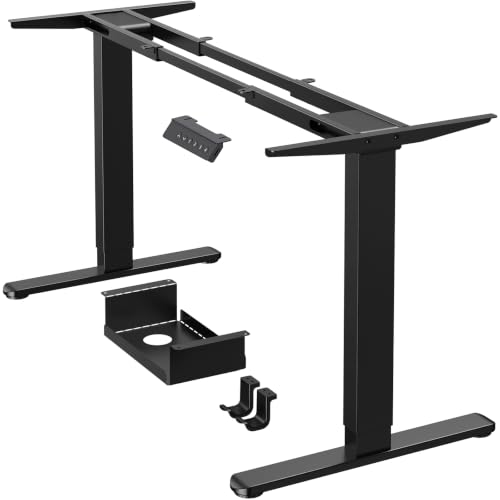 ErGear Dual Motor Standing Desk Legs for
- [Super Durable, Extremely Stable]ErGear upgraded standing desk frame…
- [Powerful Dual Motor Lifting] With over a decade…
- [Smart Control within Reach] Full electric adjustable desk…
| Product | Key specs | |
|---|---|---|
| HUANUO Standing Desk Frame with Brushless Motor | Powerful Brushless Motor: This standing desk frame features… Larger and Thicker Frame: The desk frame is… DIY Desktop Workstation: The adjustable desk legs are… | Check price |
| ErGear Electric Standing Desk Legs for 39.4-63.3 | Ergonomic Comfort & Height Flexibility: This ErGear electric… Choose Your Desktop: Adjustable to fit a wide… Smart, User-Friendly Design: The raising desk legs feature… | Check price |
| ErGear Dual Motor Standing Desk Legs for | [Super Durable, Extremely Stable]ErGear upgraded standing desk frame… [Powerful Dual Motor Lifting] With over a decade… [Smart Control within Reach] Full electric adjustable desk… | Check price |
 TOPSKY Dual Motor Standing Desk Frame TOPSKY Dual Motor Standing Desk Frame | Check price |
As an Amazon Associate we earn from qualifying purchases at no extra cost to you.
2. Your top’s size and weight. Frames specify a compatible top width range, for example 39 to 63 inches or 44 to 90 inches, and a depth range, typically 24 to 35 inches. Weigh or look up your top: laminate at 48 by 30 inches is 35 to 45 pounds; hardwood at 60 by 30 inches is 55 to 75 pounds. That weight comes off the frame’s rating before your gear does.
3. Single or dual motor. Single-motor frames drive both legs through a crossbar, cost $90 to $130, and carry 150 to 180 pounds total. Dual-motor frames have a motor in each leg, cost $140 to $250, lift 220 to 300 pounds, move faster, and stay more level under uneven loads. If your loaded desk will exceed about 120 pounds including the top, or you plan to clamp two monitor arms, go dual.
Height Range
The single most important spec. Frames advertise their travel as leg heights without a top, such as 27.6 to 47.3 inches or 24.4 to 50 inches. Two-stage legs, with two telescoping sections, typically cover 28 to 47 inches; three-stage legs cover a wider 24 to 50 inches and move about 30 percent faster because they have more overlap and stiffer columns. Users under 5 feet 6 inches or over 6 feet 2 inches should insist on three-stage legs. Also check the lowest height with your top added, and confirm the highest height leaves room for your monitors under any shelf or window.
Load Capacity and Stability
Look at the rated lifting capacity, then subtract your top. A typical single-motor frame such as the ErGear Electric Standing Desk Legs for 39.4 to 63.3 inch desktops, about $99.98, is rated 176 pounds; with a 40-pound laminate top that leaves 136 pounds for monitors, arms, and a PC. Dual-motor frames such as the TOPSKY Dual Motor Standing Desk Frame at about $149.98 (225 pounds) and the ErGear Dual Motor Standing Desk Legs for 44 to 90 inch desktops at about $169.99 (264 pounds) give far more headroom for hardwood tops. Stability is separate from capacity: leg columns of roughly 2.75 by 2.4 inches or larger, a steel crossbar, and feet at least 24 inches long all reduce sway at 45 inches. Frames under 200 pounds without a crossbar wobble noticeably with two monitors at full height.
Motor Type, Speed, and Noise
Most frames use brushed DC motors that move at about 1 inch per second and produce 45 to 55 decibels, roughly the level of a quiet conversation. Brushless motors, such as the one in the HUANUO Standing Desk Frame with Brushless Motor for tops up to 75 by 35 inches, about $107.34, run cooler, are usually quieter at around 40 to 45 decibels, and are rated for longer service life. Speed matters less than it sounds; the difference between 1 inch per second and 1.5 inches per second on a 16-inch transition is about five seconds. Duty cycle is worth checking: most frames are rated for 2 minutes of movement in every 20, which is plenty for normal use.
Controller and Presets
A basic up/down paddle is fine for a desk you adjust twice a day, but memory presets are what make the sit-stand habit stick. Look for at least two presets, preferably four so two people or two standing heights fit. Useful extras include a child lock, an anti-collision setting with adjustable sensitivity that stops the desk when it hits a chair arm, a height display accurate to a tenth of an inch, and a USB charging port in the handset. Check the handset cable length too; 6 feet lets you mount it wherever you like on a wide top.
Width Range and Top Compatibility
The crossbar telescopes to fit a range of top widths: a 39- to 63-inch range covers tops from 43 to 67 inches, and a 44- to 90-inch range covers wide executive slabs. Depth matters if you are reusing a tabletop, since leg brackets are often 22 to 24 inches front to back and a 20-inch-deep top will not fit many frames. A custom top needs eight to twelve wood screws into board at least 0.75 inch thick.
Price Tiers
Budget frames run $90 to $130: single motor, two-stage legs, 150 to 180 pounds, one or two presets, and a 1- to 3-year warranty. Mid-range frames at $140 to $220 bring dual motors, 220 to 265 pounds, four presets, anti-collision, and 5-year warranties. Premium frames at $300 to $600 add three-stage legs with 24- to 50-inch travel, 300-plus pounds of capacity, tighter tolerances that nearly eliminate wobble, and warranties of 7 to 15 years. The jump from budget to mid-range is the one most people should make; the jump to premium is worth it mainly for tall users, heavy hardwood tops, or a desk expected to last a decade.
Warranty and Support
Motors, control boxes, and handsets are the parts that fail. A 5-year warranty on the frame and 2 to 3 years on electronics is the mid-range norm in 2026; budget frames often cover only 1 to 2 years. Check whether the company ships replacement parts to individuals, because a control box is a $50 to $110 part and a motor is $60 to $150, and a frame with no parts support becomes a fixed desk the day one fails. On delivery, expect one 50- to 80-pound box and about an hour of two-person assembly including the top; a built-in cable tray or crossbar channel is worth a few dollars extra.
Spec Checklist
| Spec | Budget ($90 to $130) | Mid ($140 to $220) | Premium ($300 to $600) |
|---|---|---|---|
| Motors | Single, brushed | Dual, brushed or brushless | Dual, brushless |
| Legs | Two-stage | Two- or three-stage | Three-stage |
| Height range (no top) | 28 to 47 in | 27 to 48 in | 24 to 50 in |
| Lift capacity | 150 to 180 lb | 220 to 265 lb | 300 to 400 lb |
| Speed | 1 in/sec | 1.2 to 1.5 in/sec | 1.5 to 2 in/sec |
| Noise | 50 to 55 dB | 45 to 50 dB | 40 to 45 dB |
| Presets | 0 to 2 | 4 | 4 plus app or lock |
| Anti-collision | Rare | Standard | Standard, adjustable |
| Top width range | 39 to 63 in | 43 to 71 in | 43 to 90 in |
| Warranty | 1 to 3 years | 5 years | 7 to 15 years |
Red Flags
- No stated lowest height. If the listing gives only “up to 48 inches,” assume it bottoms out at 28 or 29 inches and is too tall for seated use by shorter people.
- Capacity listed without clarifying whether it includes the top. Reputable brands rate the total lift; vague listings sometimes quote motor thrust that does not reflect real-world load.
- No crossbar on a frame under 200 pounds. Crossbar-free designs are cleaner but need heavier steel columns to stay stable; budget versions wobble.
- Plastic feet or feet under 22 inches long. Short feet tip more easily and cannot anchor a wide top.
- No replacement parts sold. A single failed control box then ends the desk’s adjustable life.
FAQ
Is a dual-motor standing desk frame worth the extra money?
For most people, yes. The $40 to $80 premium buys 40 to 90 more pounds of capacity, faster and smoother travel, better leveling under uneven loads, and usually four presets and anti-collision. Single-motor frames make sense only for laptop-and-one-monitor setups on a light laminate top.
What size top fits a standing desk frame?
Check the frame’s width range, commonly 39 to 63 inches or 44 to 90 inches, and its bracket depth, usually 22 to 24 inches front to back. Tops from 24 to 35 inches deep fit most frames; tops under 22 inches deep often do not.
How much weight does the top take off the frame’s rating?
A 48 by 30 inch laminate top weighs 35 to 45 pounds; a 60 by 30 inch hardwood top 55 to 75 pounds. Subtract that from the rated capacity, then keep your equipment under about 80 percent of what remains for smooth, quiet operation.
Do I need three-stage legs?
Only if you are under about 5 feet 6 inches or over 6 feet 2 inches, or you want the fastest travel. Two-stage legs covering 28 to 47 inches suit the middle 70 percent of adults once a 1-inch top is added.