A heavy monitor on a poorly tensioned arm does one of two things: it sags slowly toward the desk over a workday, or it springs upward the moment you let go. Both are annoying, and both wear the arm out. A gas spring that is constantly fighting a load it was not set for loses pressure within months, and an over-cranked tension screw can strip its threads or crack the housing. On the desk side, a sagging 30 pound ultrawide puts a constant twisting load on the clamp, which is how particleboard desktops end up with a crushed rear edge.
The fix takes ten to twenty minutes and no special tools. Heavy-duty single arms such as the HUANUO TitanLift, rated 44 pounds for screens up to 49 inches, or the ErGear heavy duty arm rated 37.4 pounds, are built with a wide tension range specifically because ultrawide and 32 inch panels vary from 15 to 30 pounds. The trick is adjusting in the right order and in small increments.
Our top picks
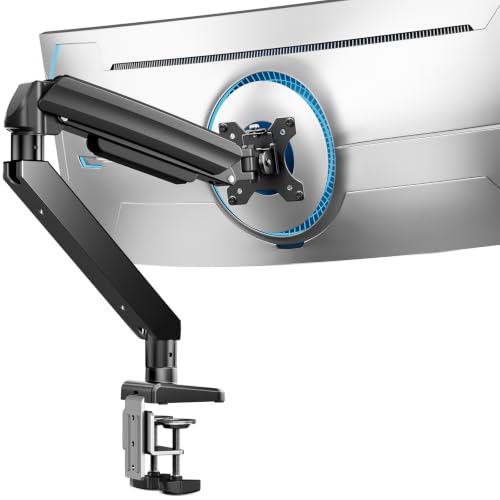
 HUANUO TitanLift Heavy Duty Monitor Arm for
- Fits up to 49" Ultrawide Screens: Ensure your…
- Maximum Support: Crafted from high-strength aluminum alloy, reinforced…
- Fully Adjustable: This ultrawide monitor arm enables precise…
As an Amazon Associate we earn from qualifying purchases at no extra cost to you.
What You Need
| Item | Why | Optional? |
|---|---|---|
| The hex key or Allen wrench shipped with the arm (usually 5 or 6 mm) | Turns the tension screw on the gas spring or mechanical spring joint | No |
| Your monitor’s spec sheet or a bathroom scale | You need the weight without stand to know how far from the arm’s limit you are | No |
| Phillips screwdriver | For VESA plate screws and any tilt-friction screws | No |
| A second person | Holding a 25 to 30 pound panel while you turn the screw is safer with help | Recommended for screens over 20 lb |
| Small level or phone level app | Confirms the arm base and pole are vertical before you tune the spring | Optional |
| Painter’s tape and a marker | Mark your starting screw position so you can return to it | Optional |
| Steel reinforcement plate for the clamp | Spreads the load on desktops under 0.75 in thick; usually included | Optional if desk is solid |
Step-by-Step
1. Confirm the monitor is within the arm’s rating (2 minutes)
Look up the panel’s weight without the stand. A 34 inch ultrawide is typically 14 to 22 pounds; a 49 inch super ultrawide runs 25 to 33 pounds; a 32 inch curved gaming monitor is 15 to 25 pounds. The arm’s rating should exceed that by at least 15 percent. If your monitor is at or above the rating, no amount of tension adjustment will hold it, and you should move to a higher-capacity arm before continuing.
2. Check the clamp and pole (3 minutes)
Tension problems are often really mounting problems. Tighten the C-clamp until the arm base cannot rock, then set a level on the pole. A pole that leans even 2 degrees forward will make the arm drift toward you regardless of spring setting. On desktops under 0.75 inches thick, put the steel plate between the clamp pad and the underside. Dual C-clamp designs, as on the two reference arms, spread this load across two pads and are less prone to leaning.
3. Find the tension screw (1 minute)
On a gas-spring arm, the screw sits at the elbow or on the underside of the upper arm, usually behind a rubber plug or labeled with a plus and minus icon. On a mechanical spring arm it is at the shoulder joint near the pole. There may be a second screw for the forearm on two-segment arms. Mark the current position with tape.
4. Set the arm to mid-height and let go (1 minute)
With the monitor attached, raise the screen to about the middle of the arm’s travel and release it. Watch for 10 seconds. If it drifts down, the spring is too weak for the load and you need to increase tension. If it floats up, the spring is too strong and you need to decrease it.
5. Adjust in half-turns (5 to 10 minutes)
Turn the screw a half turn toward plus if the screen sags, or toward minus if it rises. Heavy-duty arms rated 35 to 45 pounds can need 8 to 15 full turns to move across their whole range, so expect to repeat this step several times. After each half turn, move the screen to mid-height, release, and watch. Stop when the screen holds still. Never turn more than one full turn between tests; the change per turn is larger at the heavy end of the range.
6. Test at the extremes (2 minutes)
Raise the screen to the top of travel and release; lower it to the bottom and release. A correctly tensioned arm holds position at both ends, though many arms feel slightly stiffer at the top. If it holds at the middle but sags at the bottom, add a quarter turn. If it holds at the middle but rises at the top, remove a quarter turn.
7. Set the tilt and swivel friction (2 minutes)
Heavy monitors often nod forward on their VESA plate. Find the tilt friction screw behind the plate and tighten it until the screen stays put at a 5 to 10 degree back tilt but can still be moved by hand. Do the same for the swivel joint if the screen turns on its own.
8. Re-check after 24 hours (1 minute)
New gas springs settle slightly in their first day under load. Come back the next morning, release the screen at mid-height, and add a quarter turn if it has started to sag.
Mistakes to Avoid
- Adjusting tension with the monitor off the arm. Springs are set for a load; without the screen the arm will always fly up and you will crank it far too weak.
- Turning the screw more than one full turn at a time. Heavy-duty springs change quickly near the top of their range, and overshooting means backing out and starting over.
- Forcing the screw past its stop. If it will not turn further, the spring is at its limit and the monitor is too heavy or too light for this arm.
- Ignoring the pole. A leaning base masquerades as a tension problem.
- Adjusting with the arm fully extended. Leverage at full reach is highest; set tension with the arm at its normal working position, roughly 60 to 70 percent extended.
- Skipping the reinforcement plate on a thin desktop. Under a 30 pound ultrawide, a 0.6 inch particleboard edge will compress within weeks and the whole arm will begin to sag.
- Mounting a 200 x 100 mm VESA monitor on a 100 x 100 mm plate with only two screws. Use the correct adapter so the load is centered.
How Often
Once tuned, a gas-spring arm holding a monitor within its rating should hold for 12 to 24 months before it needs a quarter turn. Mechanical spring arms drift less but have coarser adjustment. Re-check tension whenever you change monitors, add a soundbar or webcam that increases the load by more than a pound, move the desk, or notice the screen drifting more than half an inch over a workday. Also re-check after any period where the arm was stored or the monitor was removed for more than a few days.
When to Call a Pro or Replace
There is nothing on a monitor arm that requires a professional, but there are signs that adjustment will not help. If the tension screw is at its maximum and the screen still sags, the gas spring has lost pressure or the monitor exceeds the rating; replacement is the fix, since gas cylinders on arms under $150 are not user-serviceable. If the arm holds position but makes a grinding or clicking sound at the joint, the internal cam is worn. If the clamp pad has visibly crushed the desktop, the arm needs a bigger plate or a grommet mount before it sags again.
Replacement arms rated for 35 to 45 pounds and screens up to 49 inches run $35 to $100 in 2026, so once an arm is more than three years old or has been over-tensioned repeatedly, replacement usually costs less than the time spent fighting it.
FAQ
Which way do I turn the screw to make the arm hold a heavier monitor?
Turn toward the plus sign, or clockwise on most arms, to increase spring force so it supports more weight. Turn toward minus or counterclockwise to reduce force for a lighter screen. If the arm has no markings, a half turn and a test will tell you which direction you need.
Why does my monitor sag only when I pull it forward?
Leverage increases as the arm extends, and the spring is set for one balance point. Tension the arm at the position you actually use most. If you switch between a close and far position often, tune for the far position and accept that it will be slightly stiff when close.
Can I add weight to a monitor that is too light for a heavy-duty arm?
Yes. Heavy-duty arms have a minimum load, often 8 to 12 pounds. If the tension screw is at minimum and the screen still rises, attach a small steel plate or a soundbar to the VESA area to bring the total weight above the floor.
How much does a monitor arm tension screw usually travel?
Between 8 and 20 full turns from lightest to heaviest setting, depending on the design. Heavy-duty arms with a 35 to 45 pound range have more turns, which makes fine tuning easier but means you may turn for a while before you see a change.