Key takeaways
- Measuring only the desk. The chair zone adds 36 inches of depth, which is more than the desk itself.
- Forgetting the return on an L desk. Buyers measure the 78 inch main run and forget the 55 to 60 inch second leg, which then blocks a closet.
- Assuming a 24 inch deep desk is enough for two monitors. A 27 inch monitor needs to sit 24 to 30 inches from your eyes, which on a 24 inch desk means the screen is at the back edge. Executive desks of 28 to 30 inches deep are worth the extra space if you run large displays.
- Ignoring the swing of drawers and cabinet doors. A file drawer extends 18 to 20 inches when open; a side cabinet door swings 14 to 16 inches. Both need room on the side or front of the desk.
- Placing the desk where the chair zone overlaps a door arc. The door bumps the chair every day.
- Not checking the delivery path. A 70 inch box does not make a 90 degree turn in a 36 inch hallway.
- Choosing an electric standing L desk without checking the ceiling or shelf height above. At 48 inches desk height plus a 24 inch monitor, the top of the screen reaches 72 inches, which collides with wall-mounted shelves.
What's inside
The Short Answer
A straight executive desk needs a floor area of roughly 6 by 6 feet: the desk itself occupies about 60 to 72 inches wide by 24 to 30 inches deep, and you need a further 36 inches behind it for a chair to roll back and a person to stand up. That works out to a footprint of about 60 to 72 inches wide by 60 to 66 inches deep, or 25 to 33 square feet. An L-shaped executive desk needs a corner and a clear zone of about 6 by 7 feet, closer to 40 square feet once the chair area inside the L is included.
If guests will sit across from you, add 30 to 36 inches in front of the desk for a visitor chair. If the desk floats in the middle of a room rather than against a wall, add 24 to 30 inches behind the back edge as a walkway. Most spare bedrooms at 10 by 10 or 10 by 12 feet can hold a 60 to 71 inch straight desk comfortably; an L desk with a 78 inch main run generally needs a room of at least 11 by 11 feet.
As an Amazon Associate we earn from qualifying purchases at no extra cost to you. Product prices and availability are accurate as of the date shown and are subject to change.


Standard Sizes
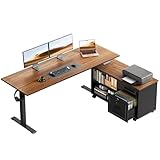
Executive desks cluster into a handful of standard footprints. The clear zone column adds 36 inches of chair space behind the desk and, for L desks, assumes the chair sits inside the corner.
| Desk type | Width | Depth | Height | Minimum clear floor zone |
|---|---|---|---|---|
| Compact executive (e.g. 59 in with file drawer and keyboard tray) | 59 to 60 in (150 to 152 cm) | 23 to 24 in (58 to 61 cm) | 29 to 30 in (74 to 76 cm) | 60 x 60 in (152 x 152 cm) |
| Standard executive | 63 to 66 in (160 to 168 cm) | 27 to 30 in (69 to 76 cm) | 29 to 30 in (74 to 76 cm) | 66 x 66 in (168 x 168 cm) |
| Large executive (e.g. 70.9 in with cabinet and power) | 70 to 72 in (178 to 183 cm) | 24 to 30 in (61 to 76 cm) | 29 to 30 in (74 to 76 cm) | 72 x 66 in (183 x 168 cm) |
| Compact L-shaped (e.g. 55 in electric standing L) | 55 in main x 40 to 48 in return (140 x 102 to 122 cm) | 20 to 24 in each run (51 to 61 cm) | 28 to 48 in adjustable (71 to 122 cm) | 60 x 60 in (152 x 152 cm) |
| Large L-shaped (e.g. 78.7 in with file drawers and CPU stand) | 78 to 80 in main x 55 to 60 in return (198 to 203 x 140 to 152 cm) | 23 to 28 in each run (58 to 71 cm) | 29 to 30 in (74 to 76 cm) | 84 x 72 in (213 x 183 cm) |
| Double pedestal traditional | 66 to 72 in (168 to 183 cm) | 30 to 36 in (76 to 91 cm) | 30 in (76 cm) | 72 x 72 in (183 x 183 cm) |
Prices in this category run from about $180 for a 59 inch compact executive desk with a file drawer to $250 to $280 for 70 to 79 inch desks with cabinets, charging stations, or an electric L-shaped frame. Traditional double pedestal hardwood desks start around $600.
How to Measure Your Space
- Measure the wall the desk will sit against. Record the usable width between the corner and any door casing, window trim, or radiator. Subtract 2 inches on each side for breathing room. A 71 inch desk needs a clear wall run of at least 75 inches.
- Mark the desk depth on the floor. Use painter’s tape at 24, 28, or 30 inches from the wall, matching the desk you are considering. Remember that desks with a modesty panel or rear cable cutout still need 2 to 3 inches behind them for plugs.
- Add the chair zone. Tape a second line 36 inches beyond the desk’s front edge. For big and tall chairs or reclining executive chairs, use 40 inches.
- Check the walkway. If people will pass behind the chair, you need another 30 inches beyond the chair zone. If the desk is against a wall and no one walks behind you, skip this.
- Check door and closet swings. A 30 inch door needs a 30 inch clear arc. Closet doors, especially bifolds, often swing into exactly the space a desk would occupy.
- For L-shaped desks, measure both walls. The main run and the return each need their full length plus 2 inches. Confirm the corner is a true 90 degrees and has no baseboard heater, outlet cluster, or window sill at desk height.
- Check the path in. Executive desks ship in boxes of 60 to 80 inches long and 70 to 160 pounds, and assembled desks are often 70 inches wide. Measure hallways, stair turns, and door widths; a 71 inch desk will not turn a 36 inch hallway corner once assembled.
By Room or Use Case
Spare bedroom, 10 x 10 feet
A 120 x 120 inch room takes a 70.9 inch executive desk on one wall with 24 inches to spare on each side for a bookcase or file cabinet. Depth is never the problem in a square bedroom; the desk plus chair zone uses 66 of 120 inches. The limiting factor is the closet, which is usually on one of the four walls and needs its door swing. Put the desk on the wall opposite the closet or on the window wall.
Spare bedroom, 10 x 12 feet, shared with a guest bed
A twin bed is 39 x 75 inches; a full is 54 x 75. On the 12 foot (144 inch) wall, a 59 inch compact executive desk plus a 54 inch full bed leaves 31 inches, which is just enough to walk between them. A 71 inch desk plus a full bed leaves 19 inches, which is not. Go compact or move the bed to the other wall.
Corner of a living room or great room
This is where L-shaped desks earn their footprint. A 55 inch compact L tucks into a corner using two walls, and the chair zone inside the L is space that would otherwise be dead. The desk reaches 55 inches along one wall and roughly 40 to 48 inches along the other, so it needs a corner with at least 60 inches clear on each wall. Electric L desks let you raise the surface to 48 inches, which also makes it easier to vacuum underneath.
Dedicated home office, 11 x 12 feet or larger
Here a large L-shaped executive desk with a 78.7 inch main run fits. Put the main run on the 12 foot wall with 30 inches to spare for a filing cabinet, and the 55 to 60 inch return along the 11 foot wall. The chair sits inside the L in a 36 x 36 inch zone. That leaves roughly 5 by 7 feet of open floor for a bookcase, a visitor chair, or a printer stand.
Executive desk floating in the room
A desk facing the door, with your back to a window, is the classic executive layout. It needs 30 inches of walkway behind the chair zone and 36 inches in front of the desk for a visitor. For a 66 inch desk that is 66 wide by 30 + 36 + 30 + 36 equals 132 inches deep, or 11 feet. Only rooms 12 feet deep or more can pull this off without feeling cramped.
Studio apartment or open-plan living
Choose a 59 to 60 inch executive desk with a keyboard tray and file drawer so the surface stays clear and the desk reads as furniture rather than an office. Place it perpendicular to a wall as a room divider; that layout needs 36 inches on the chair side and 24 inches on the far side as a path, for a total zone of 60 x 84 inches.
Common Sizing Mistakes
- Measuring only the desk. The chair zone adds 36 inches of depth, which is more than the desk itself.
- Forgetting the return on an L desk. Buyers measure the 78 inch main run and forget the 55 to 60 inch second leg, which then blocks a closet.
- Assuming a 24 inch deep desk is enough for two monitors. A 27 inch monitor needs to sit 24 to 30 inches from your eyes, which on a 24 inch desk means the screen is at the back edge. Executive desks of 28 to 30 inches deep are worth the extra space if you run large displays.
- Ignoring the swing of drawers and cabinet doors. A file drawer extends 18 to 20 inches when open; a side cabinet door swings 14 to 16 inches. Both need room on the side or front of the desk.
- Placing the desk where the chair zone overlaps a door arc. The door bumps the chair every day.
- Not checking the delivery path. A 70 inch box does not make a 90 degree turn in a 36 inch hallway.
- Choosing an electric standing L desk without checking the ceiling or shelf height above. At 48 inches desk height plus a 24 inch monitor, the top of the screen reaches 72 inches, which collides with wall-mounted shelves.
FAQ
How much space do you need behind an executive desk?
Plan on 36 inches from the front edge of the desk to the nearest wall or furniture. That gives a chair with a 26 inch base enough room to roll back and let you stand. Reclining or big and tall chairs need 40 inches.
What size room fits a 72 inch executive desk?
A room with one clear wall of at least 76 inches and a depth of at least 66 inches from that wall works, which describes almost any bedroom 8 feet wide or more. A 10 x 10 foot room is comfortable; a 9 x 9 foot room is tight but workable if the closet is not on the desk wall.
Is an L-shaped executive desk more space efficient than a straight one?
Per square foot of work surface, yes. A 78.7 inch L desk provides roughly 30 square feet of surface in a 84 x 72 inch corner zone, while a straight 71 inch desk provides about 15 square feet in a 72 x 66 inch zone. The L uses the corner, which is often unusable for anything else, and the chair sits inside the desk’s own footprint.
How deep should an executive desk be?
Twenty-four inches is the minimum for a laptop and one monitor. Twenty-eight to 30 inches is the comfortable standard for dual monitors or a monitor plus writing space, and it is what most 2026 executive desks in the 65 to 72 inch width range offer. Anything over 32 inches makes the far edge hard to reach.